Government expected to unveil tax reform package in July; President Lee says holding costs 'generally low'; multi-home and high-value property owners in crosshairs
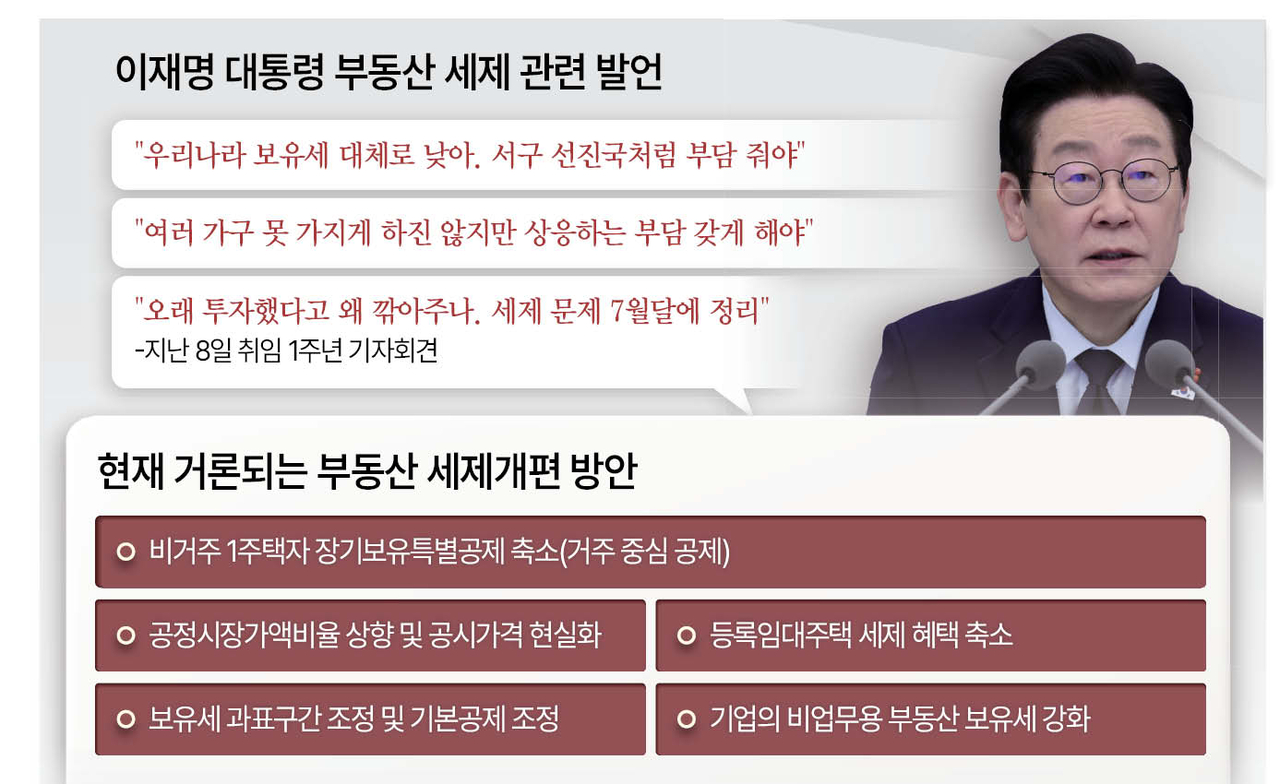
With President Lee Jae Myung again calling for tougher real estate taxation and signaling a tax reform package for July, market attention is turning to the specific tools the government could deploy to raise the property tax burden. Leading candidates include raising the fair market value ratio — adjustable without National Assembly approval — along with restructuring the comprehensive real estate tax brackets and trimming the long-term holding deduction. The ruling party's performance in the June 3 local elections was described as a mixed result after it lost Seoul, but the president's direct push to increase holding costs for non-owner-occupied properties signals that a full-scale tax drive targeting multi-home owners and high-value property holders is now all but certain.
According to political and real estate industry sources, President Lee doubled down on expanding property holding taxes Monday at a press conference marking his first year in office. "Property holding taxes in Korea are generally low," he said. "Even if you accumulate a lot of homes, the burden is not that great." He added that owners should bear holding costs comparable to those in advanced Western countries, saying, "It's fine to own multiple homes, but they should come with a cost."
As home prices continue to climb across key Greater Seoul areas and the president's tax-tightening remarks grow more frequent, tighter real estate regulation is increasingly treated as a foregone conclusion. Analysts expect the government, now free of the political constraints posed by the June 3 local elections, to accelerate a sweeping tax drive through its July reform package and other measures targeting multi-home owners, holders of high-value properties, and non-resident single-home owners buying for speculative purposes.
"In the current market environment, tax is the only card the government has left," said Song Seung-hyeon, head of Urban and Economy, a real estate consultancy. "Real estate policy is not just about suppressing demand — easing earlier regulations could also be an option — but given that the government's stance is to tighten regulation, expanding taxation will inevitably be the core of any future measures."
The easiest lever for the government to pull is the fair market value ratio, the multiplier applied to the officially assessed price to calculate the taxable base for the comprehensive real estate tax and property tax. The ratio has been held at 60 percent since 2022. It stood at 80 percent under the Lee Myung-bak administration and was raised in stages to 95 percent under the Moon Jae-in government. Because the ratio can be adjusted through a cabinet ordinance revision without passing legislation, it is seen as a reliable way to raise taxes while bypassing the legislative threshold.
"The June 1 assessment date has passed, but the comprehensive real estate tax exclusion application period opens in September, and that is when the billing process kicks into high gear," said Park Hap-su, an adjunct professor at Konkuk University's Graduate School of Real Estate. "Since adjusting the fair market value ratio requires only a Cabinet resolution, processing it by the end of August would be enough to raise taxes immediately."
Analysts also consider it more likely that the government will adjust the tax brackets rather than directly raising the holding tax rate. The current brackets are divided into seven tiers: up to 300 million won (about $217,000), up to 600 million won, up to 1.2 billion won, up to 2.5 billion won, up to 5 billion won, up to 9.4 billion won, and above 9.4 billion won. The focus is on subdividing the wider gaps — particularly the 1.2 billion-to-2.5 billion won, 2.5 billion-to-5 billion won, and 5 billion-to-9.4 billion won ranges — to apply more graduated rates.
Kim Yong-beom, chief of the Cheong Wa Dae Policy Office, also signaled the possibility of finer bracket segmentation in an interview earlier this year, saying there had been proposals to "apply holding taxes more precisely by subdividing a single home into tiers such as 2 billion, 3 billion and 4 billion won."
For multi-home owners, analysts say the government may also consider reducing the basic deduction amount or raising the comprehensive real estate tax rate back to Moon-era levels. "Lowering the basic deduction threshold for multiple homes could be one approach," Park said.
The long-term holding deduction reform that President Lee has raised since the start of the year is also expected to be included in the July package. At Monday's press conference, he questioned why speculative single-home owners should receive the benefit, asking, "Why should you get a discount just because you held it for a long time?" One option under discussion would lower the holding component of the deduction — currently capped at 40 percent — while raising the residency component, also currently capped at 40 percent.
Other measures the president has raised on his X account and at Cabinet meetings — including reducing tax benefits for registered rental housing and strengthening holding taxes on non-business real estate held by corporations — are also seen as realistic candidates. The government plans to review the various tax measures in stages and pursue legislative and ordinance revisions sequentially.
President Lee said he would "fundamentally lower the expected return on real estate investment" and that the government would "organize taxation, finance, regulation and supply in line with national economic interests and common sense, and announce them all at once soon."
hwshin@heraldcorp.com