Civil society groups say policy lacks consistency
Experts call for stronger residential welfare, lease protections
'Tax reform cannot be delayed any further'
![President Lee Jae-myung speaks at a press conference marking his first anniversary in office, held Monday at Cheong Wa Dae's Yeongbingwan banquet hall. [Yonhap]](https://wimg.heraldcorp.com/news/cms/2026/06/09/rcv.YNA.20260608.PYH2026060811390001300_P1.jpg)
By Jung Joo-won, The Herald Business
A civil society forum assessing the first year of the Lee Jae-myung administration identified policy inconsistency as the central flaw in the government's real estate agenda. Critics said the government has repeatedly sent contradictory signals — tightening financial regulations to cool home prices while deferring a normalization of property holding taxes, and calling for expanded private housing supply while keeping restrictions on rental business operators in place.
Experts acknowledged that the Lee administration has made some progress in expanding public-sector housing supply and curbing market overheating, but said the government must present a comprehensive blueprint covering supply, taxation, finance and residential welfare for the remainder of its term.
Those assessments echo remarks President Lee made Monday at his first-anniversary press conference. Lee said South Korea's property holding taxes are "generally low" and argued that while owning multiple homes should not be prohibited, owners should bear a proportionate financial burden. He also suggested the need to reform holding taxes, saying the belief that "buying up land through speculation pays off" must be dismantled.
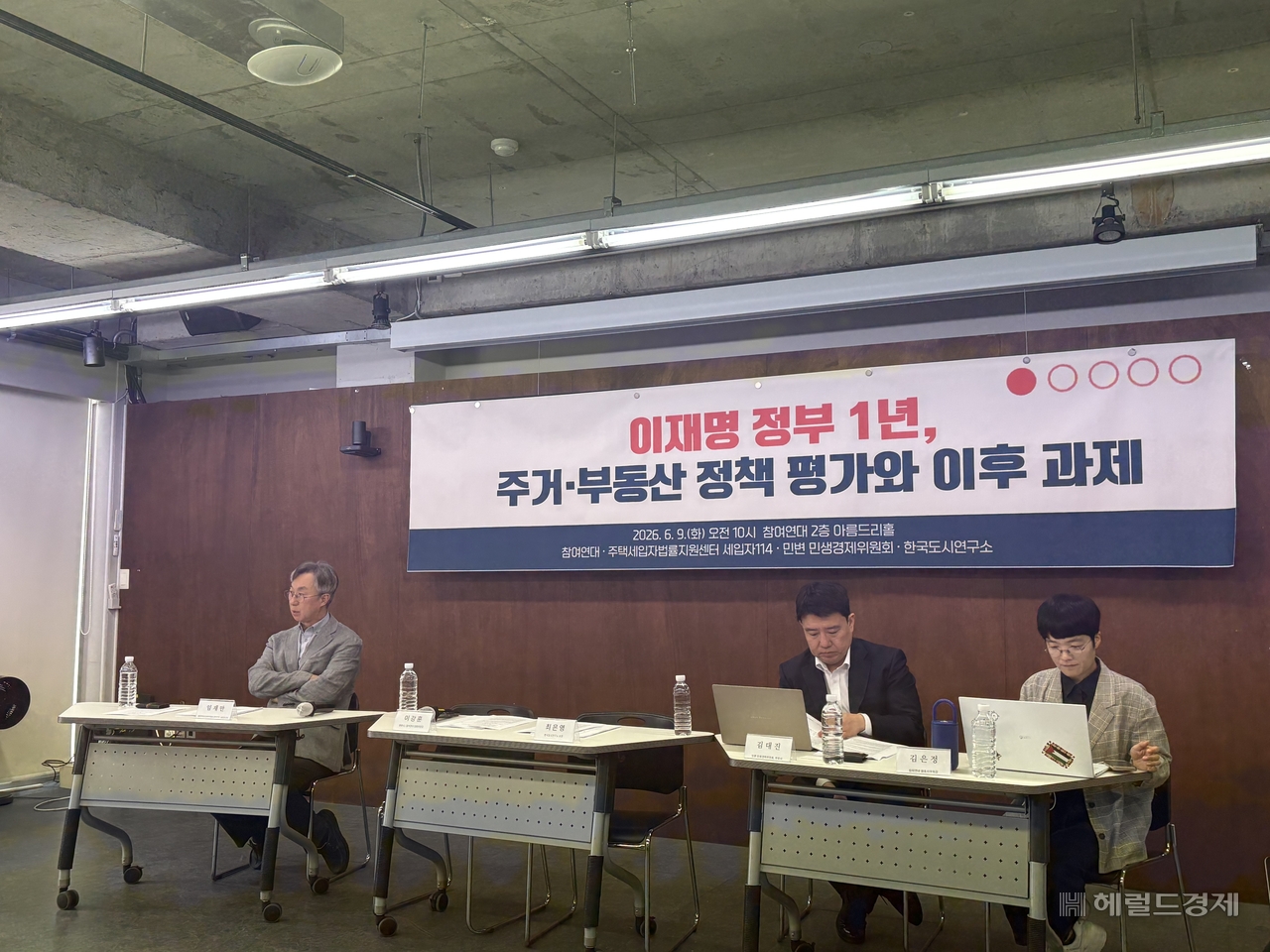
At a forum held Tuesday at Chamyeoyeondae's Areumdeulli Hall in Jongno-gu, Seoul, titled "One Year of the Lee Jae-myung Administration: Evaluating Housing and Real Estate Policy and the Road Ahead," participants said the government has focused on short-term market responses while its long-term policy direction remains unclear.
Choi Eun-young, director of the Korea Urban Research Institute, said the Lee administration had maintained "strategic ambiguity" on housing and real estate policy during the presidential election campaign. "The president has sharpened the message by putting policy proposals out through social media, but a lack of cohesion among those responsible for implementing policy is becoming apparent," she said.
She added that supply, finance and tax policies are each announced in isolation, with no overarching policy philosophy tying them together.
'Regulations tightened, tax reform shelved'
Policy contradictions were a recurring theme at the forum. Kim Eun-jung, co-executive director of Chamyeoyeondae, said the government has tightened financial regulations to suppress home prices in Seoul while continuing to delay the normalization of publicly assessed land values — the basis for property holding taxes — and a restructuring of the comprehensive real estate tax system. "The failure to link financial policy with tax policy is deepening the contradictions," she said.
![Listings are posted at a real estate agency in Gangnam-gu, Seoul, on Monday. [Yonhap]](https://wimg.heraldcorp.com/news/cms/2026/06/09/rcv.YNA.20260608.PYH2026060811210001300_P1.jpg)
Kim added that despite strict financial regulations, money in South Korea continues to flow toward real estate and asset markets rather than productive investment. "A structural overhaul is needed to change the real estate-centered financial structure and the system of asset inequality," she said.
Lee Gang-hun, an attorney at the Tenant 114 Housing Tenant Legal Support Center, also pointed to a conflict between supply policy and financial regulation. "It is contradictory to talk about stimulating private housing supply while applying blanket restrictions on rental business operators simply because they own multiple homes," he said. "If the goal is to increase housing supply, the government needs a clear policy position on how to make use of rental operators."
He also warned that blocking relocation loans during redevelopment projects could disrupt supply. "Flexible financial regulation calibrated to its purpose is what is needed," he added.
'Expand public role, strengthen tenant protections'
Experts said a stronger public-sector role is unavoidable given how difficult it has become to expand private housing supply. Choi said the government's genuine effort should be measured by its public-sector track record, and credited the Lee administration with far surpassing the Yoon Suk Yeol government in public-sector permitting and ground-breaking figures.
However, she noted that ground-breaking activity in Seoul has not increased significantly, and said the government needs to spell out more concrete targets and implementation plans for public rental housing supply.
Lim Je-man, a professor at Sejong University, said structural conditions make it difficult for the private sector to increase supply. "The plan to provide 1.1 million units of public housing needs to be made much more specific," he said.
Gaps in tenant protection policy were also flagged as an unresolved challenge. Kim Dae-jin, an attorney with the Minbyun People's Livelihood and Economy Committee, said policies to compensate victims of jeonse fraud deserve a positive assessment, but called fundamental measures to stabilize tenant housing "insufficient."
Kim said discussions on strengthening tenant protections have been inadequate given the worsening imbalance between jeonse supply and demand. He called for debate on expanding the right to request lease renewal and tightening the conditions under which landlords can refuse renewal on grounds of owner-occupancy.
Normalizing the property tax system emerged as the top priority for real estate policy going forward. Kim said stabilizing the real estate market cannot be achieved through loan regulations and supply expansion alone. "The government must move to reduce asset inequality through measures such as restoring the realism of publicly assessed land values and restructuring the comprehensive real estate tax system," she said.
With President Lee having recently spoken publicly about the need to normalize holding taxes, experts said the critical question is whether a tax reform package due to be announced in July will translate into actual policy change.
Reflecting on the recent local election results, experts agreed that "the government and the ruling party should focus on building a social foundation where people can find stability in their lives without depending on real estate, rather than stoking expectations of rising home prices."
Lim said the real estate problem cannot be solved by real estate policy alone. "It must be approached alongside the structural problems running through society as a whole — stagnant incomes, pensions, education and more," he said.
jookapooka@heraldcorp.com