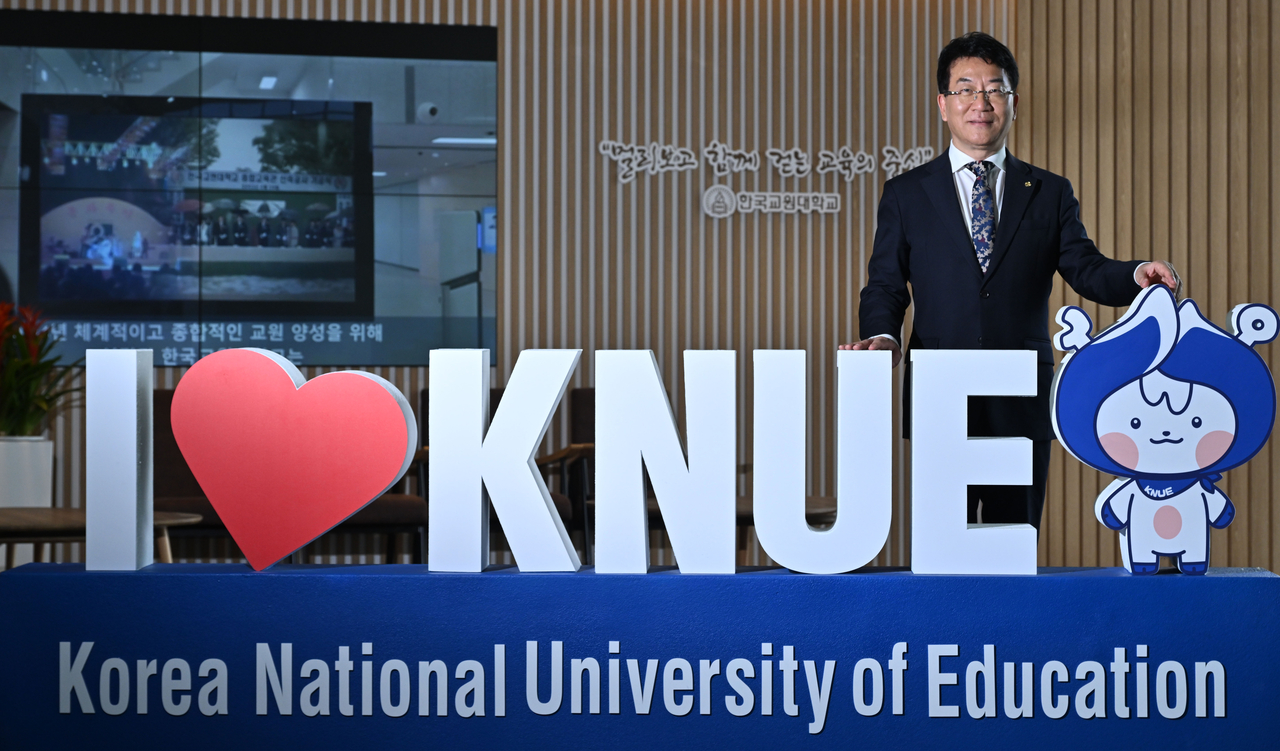
Korea's only national comprehensive teacher-training university
"Literacy is not simply knowing letters —
it is the ability to think critically to verify information.
When it declines, the quality of classroom instruction falls with it.
Our on-campus research institute works for students with dyslexia
and develops research to help them understand textbook language.
The present era, awash in misinformation, is more dangerous than ever."
In August 2022, a cafe's public apology containing the phrase "simsimhan sagwa" — meaning a "heartfelt apology," drawn from the sino-Korean word "simsimhan" — sparked a nationwide debate on literacy after commenters mistook the word for its native Korean homophone meaning "boring." The incident ignited what became known as the "digital generation literacy controversy."
The episode was far from isolated. A string of cases followed in which young people failed to correctly interpret common words such as "sahul" (three days), "geumil" (today) and "muun" (good luck in battle), elevating what had seemed like a minor curiosity into a serious social concern.
Korea National University of Education (KNUE), the country's only national comprehensive teacher-training university, took notice. Its Basic Academic Ability Research Institute held the "2026 KNUE Basic Academic Ability Research Institute Academic Seminar" on May 20, diagnosing the state of foundational learning in schools and exploring practical support measures — a direct response to voices from teachers and schools warning that declining literacy was dragging down basic academic achievement.
The Herald Business recently sat down with KNUE President Cha Woo-gyu at the university's main administration building in Cheongju, North Chungcheong Province. Over the course of an approximately one-hour interview, Cha — an expert in curriculum and digital education — spoke candidly about his concerns over the literacy crisis.
"When literacy is lacking, students cannot understand textbook passages or key subject concepts, and teachers end up spending much of class time explaining vocabulary," he said. "There is a strong sense of urgency and responsibility — a fear that if we ignore students' literacy problems, public education as a whole could collapse." The following is an edited transcript of the interview.
— Smartphones and short-form content have become enormously popular, and many say literacy has declined not only among the MZ generation but among children and teenagers as well. What exactly is literacy as an ability?
The recent surge in short-form content and over-reliance on smartphones has made declining youth literacy a major social issue. Literacy is not simply knowing letters. It is the mental muscle that allows a person to sift through an overwhelming flood of information, identify what is true, grasp the context and hidden intent of a text, and ultimately solve problems through critical thinking and communication.
— Why is literacy necessary? Some say students even need it to solve math problems on exams.
To solve a math problem correctly, a student must first understand what the question is actually asking — and many students reportedly cannot solve problems simply because they cannot comprehend the question itself. Ultimately, literacy is not confined to language arts. It is the foundational fitness that underpins all academic subjects and everyday life.
— Author Kim Jin-myeong, who recently published "The Nation of Sejong," told this publication that literacy is necessary to protect democracy. What is your view?
Democracy is a system in which citizens make sound decisions through healthy debate and rational criticism. A crisis in digital literacy is tantamount to fundamentally losing the tools of thought. When people can no longer think and judge for themselves, they become easy to lead wherever a demagogue directs. Ultimately, if the literacy that allows us to distinguish truth from falsehood is paralyzed, rational debate disappears from our society, replaced by a distorted structure dominated by emotional conflict and misinformation — and democracy collapses.
— Many worry that a lack of literacy leads directly to lower academic achievement and declining foundational learning ability.
When literacy is lacking, a disproportionate share of class time must be devoted to explaining vocabulary. That makes it difficult to maintain a normal curriculum pace and becomes a cause of declining instructional quality. In severe cases, students fall into a state of "learned helplessness" and give up on learning altogether. The achievement gap between students caused by literacy deficits widens with each passing grade, potentially producing what researchers call the "Matthew effect" — the academic rich get richer while the poor fall further behind.
— How did KNUE come to focus on literacy, and what activities is the university undertaking to improve literacy among students and young people?
KNUE is the country's only comprehensive teacher-training university, producing kindergarten, elementary, middle and high school teachers — including special education teachers — all on a single campus. As a national university, it also leads national education policy. That is precisely why there is such a strong sense of urgency and responsibility: if students' literacy problems are left unaddressed, public education as a whole could eventually collapse. Literacy does not suddenly take shape in elementary school; it follows a continuous developmental arc — from phonological awareness in early childhood, to hangul acquisition in the early elementary years, to comprehensive thinking in middle and high school. The university's Basic Academic Ability Research Institute has continuously developed public-education solutions for children with dyslexia, borderline cognitive ability and slow learners, and has expanded its scope to "subject literacy" research — helping students understand not just letters but the texts of math, science and social studies textbooks. The university is strengthening its curriculum so that all pre-service teachers across every department, from elementary to secondary, develop literacy instruction competencies before they are certified. It also plans to continuously offer professional literacy training courses and foundational learning specialist training for in-service teachers nationwide. The university is pursuing a mentoring project in which KNUE students work one-on-one with struggling readers in local elementary, middle and high schools during vacations and after school, alongside curriculum programs designed to build literacy instruction capacity among pre-service teachers.
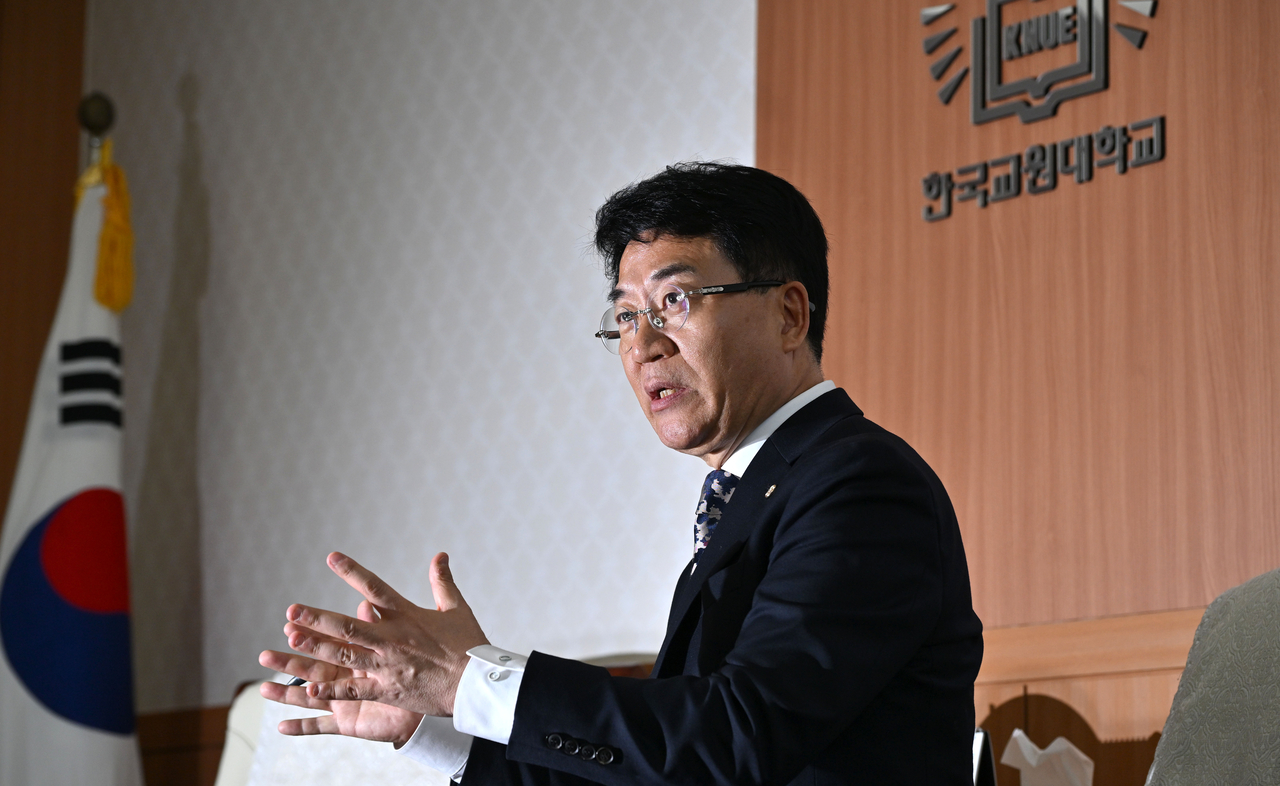
— I understand you yourself served as a middle school teacher. How different is today's educational environment from the one you knew then, particularly in terms of literacy?
When I was teaching, literacy deficiencies were mostly cases of true illiteracy — students who could not read letters at all — or slow hangul acquisition, where reading speed was the main issue. Today's students, by contrast, can generally read text fluently, but a striking pattern has emerged: they do not know the meaning of words within sentences, cannot grasp context, and fail to understand what they have read even after going through a textbook passage or exam text. In the past, students consumed information primarily through print media — books, newspapers and magazines — whose linear, logical structure naturally built the stamina to read long texts. Today's students consume information mainly through video and short-form platforms such as YouTube, TikTok and Instagram, which has made reading long texts feel tedious and left them accustomed only to rapid vertical scrolling — what might be called "scanning-style reading." As a result, the ability to patiently reason through the core logic of a text appears to have declined markedly compared with the past.
Cha drew a detailed comparison between his teaching days 30 to 40 years ago and the present. "In the past, most students' literacy tended to develop to a broadly similar, average level after going through the regular school curriculum," he said. "But today, the 'rich get richer, poor get poorer' phenomenon in literacy is extremely serious. Top students develop highly sophisticated critical thinking skills, while lower-performing students remain at an elementary-school reading level even in middle and high school — the gap between students is far more extreme than it used to be."
"In the past, we mostly read verified texts, so there was little need to seriously question the reliability of information — accepting a text at face value rarely caused problems," he said. "But today, the internet and social media are flooded with fake news, stitched-together information and AI-generated distortions. Literacy today demands more than simply reading. It requires the capacity for 'critical media literacy' — the ability to ask, 'Is this information real? What was the intent behind it?' — and to filter accordingly."
— This publication has worked to promote the excellence of hangul and strengthen literacy through events such as the Hangul Run, and has collaborated with KNUE in that effort. What are the university's related plans?
The Hangul Run initiative by Herald Media Group and Sejong City is, in my view, a highly symbolic movement — one that, in step with the global rise of K-culture, seeks to share the cultural value of hangul with the world and raise public literacy. If Sejong City positions itself as a "hangul culture city" and The Herald Business amplifies that message to a broad public, then KNUE should serve as the solid academic and educational institutional backbone supporting it all within the public education system. For events like the Hangul Run, we can actively consider having KNUE students operate educational experience booths, and having our research team participate in developing hangul learning apps and content for foreign learners. We are also keenly interested in advancing a system that uses AI to analyze the patterns in which students read text on digital devices — tracking eye movement, reading speed and similar metrics — to precisely diagnose literacy levels. We also intend to continue expanding regular literacy humanities lectures to raise the overall literacy level of the surrounding community.
— What are your plans going forward for yourself and for KNUE?
We want to comprehensively overhaul the curriculum so that all pre-service teachers, before graduation, can fluently use AI courseware — software that integrates AI technology into digital textbooks to deliver personalized learning for individual students — and can directly teach students "digital media literacy," the ability to assess the reliability of information in digital spaces. We will strengthen KNUE's role as the leading institution for public teacher education by sharing outstanding future education content and literacy instruction infrastructure with pre-service teachers across the country. Through the university's comprehensive education training institute, we intend to greatly expand not short-term training courses but professional certification programs that equip teachers to directly support, within their own schools, students with dyslexia or borderline cognitive ability — slow learners.
■ Profile: President Cha Woo-gyu
Born in Seoul in 1963, Cha graduated from Mapo High School in 1982 and earned a bachelor's degree in civic ethics education from Seoul National University in 1986, after which he taught moral education at middle schools including Munchang Middle School in Seoul. He received a doctorate in education — specializing in civic ethics education — from Seoul National University in 1997. He joined the Korea Institute for Curriculum and Evaluation as a senior research fellow in 1998 and became a professor in the elementary education department at KNUE in 2005. He served as president of the Korean Association for Population Education in 2020 and as a specialist committee member for the national curriculum at the National Education Commission in 2023. He was appointed president of KNUE in 2024 and became president of the Korean Association for Moral and Ethics Education in 2025.
ken@heraldcorp.com
ikson@heraldcorp.com