
President says ballot shortage 'ruined' South Korea's image as model democracy; leaves supplementary investigation authority question to National Assembly
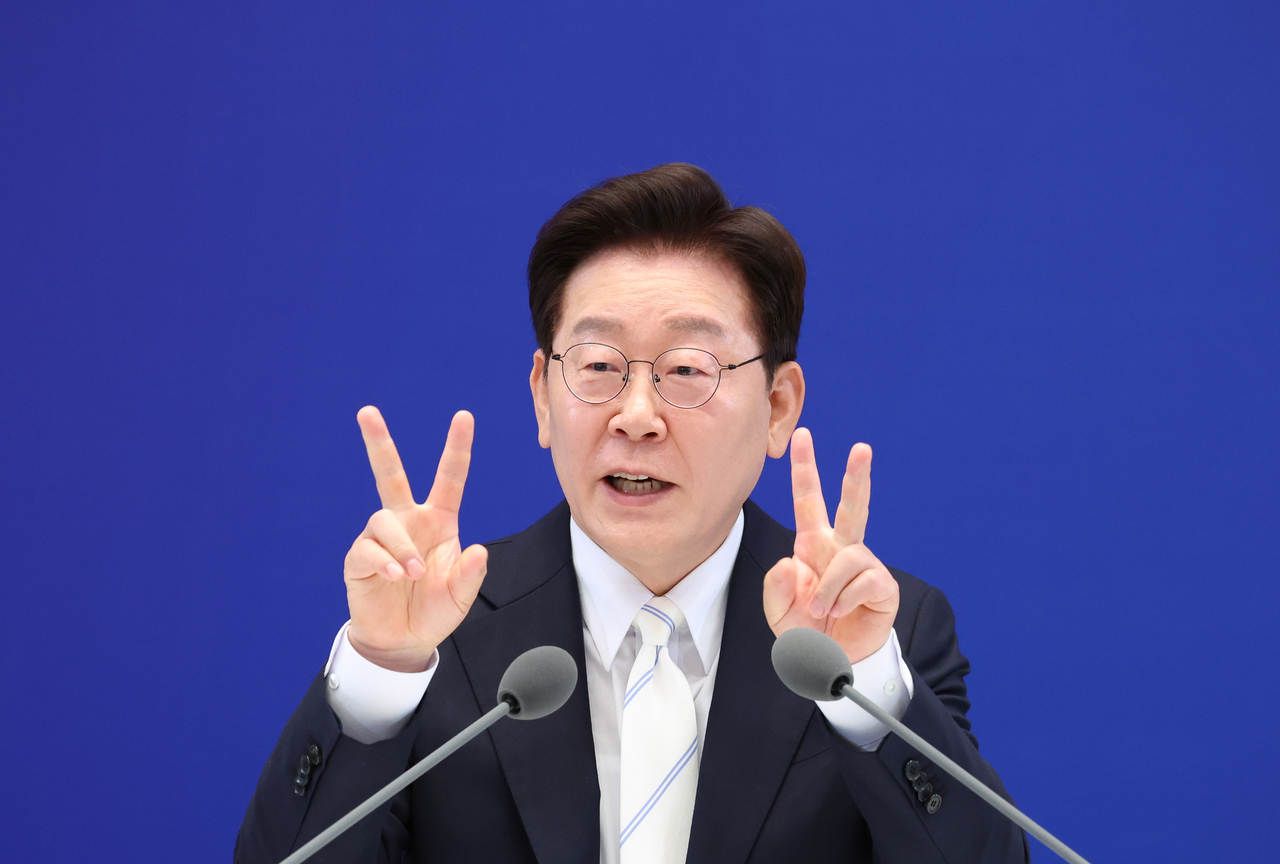
President Lee Jae-myung said Monday that the National Election Commission's ballot shortage during the June 3 local elections was an entirely separate matter from allegations of electoral fraud, and called the young people who raised the issue deserving of respect.
He also said proposed special prosecutor investigations — including one targeting alleged fabricated indictments and another seeking withdrawal of charges — should proceed according to principle.
Speaking at a press conference marking his first anniversary in office at Cheong Wa Dae's Yeongbingwan, Lee was asked how the government planned to respond to the ballot shortage. He called it "an absurd affair" and said it had "ruined, in an instant, everything that makes South Korea a model democracy."
On the public criticism surrounding the shortage, Lee said the outcry was "somewhat mixed up with fraud election theories, but it is different." He drew a sharp distinction between those who exploit unverified claims through "endless incitement and indoctrination as a tool for building political power" and citizens who simply ask, "How can people in our country be unable to vote?" — calling the two concerns "on entirely different levels."
He said the issue "is not a matter of vote counts or outcomes — it is itself a very serious problem," and added, "I find the young people who raised this point truly precious and worthy of respect."
Lee acknowledged that he had initially overlooked the gravity of the situation. "I have to admit I did not think of it that way at first," he said. "I thought, 'A dozen or so people could not vote — it did not affect the result.'"
He said the episode prompted self-reflection. "People like us may have grown numb, lacking sensitivity to questions of sovereignty," he said. "This is not a matter of a few votes or the outcome — it is a matter of principle. The young people raised it as a fundamental question about the exercise of sovereignty in South Korea, and I reflect deeply on that."
On follow-up measures, Lee said investigators needed to determine "whether it was intentional or whether there was a fundamental, structural problem." He said he had called for a joint investigative team to move quickly. Because the election commission is an independent body, he added, he intended to meet with key officials to hear their views on the right approach.
On the proposed special prosecutor investigations into alleged fabricated indictments and charge withdrawals, Lee reaffirmed a straightforward position. "Countless complaints and accusations have been filed, and many questions have been raised," he said. "If something was wrong, correct it; if nothing was wrong, leave it alone. Just follow the law and common sense."
He added that while he had his own subjective views, "there are quite a few things that appear problematic even objectively," and said "at a minimum, the truth must be established."
Lee said the investigation could be conducted either by prosecutors and police under his command through a large-scale joint team — "that would normally be the standard approach" — or by a special prosecutor appointed by the National Assembly. He said he personally would prefer the former, but acknowledged that "from the public's and the opposition's perspective, a neutral special prosecutor would be better." To avoid unnecessary suspicion, he said, "it would be best for the National Assembly to decide" on the special prosecutor.
"The outcome should be judged according to law and common sense," he added. "If something was wrong, fix it; if not, leave it. It only seems complicated because people make it that way — it really is not."
On the ongoing political debate over supplementary investigation authority ahead of the planned abolition of the Prosecution Service, Lee said "public distrust of prosecutors is deep" and confirmed that "the question of supplementary investigation authority has been left for the National Assembly to resolve."
bigroot@heraldcorp.com
rimsclub@heraldcorp.com
sunpine@heraldcorp.com




