
Erasing 'Korea passing,' Nvidia picks Korean firms as ideal partners
Nvidia-Korea AI alliance goes on display before the world
From semiconductors to AI factories — Nvidia's lock-in strategy
The show must translate into real investment
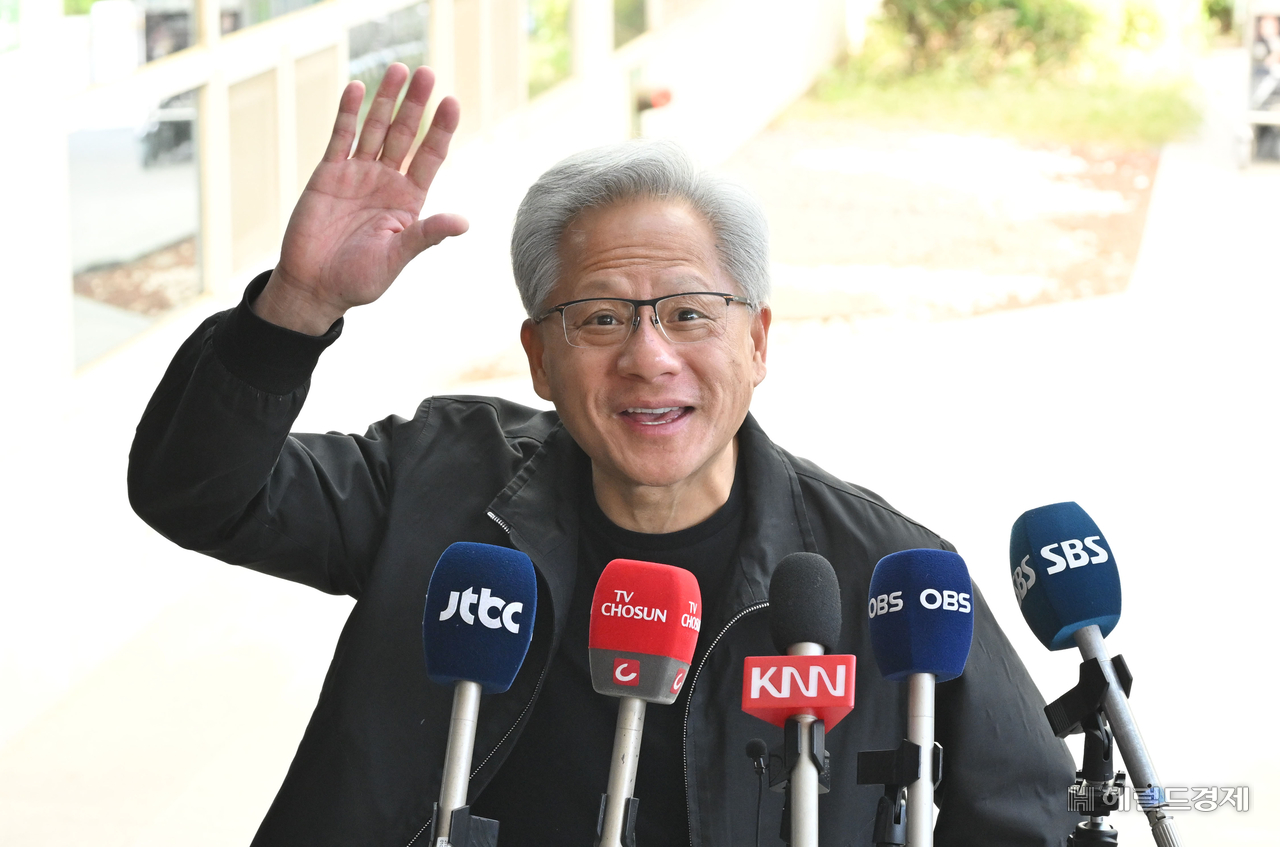
Nvidia CEO Jensen Huang wrapped up a five-day visit to South Korea on Monday, declaring that "building our advanced supercomputing without Korean technology is impossible" and pledging to return soon. "There is so much business to do here," he said. "I'll be back."
Huang made the remarks at 9:03 a.m. as he departed through Seoul's Gimpo Business Aviation Center in Gangseo-gu. "Collaboration with Korean partners is moving very quickly," he said. "There are so many opportunities for me here."
Having packed his schedule with back-to-back partner meetings throughout the visit, Huang was asked when he planned to return. "You all need a rest," he said. "My samgyeopsal and fried-chicken friends need a rest too — but I look forward to coming back very soon."
Asked to name the highlights of the trip, he pointed to a multi-year partnership with SK Hynix and an AI cloud partnership with SK Telecom and Naver.
"It was a very good announcement — a win-win for both sides," he said. "I was delighted to be able to announce such major partnerships."
When pressed on what both sides stood to gain, Huang said the greatest contribution Nvidia had made to Korea was "inventing the AI industry and creating the AI ecosystem here." "We will grow the AI industry together," he added.
Huang's view of Korean industry has fundamentally shifted, analysts say
After Nvidia rose to become the world's leading AI company, Huang traveled extensively — to China, Japan, Taiwan, the United Kingdom, France and beyond — while conspicuously skipping South Korea, fueling talk of "Korea passing."
This visit, analysts say, signals a complete reassessment of Korea's market potential and the capabilities of its companies.
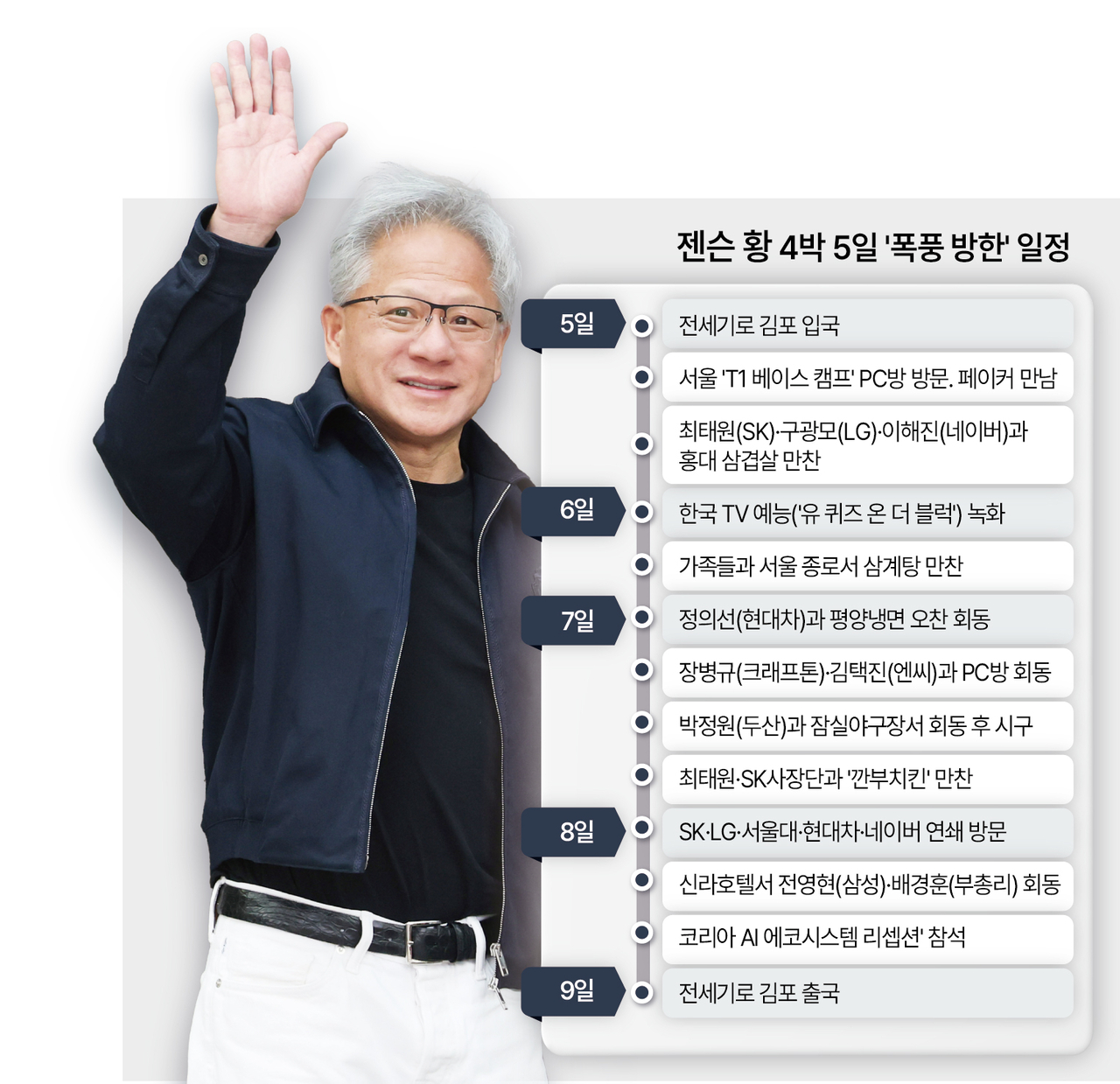
Huang moved at a relentless pace, meeting the country's four largest conglomerates as well as robotics, gaming, telecommunications and cloud companies, startups, universities, a PC bang and a baseball stadium.
He signaled ambitions to build a distinctly Nvidia "AI universe" in Korea, broadening the partnership beyond memory chips to encompass AI data centers, autonomous driving and robotics.
Departing Monday, he reiterated the point. "There is a very large opportunity in Korea in robotics and AI infrastructure," he said. "There is also a great opportunity to work with companies here and expand their business beyond Korea — and I am very excited about that."
The plan, as Nvidia envisions it, involves supplying Korean manufacturers with its proprietary software platforms — Omniverse for digital twins, Isaac for robotics and Cosmos as a physical AI foundation model — while harvesting data from Korean factory floors to sharpen its physical AI technology.
Huang: Korea excels at both manufacturing and software — a perfect fit for Nvidia's lock-in play
Huang, who has long taken note of Korea's manufacturing prowess, used the visit to deepen ties with existing partners — Samsung Electronics, SK Hynix and Hyundai Motor Co — while putting a spotlight on newer alliances with LG Corp, Doosan and Naver.
The strategy is to secure a more stable supply of HBM and other memory chips from Samsung Electronics and SK Hynix, then channel the resulting AI superchips and autonomous-driving and robotics software to Hyundai Motor, LG Corp, Naver and game developers — locking them into the Nvidia ecosystem across the full AI value chain.
Nvidia, which started more than 30 years ago as a maker of gaming graphics cards, is evolving into a comprehensive AI platform company spanning autonomous driving, robotics and data centers. Analysts say it has chosen Korean firms — with their rare combination of manufacturing depth and software capability — as its ideal partners for that transformation.
The approach mirrors the lock-in effect Nvidia achieved with CUDA, its proprietary GPU software platform that made companies worldwide dependent on Nvidia hardware. The company now aims to replicate that dominance in autonomous driving, robotics and AI factories.
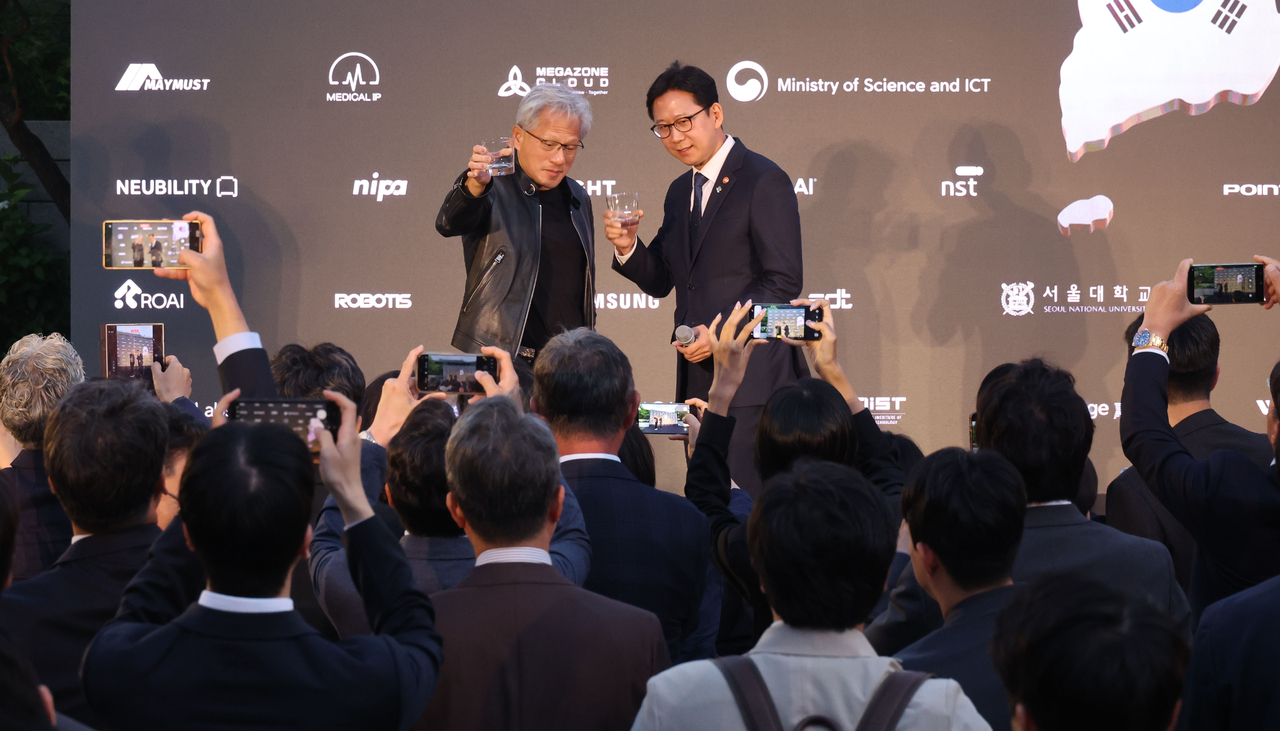
At the Korea AI Ecosystem Reception at the Shilla Hotel in Jung-gu, Seoul, on Sunday, Huang made the case directly. "Countries that are great at heavy industry and manufacturing tend to be weak at software, and countries that are very strong at software tend to be weak at heavy industry," he said. "Korea is great at everything. It is a unique situation."
Korean industry faces pressure to turn Nvidia partnerships into concrete action plans
Korean companies that expanded their partnerships with Nvidia during the visit now face the task of quickly translating those agreements into concrete action plans.
Samsung Electronics and SK Hynix came away from their meetings with Huang having reinforced ties with the world's largest memory customer. Huang signaled that securing a stable memory supply from both companies remains a top priority as he works to overcome a chip shortage.
When SK Group Chairman Chey Tae-won announced plans to double SK Hynix's memory production capacity by 2030, Huang was blunt: "That may not be enough — AI demand is growing enormously." The comment underscored that memory supply will remain one of Nvidia's most pressing challenges.
Whether Nvidia — which spent much of the visit selling its chips and software to Korean companies — will in turn commit to investing in Korea is another question drawing close attention.
Deputy Prime Minister and Minister of Science and ICT Bae Kyung-hoon said he told Huang directly during a private meeting Sunday: "Don't just put on a show in Korea — invest here too." The remark reflects a growing chorus of voices calling on Nvidia to announce concrete investment plans to help develop Korea's AI industry.
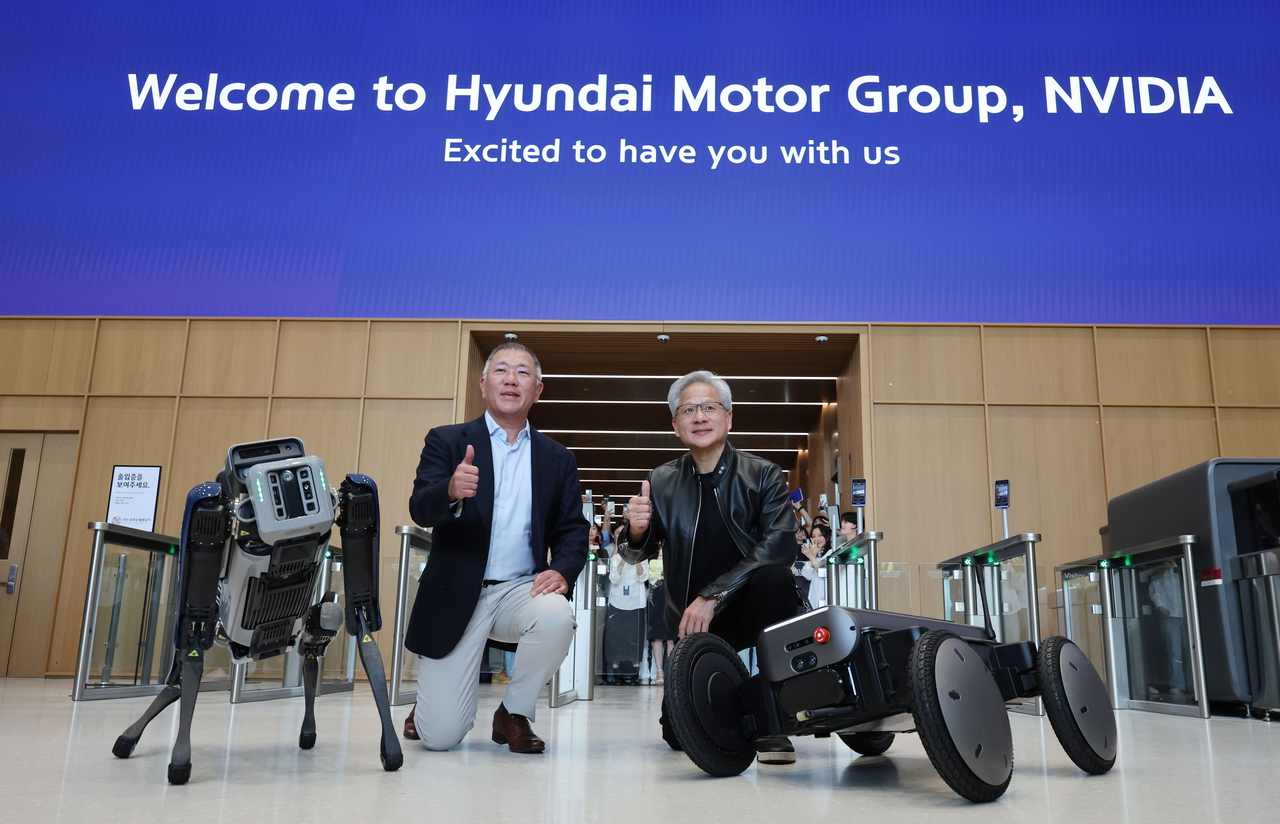
One potential avenue draws particular attention: during his visit to Hyundai Motor's Yangjae headquarters on Sunday, Huang mentioned the Saemangeum development zone near Gunsan, North Jeolla Province, as a possible investment site.
Hyundai Motor Group Chairman Euisun Chung said he briefed Huang on the Saemangeum project, which is designed to incorporate AI and robotics. "I told him that if he was willing to join us, we could work together to build a more complete AI, robotics and data center system," Chung said.
Huang responded positively, indicating Nvidia would work with Hyundai Motor Group to develop all forms of future AI-powered mobility.
"Korea's AI infrastructure is currently insufficient," Huang said. "Just as manufacturing needs factories, AI needs factories too. Korea is building robots, so it needs AI factories. These two areas will be critical investment priorities."
Industry watchers say one scenario under discussion involves Nvidia establishing an AI data center or a robotics research and development facility centered on the Saemangeum zone.
![[단독] 삼성물산, 美 데이터센터 개발 사업 추진](https://wimg.heraldcorp.com/news/cms/2026/06/09/news-p.v1.20260609.eea2ce6fe1b749d1b8b07a098107eff8_T1.jpg)
joze@heraldcorp.com




