Hyundai Motor's share price has surged 134% since the start of the year, while Toyota's earnings slump and the rise of physical AI prompt analysts to reassess the Korean automaker's valuation — with some setting price targets as high as 1.2 million won ($785) per share.
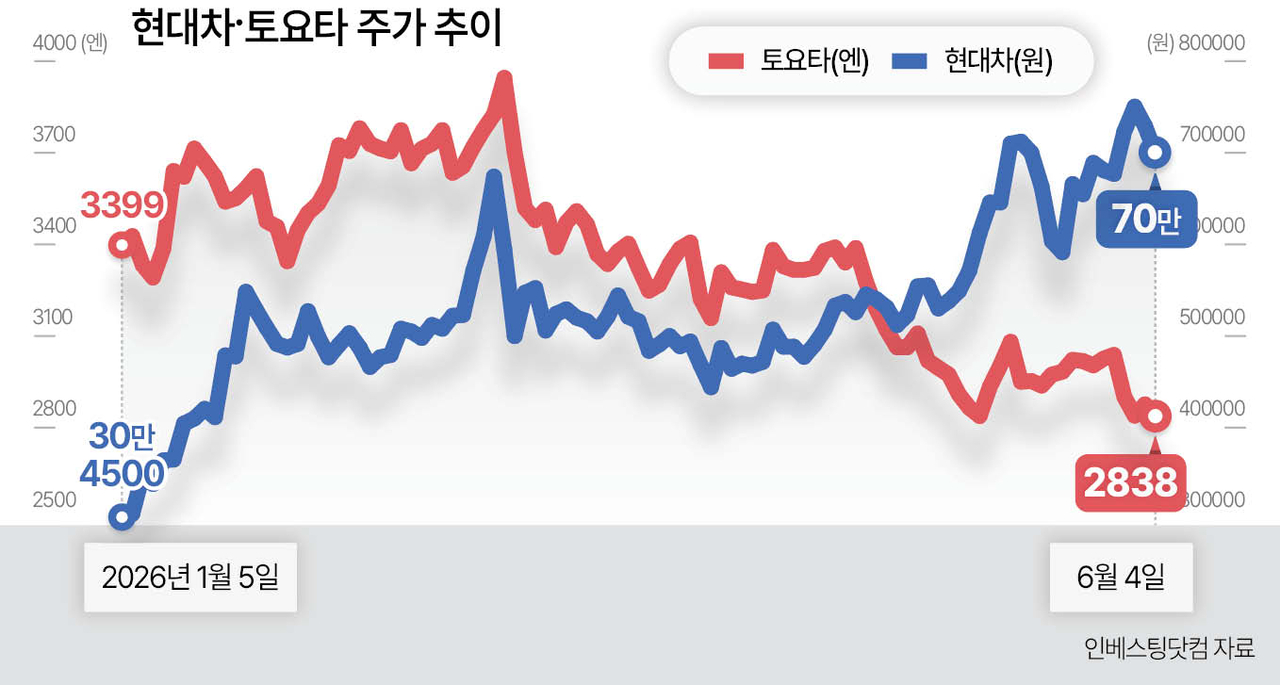
With excitement over robotics stocks building ahead of Nvidia CEO Jensen Huang's visit to South Korea, analysts are raising the prospect that Hyundai Motor's market cap could surpass that of Toyota, the world's top automaker by sales.
Hyundai Motor's share price surged 134.50% from the start of the year through Wednesday, according to Korea Exchange — the steepest gain among major automakers. Over the same period, Toyota fell 16.49% while General Motors managed only a 2.76% gain.
The gap in market cap remains wide. Based on Wednesday's closing price of 700,000 won, Hyundai Motor's market cap stood at 143 trillion won, roughly one-third of Toyota's 44 trillion yen (approximately $275 billion, or about 421 trillion won).
Analysts believe the gap will narrow quickly as the auto industry is reshaped by the era of physical AI. "Despite securing competitiveness in its core auto business and future humanoid robot operations, Hyundai Motor Group's market cap of just 201 trillion won will, over the medium to long term, set its sights squarely on Toyota's 441 trillion won," said Kang Sung-jin, an analyst at KB Securities.
Toyota's own stumbles underpin that outlook. In its fourth-quarter earnings for fiscal year 2026, Toyota reported a 49% year-on-year drop in operating profit, missing market estimates by 30%. Its guidance for next year calls for operating profit of 3 trillion yen, down 20% from the prior year.
Analysts read this as a sign of structural change in the auto industry — evidence that even the world's top-selling automaker has hit the limits of a hybrid-centered strategy in the face of a broader industry paradigm shift.
"Toyota's deteriorating earnings have led the market to recognize Hyundai Motor as the only automaker capable of competing with Tesla in the physical AI era," said Im Eun-young, an analyst at Samsung Securities. She described Hyundai Motor Group as a kind of "physical AI ETF," saying the conglomerate houses leading physical AI companies across multiple sectors.
Analysts argue that Hyundai Motor should no longer be valued by the standards of a traditional automaker. The factors driving future corporate value are shifting from vehicle sales volume to AI and robotics competitiveness.
"There are in effect no legacy automakers actively responding to physical AI right now," said Park Gwang-rae, an analyst at Shinhan Investment. "While Tesla and leading Chinese players dominate the market, Hyundai Motor Group is the only one continuing to invest in the space."
He added that South Korea holds an edge over China in AI infrastructure, and that Hyundai Motor could see its valuation re-rated to the level of Chinese software-defined vehicle companies.
Hyundai Motor's physical AI momentum is expected to carry into the second half of the year. The company plans to launch a pilot program to deploy humanoid robots on production lines through its Robot Meta Plant Application Center (RMAC), which is scheduled to begin operation in the third quarter.
The RMAC serves as a testbed linking humanoid robot training, real-process verification, data accumulation and retraining. It is also where Hyundai Motor's manufacturing capabilities, Boston Dynamics' robotics technology, and AI technology from Nvidia and Google DeepMind will converge.
"This marks the beginning of preparations for the mass production of humanoid robots and their full-scale deployment on assembly lines," said Lee Jae-il, an analyst at Eugene Investment & Securities. "We look forward to seeing the results of combining Hyundai Motor's manufacturing capabilities, Boston Dynamics' hardware technology, and the AI technology of Nvidia and DeepMind."
Hyundai Motor's core auto business is also maintaining an edge over rivals. Volkswagen has moved to revise its electric vehicle strategy and restructure operations, while Ford and Honda have flagged additional losses. Hyundai Motor, by contrast, is pursuing parallel electric vehicle and hybrid strategies and expanding its market share in the United States and Europe.
According to Eugene Investment & Securities, Hyundai Motor's sales this year are forecast to rise 2.3% from a year earlier to 191 trillion won, with operating profit projected to climb 14.8% to 13.2 trillion won. "Growth driven by hybrids and SUVs will continue, and rising raw materials prices will be offset by a favorable exchange rate environment," Lee said.
As expectations for a broader revaluation of Hyundai Motor grow, price targets are climbing. Samsung Securities has set a target of 900,000 won per share, Daol Investment Securities 1 million won, and KB Securities as high as 1.2 million won.
moon@heraldcorp.com