Toyota example raised at 9th bargaining session
Union warns patience is running out
Flexible work, housing, sales staff pay also in dispute
![Hyundai Motor management and union representatives sit down for the opening session of this year's wage negotiations at the Ulsan factory on May 6. [Provided by Hyundai Motor]](https://wimg.heraldcorp.com/news/cms/2026/06/05/rcv.YNA.20260506.PYH2026050607740005700_P1.jpg)
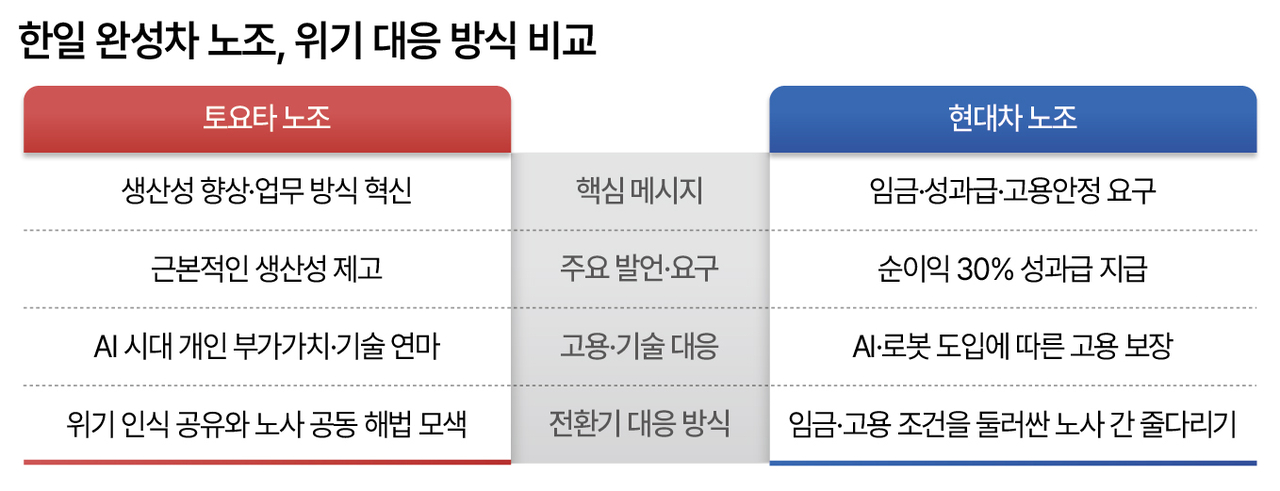
Hyundai Motor's labor and management continued to spar over bonuses and compensation during this year's wage and collective bargaining negotiations. As the union demanded record-high bonuses and pay raises, the company pushed back, citing Toyota's union and arguing that productivity and future competitiveness must also be part of the equation.
At the ninth bargaining session held Friday, Hyundai Motor President and CEO Choi Young-il said Toyota's union is focused on preparing for the future rather than resting on current results. "Since this is a wage negotiation, separate demands need to be reviewed in line with that purpose," he said, according to industry sources.
The remarks were widely seen as a reference to Toyota's union, which this year paired its wage demands with calls for higher productivity and stronger corporate competitiveness.
A report recently published by the Korea Employers Federation, titled "Implications of Toyota's Labor-Management Relations," found that Toyota's labor and management held four joint council meetings this year to discuss corporate survival amid rapid industry upheaval. At the first meeting, Toyota union chief Keisuke Kito cited production stoppages and project delays caused by quality problems and called on the union to "break free from the past and drive change ourselves." At the fourth meeting, he said the union would "decisively raise fundamental productivity to strengthen future competitiveness."
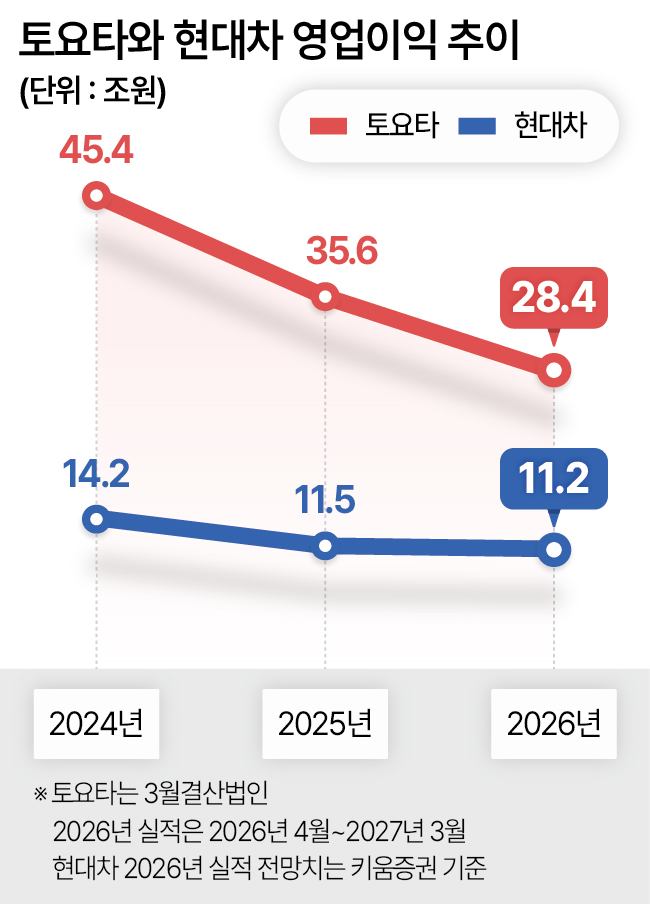
Particularly notable is that Toyota's union put productivity improvement front and center — ahead of profit-sharing — even as the automaker grappled simultaneously with falling operating profit, slowing sales, US tariffs, rising raw material prices, and the financial burden of electrification and software investment. Industry observers say the contrast carries clear implications for Hyundai Motor's own labor talks.
The union responded by raising the pressure, saying negotiations have stalled. Union chief Lee Jong-cheol said member compensation is paramount and told management to "stop making excuses about internal and external conditions."
The session also exposed a sharp divide over expanding flexible work arrangements.
Management argued that broader flexible work could hurt operational efficiency, while acknowledging a need for some flexibility in certain divisions to reflect the post-COVID environment. The union countered that autonomous work arrangements had in fact boosted efficiency without disrupting operations, and warned that dissatisfaction with rigid work policies was accelerating a talent drain.
The dispute over remote work at Hyundai Motor has already spilled into the courts. The union at Hyundai Motor's Namyang R&D Center sought an injunction to block the company's decision to cut remote work from two days a week to one, arguing it constituted an adverse change to working conditions. A court recently rejected the application, ruling that the reduction did not impose a significant disadvantage on workers and noting that employment contracts designate the company's premises as the place of work.
Staff housing also emerged as a major sticking point. Management said the cost of building a new dormitory worth 200 billion won (about $145 million) was a heavy burden and that eligibility rules and other operational issues needed to be addressed first. On company-owned apartments, management said it would respond based on the results of a safety assessment scheduled for this month. The union framed housing as a matter of basic livelihood, demanding that the company follow through on a 2023 agreement to build new residential facilities and draw up a fundamental plan to address aging company apartments.
Compensation for sales staff was another flashpoint. On holiday work allowances for the sales division, management argued that customer service is a core duty and that on-call shifts should be treated as regular work. The union disagreed, saying on-call shifts carry the added burden of customer-facing responsibilities and called for the application of the new standard wage criteria.
The two sides also clashed over the broader compensation structure for sales employees. Management said performance-based differentiated pay is unavoidable given the nature of sales work, and noted that total compensation in the sales division is already the highest of any employee group. The union pushed back, saying excessive internal competition and out-of-pocket expenses place an unreasonable burden on workers, and called for a revised compensation structure that accounts for base pay disparities.
![“생산성 높이자”vs“이익 나누자”…엇갈린 토요타·현대차 노조 [N% 성과급 시대, 노사관계 갈림길]](https://wimg.heraldcorp.com/news/cms/2026/06/01/rcv.YNA.20260518.PRU20260518295901009_T1.jpg)
kwater@heraldcorp.com