$20B surplus hit for 3 straight months for first time
Cumulative Q1 surplus second only to China globally
May surplus seen matching record highs
Won-dollar rate above 1,500 for second-longest stretch in history
Loan rates jump as rate hike signals grow louder
South Korea's current account posted a large surplus for the second straight month in April, extending a run of consecutive monthly surpluses to 36 months. The streak is expected to continue in May at near-record levels. Yet even as the external balance shines, ordinary households are feeling the pinch from a triple squeeze of a weak won, rising prices and the prospect of higher interest rates — a combination economists have dubbed the "three highs."
The Bank of Korea said Friday that April's current-account surplus reached its second-largest level on record despite the fallout from the Iran war, driven by strong IT exports led by semiconductors.
Yu Seong-uk, head of the Bank of Korea's financial statistics department, told a briefing Friday morning that the surplus shrank slightly from the previous month's all-time high due to seasonal factors — a narrower goods-trade surplus, a temporary deficit in primary income and a wider services deficit. Even so, he said, South Korea's current-account surplus exceeded $20 billion for three consecutive months for the first time in history, pushing the cumulative total through April past $100 billion. South Korea's first-quarter surplus was the second largest in the world, trailing only China. "Last year South Korea ranked fifth globally — behind China, Germany, Japan and Taiwan — but this time it surpassed Japan, Taiwan and Germany," Yu said.
IT exports led by semiconductors again drove the surplus. The goods-trade balance came in at $33.88 billion, the second-highest on record, matching the ranking posted in March.
On the outlook for May, Yu said semiconductor exports were strong enough to set an all-time high in the trade surplus, rivaling March's performance. "Primary income is also expected to swing back to a surplus as seasonal factors such as concentrated dividend payments improve, so I would expect a surplus close to March's level," he said.
The strong current-account numbers, however, stand in sharp contrast to the squeeze felt by ordinary households. High exchange rates, high prices and high interest rates — the so-called "three highs" — are increasingly straining personal finances.
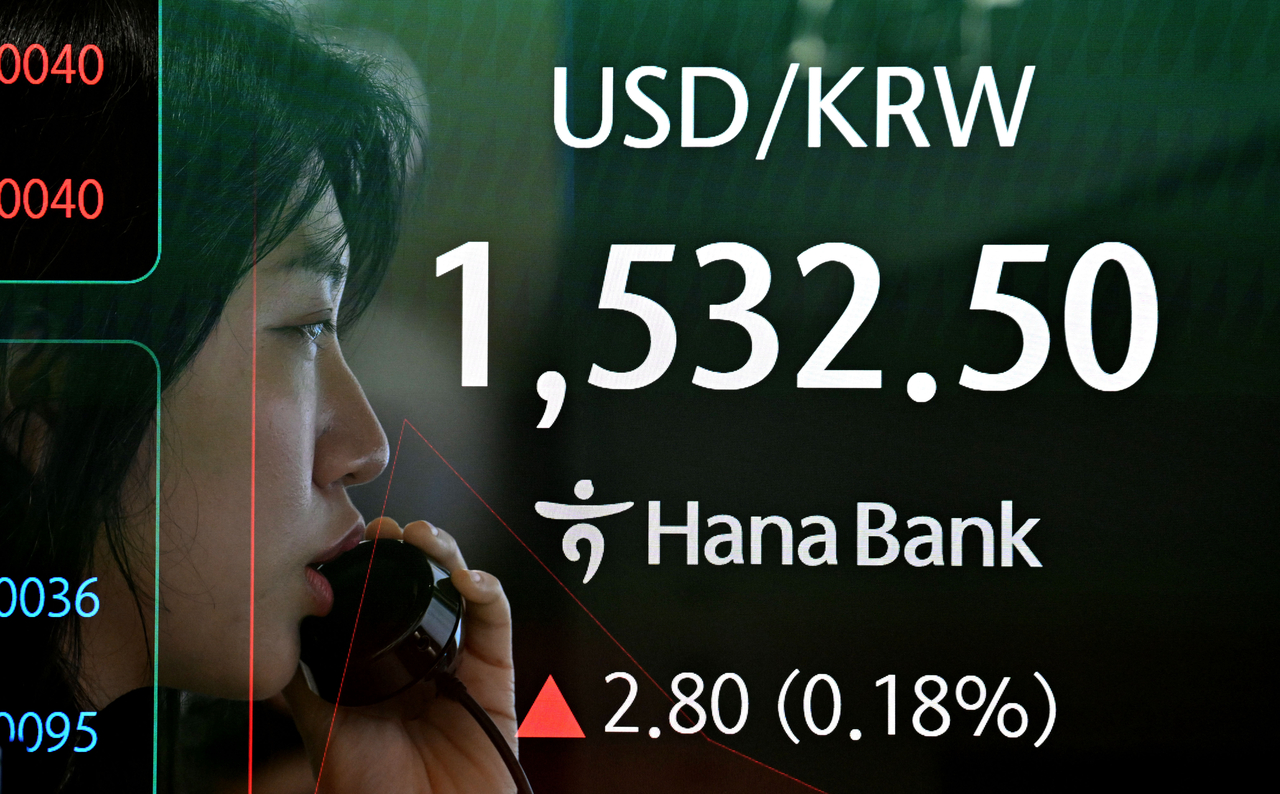
The exchange rate is the most immediate pressure point. A weaker won pushes up import prices, which feed through to consumer prices with a lag. The won-dollar rate has become entrenched above 1,500 won, and voices within the foreign-exchange authorities are now asking whether that level should be accepted as the "new normal."
The won-dollar rate closed above 1,500 won for 13 consecutive trading sessions through Thursday — the second-longest such streak since the 49 consecutive sessions recorded during the currency crisis of late 1997 to early 1998. It surpassed both the nine-session run immediately after the outbreak of the Iran war in March and April, and the 11-session run during the global financial crisis in February and March 2009.
The won opened Friday at 1,529 won, down 0.7 won from the previous close, before climbing back to 1,538.3 won around 9:18 a.m. In overnight trading Thursday, the rate briefly touched 1,540.3 won. That was the highest intraday level in roughly 17 years, since the 1,561-won intraday peak recorded on March 10, 2009, during the global financial crisis.
Inflation is also accelerating. The Ministry of Statistics said consumer prices rose 3.1 percent in May from a year earlier — the largest increase since March 2024 and the first time the rate has entered the 3 percent range since then. The lifestyle price index, which tracks 144 items that households buy frequently and spend heavily on, rose 3.3 percent, also the highest since March 2024.
Government price caps on petroleum products and fuel-tax cuts are helping to contain some of the upward pressure on consumer prices, but a prolonged Middle East war and sustained high oil prices could push inflation higher still. The Bank of Korea last month projected consumer price inflation of 2.7 percent this year and 2.3 percent next year.
The prospect of higher interest rates is adding to the burden on households. The Bank of Korea has repeatedly signaled the need for tighter monetary policy in recent weeks, as upward pressure on prices and the exchange rate remains strong and the real estate market stays overheated — all indicators pointing toward a rate hike. Bank of Korea Governor Shin Hyun-song strongly hinted at a rate increase at last month's monetary policy press conference, saying, "Whether you look at prices, growth, the exchange rate or real estate, the direction is relatively clear."
Markets expect one or two benchmark rate hikes before year-end. The Bank of Korea's monetary policy committee dot plot released last month — showing committee members' rate expectations six months out — had 10 of 21 dots, or 47.6 percent, clustered at 3 percent, with two more at 3.25 percent.
A higher benchmark rate would push up lending rates. The Bank of Korea estimates that a 0.25 percentage point increase in lending rates would add roughly 3.002 trillion won (about $1.96 billion) to the annual interest burden on domestic household borrowers. Fixed-rate mortgage rates at major commercial banks are already approaching 8 percent at the upper end, while personal credit loan rates are nearing 6 percent.
Shin Se-don, an economics professor at Sookmyung Women's University, said the central bank would have no choice but to act. "If the central bank does not raise rates, the exchange rate will become even more unstable," he said. "Ultimately, it will take a decisive hike." He added that the Bank of Korea should send strong warning signals on the exchange rate before next month's monetary policy committee meeting.
![슈퍼카·억대 급여·인테리어…잘못된 가족기업 비용처리 5.8억 세금 부메랑 왜? [이세상]](https://wimg.heraldcorp.com/news/cms/2026/06/04/news-p.v1.20260604.5dae8ebe0341469c8bb58b076b0a2a15_T1.png)
kimstar@heraldcorp.com
forest@heraldcorp.com
hyuk@heraldcorp.com