Song Young-gil says Jung must take full responsibility; warns Lee government's success not guaranteed under current leadership
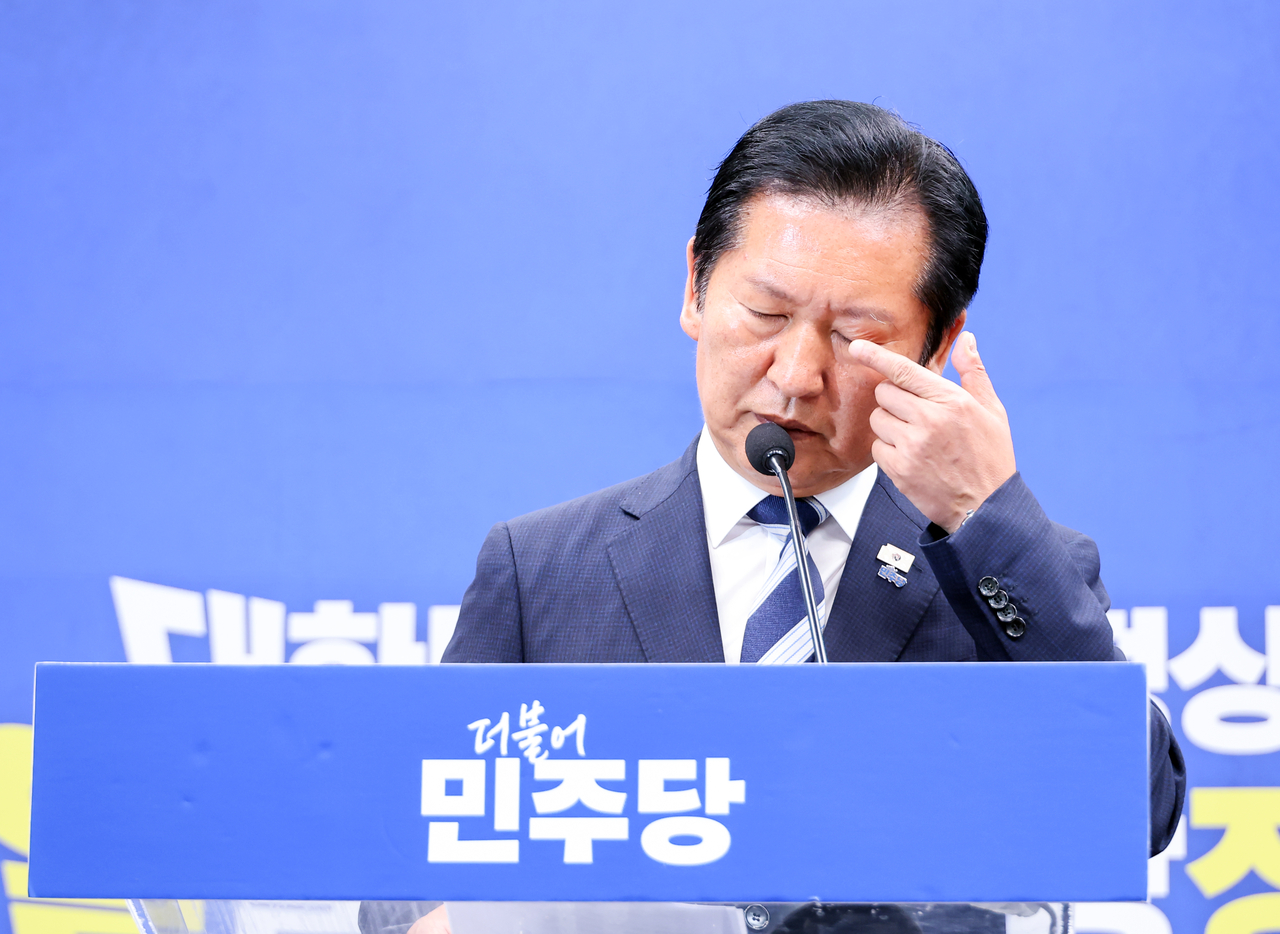
By Joo So-hyun, The Herald Business
The Democratic Party of Korea won 12 of 16 regional government head races in the June 3 local elections, but its failure to reclaim the Seoul mayoral seat denied it a decisive victory — and triggered a wave of internal criticism directed at party leader Jung Chung-rae.
Song Young-gil, a former Democratic Party leader who returned to the National Assembly through a by-election in Incheon's Yeonsu-gu, appeared on MBC Radio on Thursday and lamented the results. "When Seoul loses, Pyeongtaek loses too, and so does Busan's Buk-gu — and even in Ulsan, where we won the mayoral race, we lost the constituency seat. It's deeply frustrating," he said. "The party's election strategy failed to capitalize on the strong approval ratings of the Lee Jae Myung government, and that is a major regret."
According to the National Election Commission's vote count, the Democratic Party secured 12 regional government head posts — in Busan, Ulsan, the Greater Seoul metropolitan area, the Chungcheong provinces, the Honam region, Gangwon Province and Jeju. The result reversed a 5-to-12 rout in the 2022 local elections, turning it into a 12-to-4 advantage four years later. Yet the outcome fell short of early expectations that the party could win every regional race except North Gyeongsang Province, and the loss of the Seoul mayoral seat to the People Power Party led many in political circles to conclude the Democratic Party had not achieved a clean sweep.
Of the five regional government head races and three National Assembly by-elections in the Yeongnam region, the Democratic Party narrowly won only the Busan and Ulsan mayoral contests. Song said the party had "fallen into a self-contradiction by blocking its own room for expansion in Daegu, North Gyeongsang and similar areas." He added that campaigners had gone to the Yeongnam region and kept talking about ending the insurrection. "This was an election to form local governments, not a general election — the focus should have been on people's livelihoods and the pragmatic path of the Lee Jae Myung government, not identity politics," he said.
Song also sharply criticized the handling of the Gyeonggi Province Pyeongtaek constituency re-election, where a candidate unification between the Democratic Party's Kim Yong-nam and Cho Guk Innovation Party candidate Cho Guk fell through, allowing People Power Party candidate Yoo Eui-dong to win. "They turned Cho Guk's presence in Pyeongtaek into a fight over 'New Lee Jae Myung' versus identity," Song said. He added that the party leadership had been "one-sidedly infatuated with the Cho Guk Innovation Party" and had "failed to firmly establish the party's identity and center, drifting in an ambiguous state from the merger debate all the way to this point."
Jung faced particularly strong backlash over the candidate nomination process in Honam, the Democratic Party's traditional stronghold. Kim Kwan-young, a former North Jeolla governor expelled from the party over allegations of distributing cash-stuffed envelopes, ran as an independent, citing what he called a double standard in how the party handled third-party meal expense allegations against Democratic Party North Jeolla governor candidate Lee Won-taek. The move fueled an anti-Jung sentiment that spread across the Honam region. Lee ultimately defeated Kim by 9.44 percentage points, but the internal wounds have not subsided.
Analysts also noted that Jung's "four-no, four-strong" nomination policy produced more primary election losers than in the previous local elections, souring sentiment within the party. A lawmaker from the Honam region said, "Anti-Jung sentiment in the region has grown through this election cycle. As a National Assembly member, I have been on the receiving end of enormous criticism, and enemies have been made on all sides."
Once the votes were counted, public dissent broke out. Former South Jeolla governor Kim Young-rok posted on Facebook on Wednesday around 6 p.m., writing: "I have been waiting for this moment — I could not say anything that might damage the Democratic Party. But from this very moment, I will devote everything I have to removing Jung Chung-rae from the party leadership. Our Honam region suffered deep wounds in this election."
Yoon Jun-byeong, a Democratic Party lawmaker and chairman of the party's North Jeolla provincial chapter, also posted on Facebook on Thursday: "The outward appearance of victory in the June 3 local elections may look impressive, but if the Democratic Party narrowly lost the Seoul mayoral race, it cannot be called a complete victory."
The accountability debate has set off what appears to be an early contest for control of the party's next leadership. Song said the party leader must "bear full political responsibility," adding that "whether or not responsibility is taken, there will be a party convention anyway — so a comprehensive evaluation will come."
Song left open the possibility of running in the convention himself, saying he would "assess the mood among party members and the public before deciding." He said many party members were worried that "if this leadership structure under Jung does not change, there could be serious problems in guaranteeing the success of the Lee Jae Myung government," and added: "Since Prime Minister Kim Min-seok has also said he will run, I will take stock of the overall situation."
addressh@heraldcorp.com