Ministry of Land, Infrastructure and Transport promulgates revised vehicle performance rules, requiring automatic headlight activation
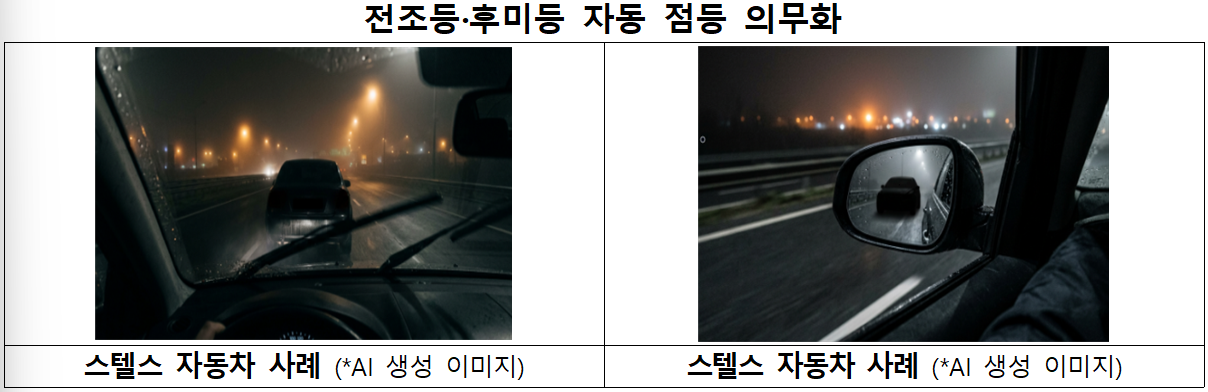
South Korea will require all new vehicles to automatically switch on their headlights and tail lights, targeting the danger posed by so-called "stealth cars" — vehicles driven at night without their lights on.
The Ministry of Land, Infrastructure and Transport said it will promulgate Thursday a revised version of the "Rules on the Performance and Standards of Motor Vehicles and Motor Vehicle Parts" containing the new requirements.
Under the revised rules, all domestically manufactured and imported vehicles will be required from September to be equipped with ambient-light sensors that automatically activate headlights and tail lights. Drivers will not be able to manually turn off the lights while the vehicle is in motion, a measure aimed at preventing fatal accidents caused by other drivers failing to spot an unlit vehicle.
The revision also addresses a hazard specific to electric vehicles: when one-pedal driving triggers regenerative braking and slows the vehicle, the brake lights do not always illuminate, catching following drivers off guard. Under the new standard, brake lights must automatically activate whenever the vehicle decelerates beyond a set threshold through regenerative braking.
In addition, the ministry established standards for remote-control driving functions that allow operators to move a vehicle at low speed from outside using a remote device. It also tightened the rear underrun protection strength standard for medium and large freight and special-purpose vehicles, raising the requirement from 10 metric tons to 18 metric tons to reduce the severity of rear-end collisions.
"We have proactively strengthened safety standards directly tied to public safety in line with advances in vehicle technology," said Park Yong-seon, director of the ministry's Vehicle Policy Division. "We will continue to improve standards so that safe vehicles are manufactured and used, in harmony with international norms."
smh@heraldcorp.com