Individual desires reduced to data, eroding uniqueness
'Re-personalization' through 'connection labor' examined
Automation defended, but inequality in human connection warned
In 2019, a Dutch supermarket introduced an unusual checkout lane called the "Kletskassa" — loosely translated as the "best lane when you're not in a hurry." While self-checkout machines processed transactions in silence, this lane kept a human cashier on hand to greet customers and chat. The supermarket described the initiative as "a small gesture against loneliness."
We live in an age of hyper-connectivity. People are linked at all times through smartphones, cloud services and high-speed networks. Yet paradoxically, the kind of human connection that comes from face-to-face conversation and genuine relationship-building is steadily eroding. Self-checkout kiosks at supermarkets, ordering terminals at restaurants, and banking apps that have replaced tellers — daily life increasingly means dealing with machines rather than people.
As AI technology advances, automation is moving beyond routine tasks and into the realm of what might be called "connection labor" — work grounded in mutual communication, empathy and understanding. AI now counsels couples in crisis, virtual daycare centers and kindergartens operate in digital spaces, and smartphone apps rather than doctors or nurses advise diabetic patients on managing their health. The deeper problem is that this wave of automation and mechanization is spreading a new social cost: loneliness.
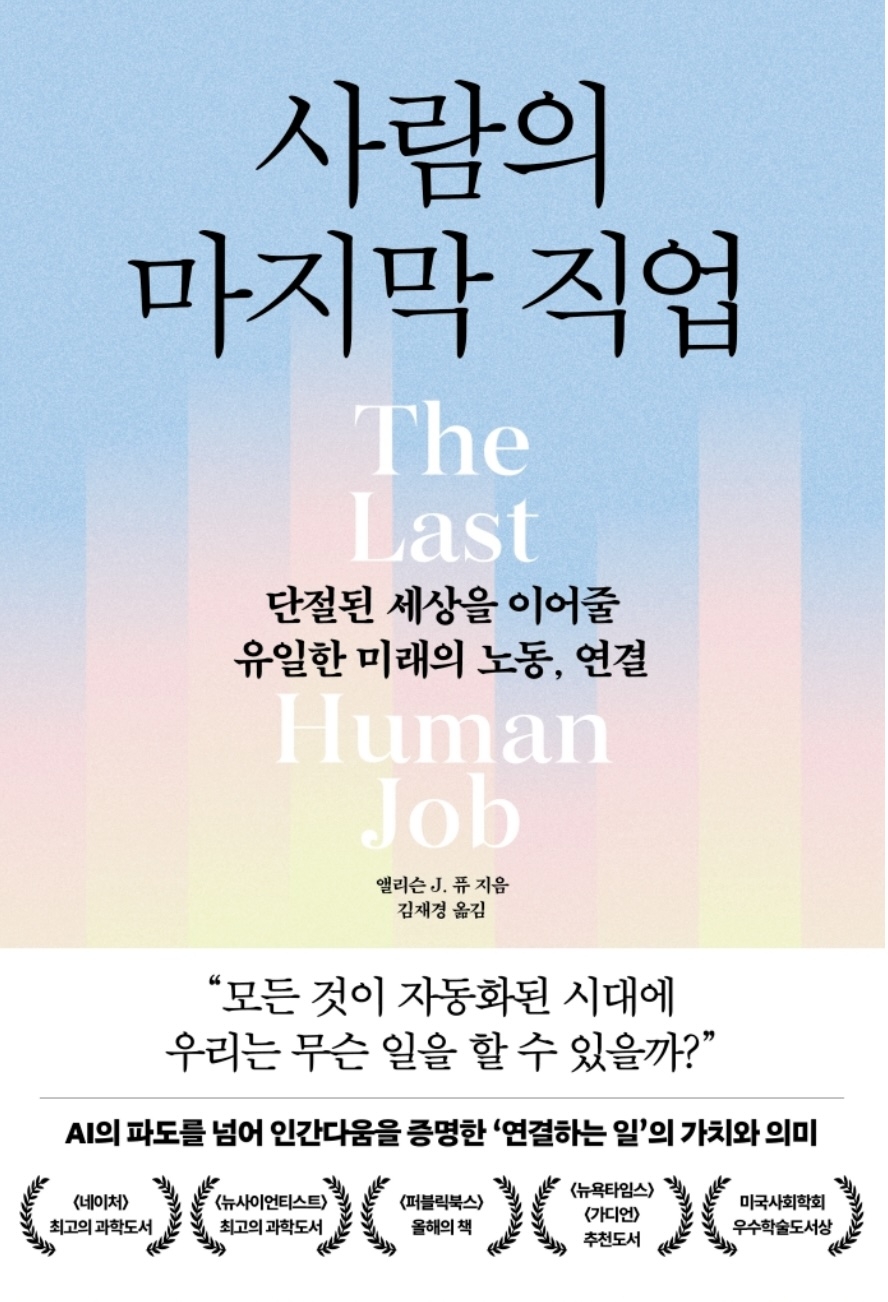
Allison J. Pugh, a sociology professor at Johns Hopkins University, diagnoses this phenomenon in her book "The Last Human Job" as "de-personalization" — a process by which individual behavior and preferences are reduced to data, gradually stripping away the distinctiveness and uniqueness that make each person who they are.
Pugh identifies connection labor as the last occupation capable of preserving humanity and achieving "re-personalization" in the age of AI. Through in-depth interviews with counselors, pastors, teachers, therapists, physicians, community organizers and hairdressers, she argues that connection labor holds a value algorithms cannot easily replicate.
Connection labor, as Pugh defines it, involves recognizing another person as a singular, irreplaceable individual, sharing emotions, responding to the specific contours of a situation, and building mutual understanding. "Connection labor is an inherently human activity — emotional and improvisational in ways that make it resistant to algorithmic processing," she writes.
What makes her argument striking is that even as technology eliminates much connection labor, people still hunger to feel tethered to the social world. "The need to belong is as urgent as the need to eat," Pugh writes. "What we lack is the human connection that people must build together."
Some observers view the automation of connection labor more favorably. The argument holds that automation can deliver similar services at lower cost to those who would otherwise lack access to connection labor, freeing humans to focus on more meaningful work. A related logic suggests that as computers handle information processing and analysis, humans should concentrate on emotion and relationship-building. Experimental schools where students learn through computers while teachers focus solely on motivation and emotional support illustrate this shift in practice.
But Pugh warns that this logic risks deepening inequality in connection labor. The cost of personalized human connection is already rising. "A future may come," she cautions, "where those lower in the social hierarchy provide direct connection labor to those above them, while receiving only automated services in return."
The book also calls for a reassessment of the value of connection labor — caregiving and its many related forms. Connection labor is not simple work, yet it resists being fully measured by quantifiable outcomes. As a result, connection workers in the gig economy are treated as disposable, shouldering intense labor alone under the banner of personal calling. "Connection labor is extraordinarily special and important," Pugh writes, "yet it is understood only in fragments and receives neither the recognition nor the compensation it deserves."
The answer to protecting humanity and social health, Pugh argues, does not lie in driving out machines. What is needed, she says, is vigilance against the inflated promises of technologies that claim to replace connection labor. "We must be alert to the unintended consequences of allowing automation and AI to stand in for the human role of caring for and understanding one another," she writes. "The task is not to eliminate computers and bots, but to prepare for the effects they bring."
"The Last Human Job" by Allison J. Pugh, translated by Kim Jae-kyung / Chusuhbat
balme@heraldcorp.com