
Property swaps gain traction in a frozen real estate market
Single homeowners can use tax exemptions in exchange deals
Overall tax bill can beat gift tax even when capital gains apply
Use appraisals for pricing and settle any price gap to the penny

Na Se-sang, a man in his 30s living in Gwacheon, Gyeonggi Province — a government-designated adjustment target zone — owns a roughly 66-square-meter apartment valued at 1.2 billion won (about $796,000) and qualifies as a single-homeowner household. His father, in his 60s, has owned and lived in a roughly 99-square-meter apartment in the same city, valued at 1.5 billion won (about $995,000), for more than 15 years. Se-sang wants to move to a larger home to raise his children; his father wants to downsize to fund his retirement. Both have listed their properties for sale.
With the real estate market frozen, neither has found a buyer in over a year, and frustration is mounting. "If the homes just won't sell, wouldn't it make more sense to swap with each other?" The father and son visited a tax accountant known as "National Tax Sister" to find out whether a property exchange could be a realistic solution.
Q: What are the advantages of a property swap over a distressed sale?
A: In a market where buyers and sellers have both all but disappeared, property exchange deals are drawing renewed attention. The two parties simply hand over their homes and settle the price difference, making it possible to move without mobilizing large amounts of cash — and it is one of the questions coming up most often in consultations lately.
In this case, the father's home is valued at 1.5 billion won (about $995,000) and Se-sang's at 1.2 billion won (about $796,000), so Se-sang only needs to pay his father the 300 million won (about $199,000) difference. There is no need to move billions of won at once. If cash is tight, a bank loan or assumption of the existing lease deposit can also be used. In the current environment, where liquidity is severely constrained, this is a highly practical approach.
There is also no need to handle a sale and a purchase separately. An exchange is structured so that both happen simultaneously — there is no need to find a buyer for one home and then hunt for another to purchase. Everything from the contract to the final payment and title transfer is handled in one go, saving considerable time. Brokerage fees work the same way: instead of paying commissions on two separate transactions, the parties typically pay once based on the higher-valued property, or negotiate a reduced fee.
Q: What are the key tax characteristics of a property exchange?
A: Exchanging real estate means transferring your home to the other party while simultaneously acquiring theirs. The other party does the same — each person is both a transferor and an acquirer in the same transaction.
So while an exchange looks like a single deal on the surface, tax law treats it as one transfer and one acquisition occurring simultaneously for both parties. Even if no cash changes hands because the values are equal, capital gains tax and acquisition tax are each assessed separately. Understanding this structure upfront is essential to avoid confusion when calculating the tax bill.
Timing is particularly critical for an exchange to be treated differently from an ordinary sale. If the contract date, final payment date, or title transfer date falls out of sync between the two sides, problems can arise. If one party's transfer is completed before the other's acquisition, the gap period could be treated as temporary two-home ownership — which can break the tax exemption conditions or trigger the surcharge rate for acquisition tax.
In practice, tax investigators look not at a party's claim that the deal was an exchange, but at the title transfer dates in the registry and the dates written in the exchange contract. In an exchange deal more than any other, it is therefore essential to align every procedural step precisely.
Q: If my father ends up paying a large capital gains tax anyway, is there still a point to doing the exchange?
A: There is no need to abandon the exchange outright. Even if the tax exemption conditions are not met, the overall picture can look very different once you consider the full structure. In many cases an exchange is far more advantageous than a straightforward gift, so it is worth running the numbers.
Choosing a gift triggers gift tax liability immediately, but an exchange is a sale transaction, which means the nature of the tax and who bears it are entirely different. The party transferring the existing home faces capital gains tax, while the party acquiring the new home faces acquisition tax — each assessed separately.
Even after accounting for the capital gains tax the father pays on the higher-valued home, adding up all the taxes borne by both parties often shows that the exchange comes out ahead overall.
Q: I understand we both owe acquisition tax. But on the capital gains side, I have no liability as a single homeowner — whereas my father's home is a high-value property, so I worry his tax bill will be substantial.
A: In an exchange, both the father and the son acquire a new home, so both face acquisition tax.
The father acquires a home worth 1.2 billion won (about $796,000) and pays acquisition tax at 3 percent — roughly 36 million won (about $23,900), or about 40 million won (about $26,500) including local education tax. Se-sang acquires the 1.5 billion won (about $995,000) home and faces acquisition tax of roughly 50 million won (about $33,200), including local education tax. An exchange deal does not reduce acquisition tax.
The gap in capital gains tax exposure between the two is significant. Se-sang's home is valued at exactly the 1.2 billion won (about $796,000) threshold for the single-household capital gains tax exemption, so he owes nothing when he transfers it. The father, however, owns two homes and is transferring a high-value property worth 1.5 billion won (about $995,000), so capital gains tax applies.
The father can still take advantage of a substantial deduction. Having held the property for more than 20 years, he qualifies for the long-term holding special deduction of up to 80 percent. Taking that into account, his estimated capital gains tax liability on the exchange comes to roughly 51 million won (about $33,800).
Q: How much less would I pay in taxes by choosing an exchange over an outright gift?
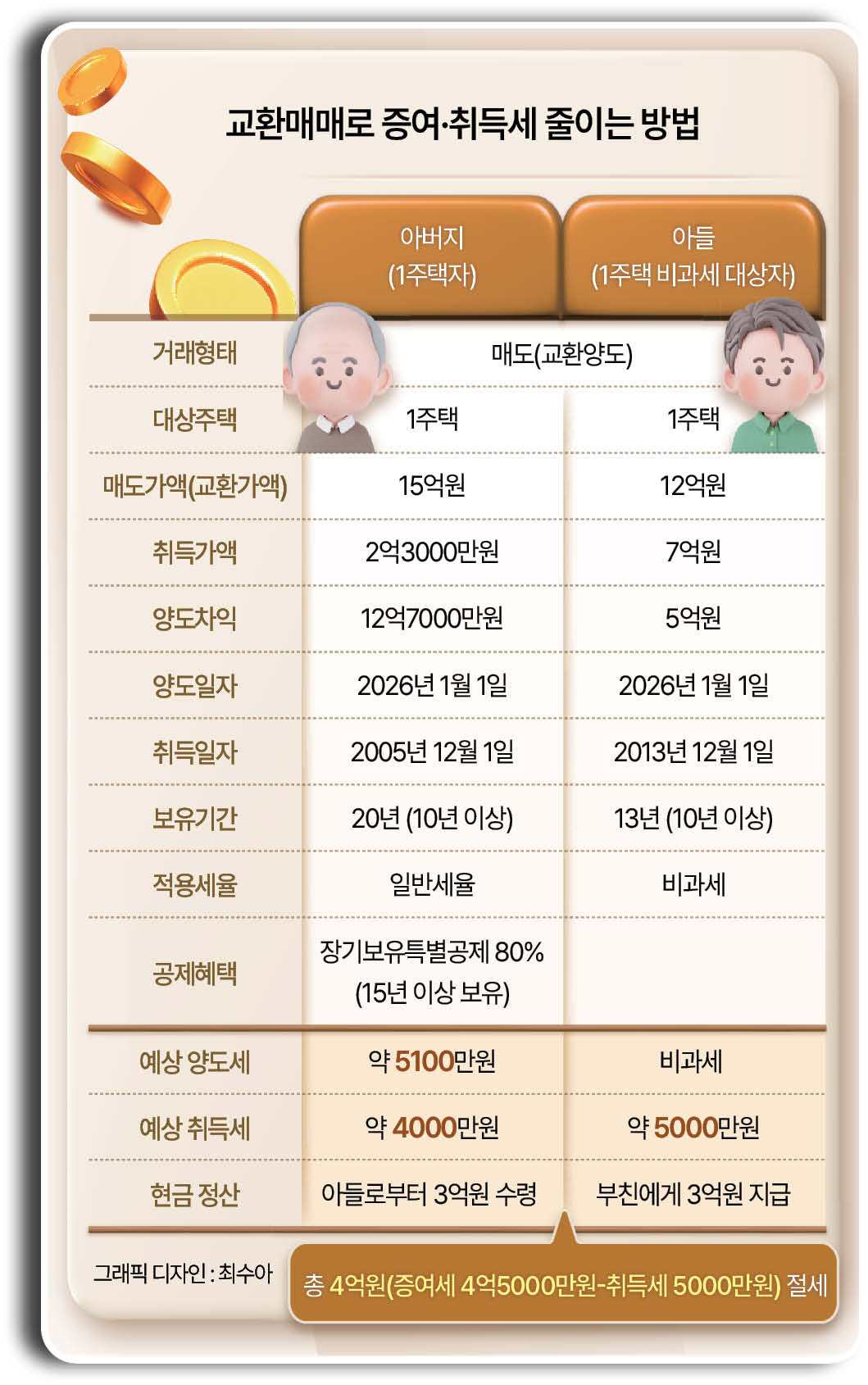
A: Through the exchange, Se-sang acquires his father's roughly 99-square-meter apartment valued at 1.5 billion won (about $995,000). Had he received that home as a gift instead, the gift tax alone would come to roughly 400 million won (about $265,000). Add acquisition tax of about 50 million won (about $33,200), and the total tax burden reaches roughly 450 million won (about $299,000).
With an exchange, the picture changes considerably. Se-sang pays his father the 300 million won (about $199,000) price difference, and the father uses that money to cover his own tax liabilities — acquisition tax of about 40 million won (about $26,500) and capital gains tax of about 51 million won (about $33,800). In effect, the price-gap settlement funds the father's tax obligations.
Se-sang also benefits from the single-household capital gains tax exemption, so he owes no capital gains tax at all — his only direct tax cost is the acquisition tax. And unlike a gift, which requires paying a large lump sum all at once, an exchange distributes the burden in a way that is easier to manage.
Ultimately, Se-sang avoids a gift tax bill running into the hundreds of millions of won while moving into a larger home, and the father downsizes while securing both retirement funds and the cash to cover his taxes. Carefully mapping out the taxes involved in a property exchange can make it a compelling option for significantly reducing the family's overall tax burden.
Q: Is there a risk of a tax investigation with this kind of exchange?
A: Transactions between family members receive particularly intense scrutiny from the National Tax Service. If an exchange is deemed a gift in substance despite its sale form, the tax treatment changes immediately — so caution is essential. Three rules must be followed without exception for the deal to be recognized as a genuine exchange and transfer.
First, set the exchange price through a formal appraisal.
The thinking that "it's just between us, so let's go a little lower" is the most dangerous mistake. For homes valued at 1 billion won (about $663,000) or less, one licensed appraisal is required; for homes above that threshold, the transaction price must be the average of two independent appraisals. Pricing the deal in a way that favors one party can immediately trigger a tax investigation. Do not make arbitrary judgments about market value just because there are no recent actual transaction prices — obtain an objective market value through a formal appraisal. The National Tax Service trusts appraisal-based valuations above all else.
Second, the price difference must actually be settled.
An exchange means swapping homes and paying the difference — that 300 million won (about $199,000) gap must genuinely change hands. A bank transfer works, as does a loan or assumption of the existing lease deposit. The moment the parties decide to "just let it slide," the deal is treated as a gift. Leave a clear financial trail — bank transfer records, loan assumption documents and the like. Even without a large amount of cash on hand, a well-structured arrangement can keep the burden manageable.
Third, never use an understated contract price.
Writing down 1 billion won (about $663,000) and 700 million won (about $464,000) on a contract for homes actually worth 1.5 billion won (about $995,000) and 1.2 billion won (about $796,000) to reduce acquisition tax will result in penalties and surcharges if discovered. The special terms of the contract must explicitly state the price-gap settlement for the exchange — for example: "Party A (father) and Party B (child) agree that Party B shall pay Party A 300 million won (about $199,000) in cash (or via lease deposit assumption) representing the difference in the appraised values of the two properties."
[By Yu Hye-rim / Kim Hye-ri, deputy head tax accountant at HKL Tax Corporation]

forest@heraldcorp.com




