
A so-called "cash-settled comprehensive share exchange" — in which a private equity fund cashes out minority shareholders and proceeds to delist a company — has finally drawn a court ruling after years of simmering tension in South Korea's capital markets. Minority shareholders argued the exchange price was unfairly low, but the court sided with the fund, ruling that market price constitutes an objective benchmark.
The outcome is far from settled, however. A recent amendment to the Commercial Act has thrust directors' fiduciary duties to shareholders into the spotlight, rapidly shifting the regulatory landscape. With minority shareholder rights groups growing louder and financial regulators now demanding stricter procedural fairness, the battle over corporate delistings is entering a sharper new phase.
First ruling on private equity's share-exchange delisting strategy
The Suwon District Court's Pyeongtaek Branch Civil Division 2, presided over by Judge Jo Jeong-ung, recently ruled that the 8,755-won-per-share buyout price set by Lock & Lock was appropriate in a share-purchase price determination case brought by the company's minority shareholders, according to legal sources Monday. The court issued a partial ruling in favor of the plaintiffs. The case is currently under appeal. It is the first known court ruling on a private equity fund's use of a comprehensive share exchange.
A comprehensive share exchange is a mechanism by which a parent company acquires all shares of a subsidiary — exchanging them for either parent company shares or cash — to make the subsidiary a wholly owned unit. It requires a special resolution at a general shareholders' meeting, passing with the approval of at least two-thirds of attending shareholders and at least one-third of total issued shares. Dissenting shareholders may petition a court to determine a fair purchase price.
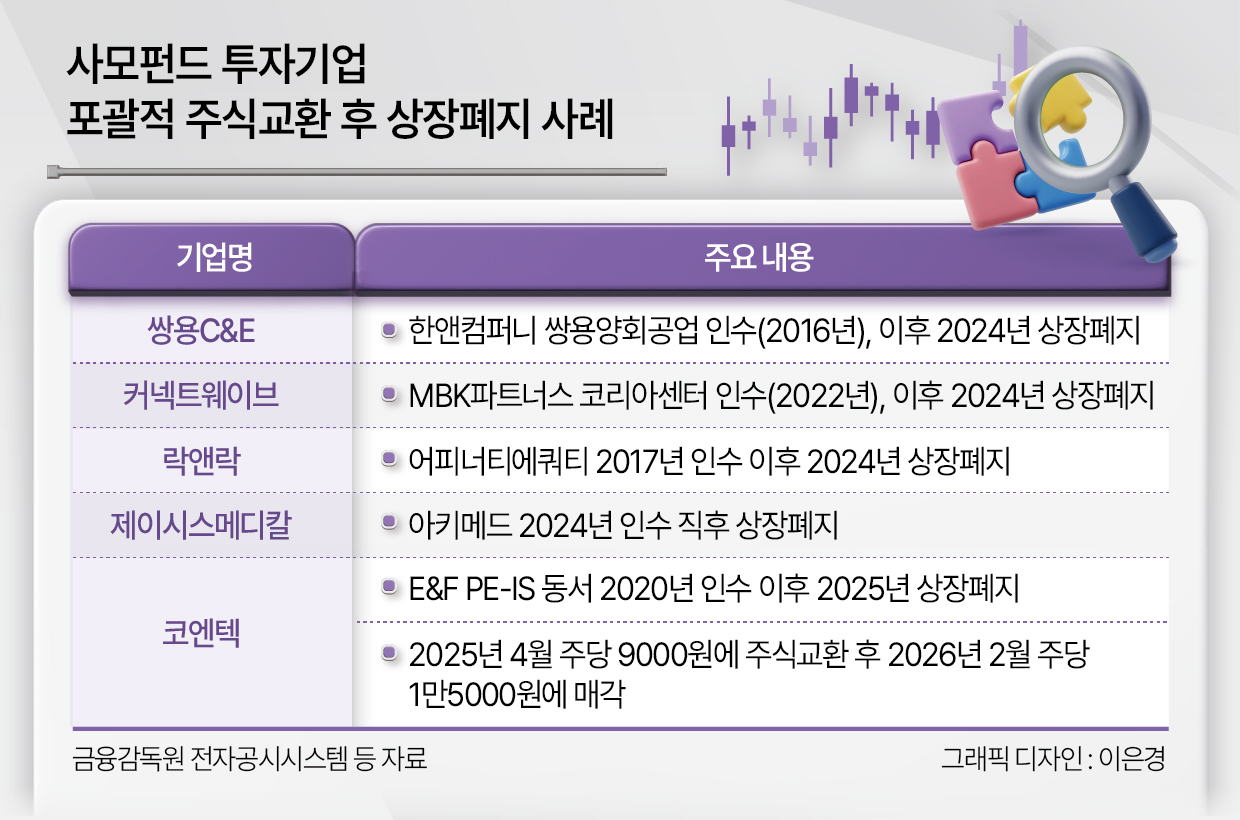
The dispute stems from the delisting of Lock & Lock pursued by private equity fund Affinity Equity Partners. Affinity acquired a controlling stake in Lock & Lock in 2017 for approximately 630 billion won ($423 million) and delisted the company in December 2024.
The trouble began when Affinity fell short of the ownership threshold required for a voluntary delisting. Under Korea Exchange listing rules, a controlling shareholder must hold at least 95 percent of shares to voluntarily delist. Affinity conducted two rounds of tender offers at 8,750 won per share between April and June 2024 and made additional open-market purchases, but its final stake reached only 89.17 percent.
Affinity turned to the cash-settled comprehensive share exchange as a workaround. Shareholders representing 2.98 percent of the total then petitioned a court to adjust the purchase price, formally igniting the dispute. The company ultimately offered those shareholders 8,755 won per share — five won above the original exchange price.
Minority shareholders raised two main objections. First, they argued that the market price itself was distorted and could not serve as a fair benchmark — that the prospect of delisting created strong selling pressure, forcing the share price to converge toward the tender offer price.
Second, they contended the buyout price was below the company's asset value. The company maintained it had offered a premium above the 5,000-to-7,000-won range where the stock had been trading. Minority shareholders countered that the tender offer price represented only 0.76 times price-to-book ratio as of end-2023, undervaluing the company, and that a fair price should be at least 11,658 won per share (about $8) once retained earnings and other factors were taken into account.
The first-instance court rejected both arguments. "Market price is in principle regarded as an objective value reflecting the information and judgment of many investors," the court said, adding that "it is appropriate to calculate the purchase price based on market price absent special circumstances."
The court also dismissed the argument that using a price formed through a prolonged tender offer process undermined the purpose of the judicial price-determination mechanism. Minority shareholders had argued that the mechanism exists precisely to arrive at a fair price free from the controlling shareholder's influence.
When a controlling shareholder can influence share price formation, using market price as the benchmark in effect subordinates the court's judgment to the controlling shareholder's strategy. The Supreme Court has previously acknowledged that market price can deviate from fair value when a controlling shareholder is able to choose a favorable timing.
The first-instance court said it "must rigorously examine the fairness of the consideration, given that a cash-settled share exchange structurally strips minority shareholders of their shareholder status regardless of their wishes" — but added that "it is difficult to conclude that market price fails to reflect objective value simply by comparing it with financial conditions or asset value."
Introduced for post-IMF restructuring, now a private equity staple
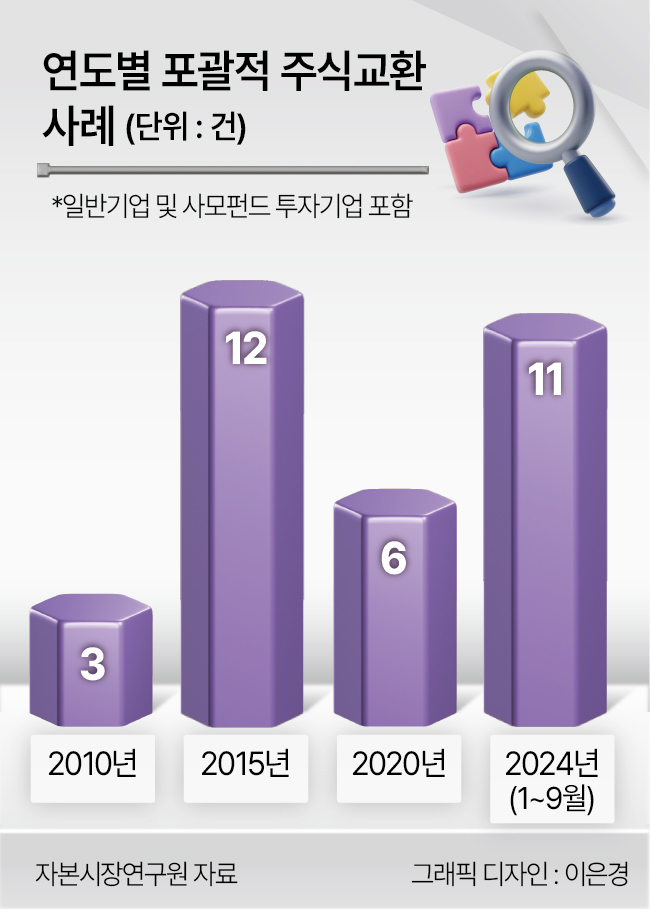
Although the court has sided with the private equity fund for now, similar cases continue to emerge in the market, and disputes are expected to persist. Bain Capital plans to carry out a comprehensive share exchange for Ecomarketing — operator of athleisure brand Andar — in June. Bain Capital attempted three rounds of tender offers but secured only a 92.4 percent stake. The exchange price is set at 16,000 won per share (about $11), matching the tender offer price.
EQT Partners is also conducting a second tender offer for Kospi-listed Douzone Bizon. There is speculation that the fund may pursue a delisting after the tender offer closes, potentially through a comprehensive share exchange or by exercising a controlling shareholder's squeeze-out right.
The comprehensive share exchange was introduced after the 1997-98 IMF financial crisis to facilitate corporate restructuring and the adoption of holding company structures, streamlining a process that had previously required mergers or in-kind contributions. The mechanism has since been widely used in corporate governance overhauls — notable examples include Hana Financial's acquisition of Korea Exchange Bank in 2012, KB Financial's acquisition of Hyundai Securities in 2016, Hanwha Galleria's merger with Hanwha Galleria Timeworld in 2020, and Kolon's integration of Kolon Mobility Group in 2025.
A 2015 amendment to the Commercial Act expanded the tool's reach by allowing cash to be paid in lieu of parent company shares. Private equity funds in particular have since adopted a combined strategy of tender offers followed by comprehensive share exchanges when pursuing delistings after acquisitions.
Private equity funds typically acquire stakes in target companies not directly but through a special purpose company, or SPC. If SPC shares were distributed to the target company's shareholders, those shareholders would become SPC shareholders. Paying cash instead simplifies the ownership chain to a clean fund–SPC–target structure with no minority shareholders. This makes it easier to execute decisions on dividends, asset sales, and mergers and acquisitions after taking control — and delisting eliminates disclosure obligations as well.
Minority shareholders push back as FSS tightens scrutiny
The central concern is that this structure can harm minority shareholders' interests. Critics argue the comprehensive share exchange has in effect been weaponized as a tool to expel minority shareholders.
Although the mechanism was designed for corporate restructuring, in practice it functions as a means of wholesale elimination of specific shareholders' stakes. In a cash-settled share exchange, minority shareholders do not even receive parent company shares — their status as shareholders is extinguished entirely.
The regulatory environment is shifting, however, as a Commercial Act amendment has codified directors' fiduciary duties to shareholders. The Ministry of Justice issued guidelines in February on directors' conduct standards during corporate reorganizations, noting that transactions involving mergers between affiliates or delistings can create conflicts of interest between controlling and general shareholders. The guidelines cover a range of delisting-related transactions, including tender offers, comprehensive share exchanges, open-market purchases, share consolidations and the exercise of controlling shareholders' squeeze-out rights.
The guidelines noted that delisting transactions place considerable selling pressure on general shareholders, who may feel compelled to sell — since shares become difficult to trade after delisting, and there is a risk that the exchange price in a subsequent cash-settled share exchange could be set below the tender offer price. The guidelines called for strengthened procedures in cash-settled share exchanges, including the formation of special committees and independent expert reviews, given the greater potential harm to shareholders.
The Financial Supervisory Service's recent intervention in E-mart and Shinsegae Food's planned comprehensive share exchange followed the same logic. In March, the FSS told E-mart and Shinsegae Food to revise their securities registration statements, citing omissions of material information relevant to investment decisions.
"We are reviewing whether the comprehensive share exchange process complies with the amended Commercial Act and the Ministry of Justice guidelines, and whether shareholders' views have been adequately solicited," an FSS official said.
Price fairness, procedural standards and legislative proposals all in play
Industry observers expect the central issues to be the appropriateness of the share exchange price and the fairness of the price-setting process.
"It is a tug-of-war between minority and controlling shareholders over price. Whether the benchmark is market price or net asset value, pushback is inevitable depending on the circumstances," one legal expert said. "The key is ensuring that independent experts conduct valuations fairly."
Legislative proposals are also in motion. Democratic Party of Korea lawmaker Lee Gang-il has introduced a bill that would require consideration of asset value and earnings value — in addition to market value — when calculating share prices in listed company mergers, and would set net asset value as a floor. Because the Supreme Court views comprehensive share exchanges as economically similar to mergers, a law along those lines, if passed, would likely apply to comprehensive share exchanges as well.
Hwang Hyeon-yeong, a researcher at the Korea Capital Market Institute, said South Korea currently lacks mechanisms to protect shareholders when a tender offer and comprehensive share exchange are used together to delist a company, and that courts have been ruling that the prices paid by companies are unobjectionable under existing law. "The Doosan Bobcat case in 2024 raised the issue, but regulatory reform did not follow — and now the Shinsegae Food delisting through a comprehensive share exchange is causing problems again," Hwang said. "Legislative reform is needed to prevent minority shareholders from being harmed when similar cases arise in the future."
park.jiyeong@heraldcorp.com