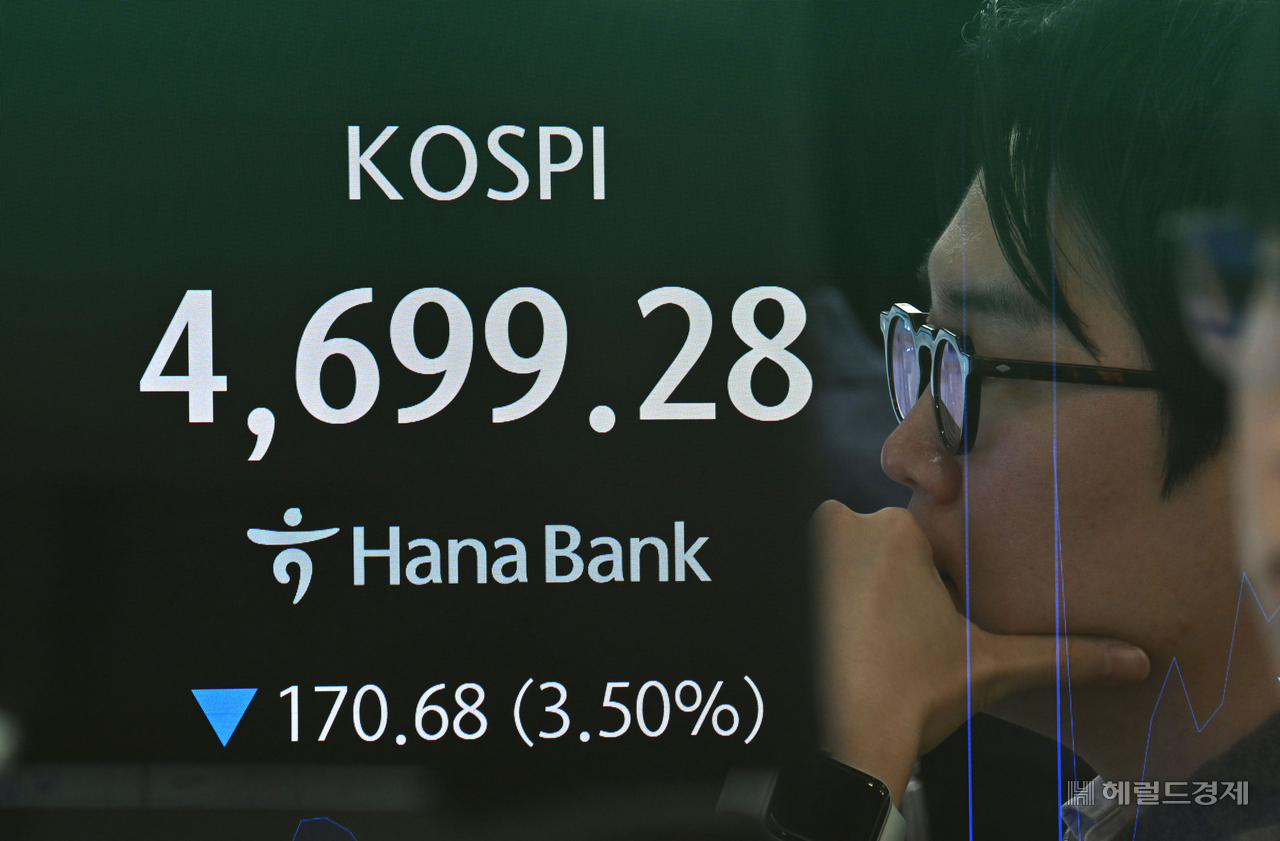
Global semiconductor stocks that surged on the AI boom have tumbled more than 70% from their peaks, battered by profitability concerns over massive AI investment and mounting management uncertainty at Nvidia. Sharp declines in Samsung Electronics and SK hynix have dragged the Kospi down more than 46% from its own high. Securities analysts say a rebound in chip stocks will be difficult for now, and some have put forward forecasts that the index could be pushed down to the 3,000-point range.
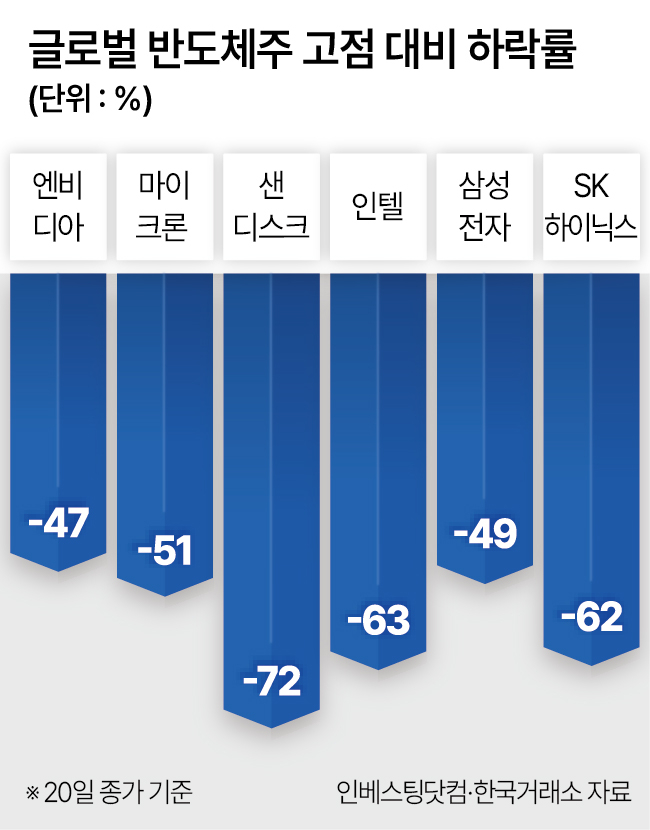
According to Korea Exchange data as of Friday, Samsung Electronics and SK hynix shares had tumbled 49.6% and 62.4%, respectively, from their all-time closing highs. Major US chip names were similarly battered — Nvidia fell 47%, Micron 51%, SanDisk 72% and Intel 63% from their peaks.
Global semiconductor stocks have been under pressure from doubts about the return on investment from big tech companies' AI spending. Markets that had counted on surging chip demand driven by AI investment are now questioning whether the enormous capital outlays can ever be recouped. The burden of financing has also grown heavier as companies have taken on more debt in a high-interest-rate environment.
A string of negative developments surrounding Nvidia then poured fuel on the sell-off. Management uncertainty has persisted since former CEO Jensen Huang stepped down, and concerns over US restrictions on semiconductor exports to China added to the pressure. Reports that the US Securities and Exchange Commission (SEC) is investigating Nvidia's accounting practices further dampened investor sentiment.
Even the record-breaking initial public offering of US AI company Anthropic failed to shift the market mood. Anthropic listed on NASDAQ on Thursday (local time) at a valuation of approximately $1.5 trillion, raising $81.3 billion in the largest IPO on record. On its first day of trading, the stock climbed as high as $115.10 during the session before closing at $97.17, then fell another 8.5% the following day. The post-listing decline — despite strong demand for the massive offering — confirmed investor wariness about the lofty valuations and profitability of AI companies.
"The prevailing view on leading AI and semiconductor value-chain stocks at home and abroad, which was dominated by euphoric optimism through the first half of this year, has shifted through a reflexive caution in the third quarter to extreme pessimism now in the fourth," said Kim Yong-gu, an analyst at Yuanta Securities Korea.
The Kospi, where the two semiconductor heavyweights account for roughly half of total market capitalization, has fallen close to half its peak value. The index has dropped 46.6% from its all-time closing high of 9,144 points, set on June 22. Its maximum drawdown is now approaching levels seen during the Asian financial crisis (64.7%), the dot-com bust (52.7%) and the global financial crisis (54.1%).
The Kospi's 12-month forward price-to-earnings ratio is estimated at just 3.2 times. Samsung Electronics and SK hynix trade at 12-month forward PERs of 2.9 times and 2.5 times, respectively. "The decline in Korean equities began far earlier and has been far steeper than in the US market, and is entering territory that cannot be explained by valuation alone," said Lee Young-won, an analyst at Heungkuk Securities.
Securities analysts have lowered their floor estimates for the Kospi, seeing little prospect of a near-term recovery in chip stocks to lead a rebound. Profitability concerns over AI investment persist, and financing pressures from high interest rates show no sign of easing. iM Securities and Hana Securities both set their Kospi floor at 4,300 points. Yuanta Securities Korea cut its Kospi forecast band for next year to 4,000–7,300 points from a prior range of 6,000–10,000 points.
Some analysts have gone further, raising the possibility that the Kospi could fall to the 3,000-point range. "Policy responses may help form a floor for share prices, but they have limited power to drive a sustained rebound before the earnings uncertainty from the AI value-chain restructuring is resolved," said Kim Byeong-yeon, an analyst at NH Investment & Securities. "It is possible to calculate a scenario in which the Kospi falls to the low 4,000s on average, or even the high 3,000s."
The key to any future market recovery lies in falling interest rates and AI companies demonstrating profitability. "If earnings forecasts do not deteriorate significantly, a decline in market interest rates could serve as the trigger for an index rebound," said Lee Jae-man, an analyst at Hana Securities.
"Restoring confidence in the AI cycle is fundamentally necessary to improve stock market sentiment," said Kim Seong-geun, an analyst at Mirae Asset Securities. "Resolving the uncertainty around Nvidia and seeing signals of improved profitability from Anthropic are prerequisites for rebuilding that confidence. Big tech companies' cash flows and whether the upward trend in credit default swap spreads is slowing are also areas that warrant close monitoring."

moon@heraldcorp.com