
Joint academic conference held Monday at National Assembly
Kim Jae-hong calls for mandatory AI literacy
Cho Dong-sung says AI must serve ESG goals
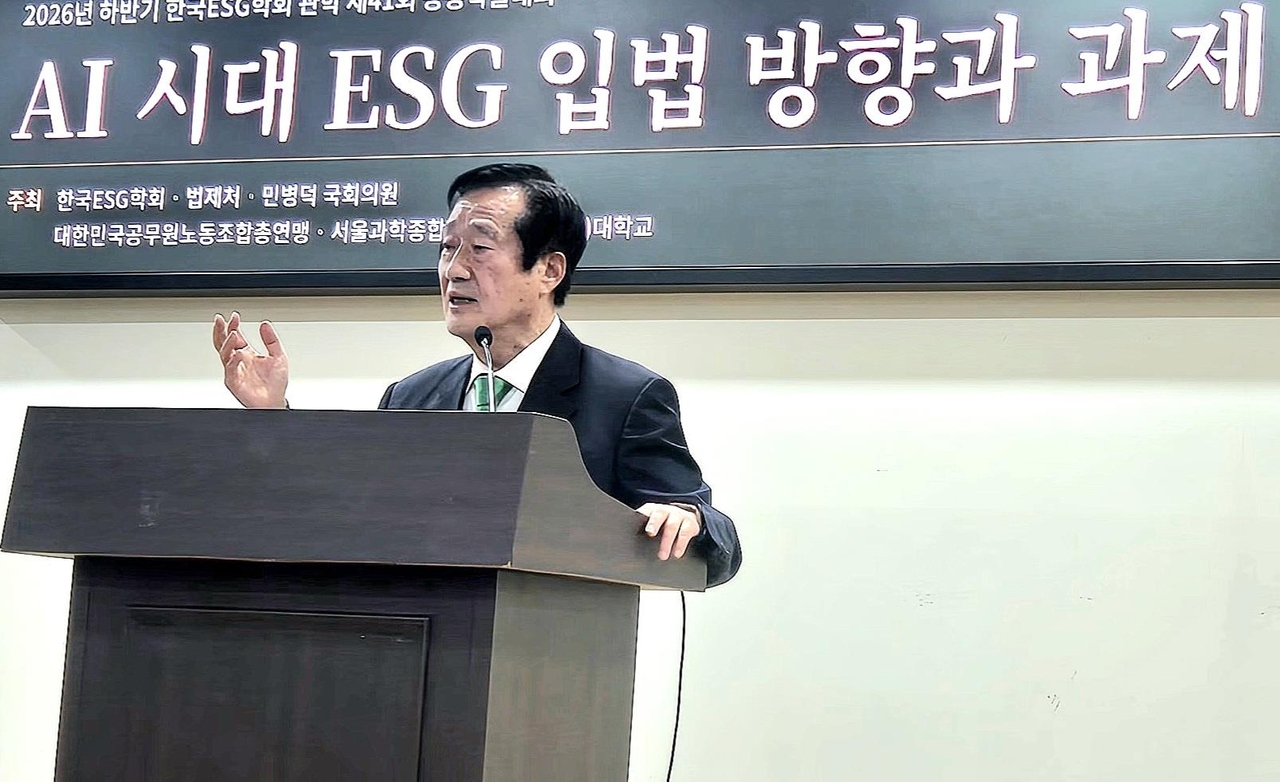
"The current AI Basic Act places too much weight on promotion and treats minimizing regulation as a guiding principle — that balance has broken down."
Kim Jae-hong, standing chairman of the ESG Practice Citizens Alliance and a former 17th-term lawmaker, made the remarks Monday in his opening address at the "AI-Era ESG Legislation: Directions and Challenges" academic conference at the National Assembly Members' Office Building. A string of AI-assisted cheating incidents has recently become a social concern, spanning the College Scholastic Ability Test, the Legal Education Eligibility Test and the certified tax accountant examination. Kim said AI promotion policy has far outpaced public AI literacy — meaning the ability to understand and use the technology responsibly. The conference was co-hosted by the Korean ESG Society together with the Ministry of Government Legislation, the Federation of Korean Government Employees' Unions and Seoul School of Integrated Sciences and Technologies.
Kim said South Korea should adopt the AI literacy obligations, prohibited practices and disciplinary frameworks set out in the EU's comprehensive AI Act. He argued that because AI has moved beyond its early role in content generation and task assistance into the "AI agent" stage — where systems reason, plan and set their own directions — conventional digital literacy focused on learning how to operate software is no longer sufficient to prevent misuse. "The current AI Basic Act lacks literacy provisions as a preventive measure," he said.
Kim also called for broadening the scope of the existing law. "The current AI Basic Act already requires human oversight for operators of high-impact AI in areas such as hiring, lending, healthcare and student assessment," he said. "That obligation should be extended beyond high-impact AI to cover general-purpose AI operators as well."
On the recent wave of AI agent-assisted hacking attacks targeting financial institutions and security organizations worldwide, Kim expressed alarm, comparing the threat to nuclear weapons — an invention of human science that now endangers all of humanity. "AI must fundamentally remain a tool that operates according to human goodwill," he said. "It must not become advanced equipment that escapes human management and control or is exploited by criminal groups."
Kim offered ESG philosophy as a solution. "We must reaffirm that human-centered values, respect for human dignity and corporate social responsibility are the pillars that will guide the AI era in a healthy direction," he said. He added that the seven core social responsibility agendas for corporations and major social organizations set out in ISO 26000 — an internationally recognized standard in the history of ESG development — should be reflected in AI literacy frameworks.
Kim has consistently emphasized AI literacy over the years. In a column published in December last year, he identified an "AI basic society" — one in which AI is not monopolized by a handful of experts or large corporations but used by all citizens in daily life with its benefits shared equally — as a top national policy priority, writing that "public AI platforms and mass education in AI literacy are essential." In a 2024 interview with The Herald Business, he said the advantages of AI technology should be actively applied to education, while its side effects must be countered through education as well.
Cho Dong-sung, chairman of the Seoul National University Honorary Professors Association and chairman of IPS, delivered the keynote address. Cho outlined three stages of AI development: AI Technology acquisition, AI Application and AI Transformation. "The United States ranks first in AI Technology, China leads in AI Application, and Finland tops AI Transformation — though South Korea has a real chance to compete for the top spot in that third stage," he said.
Cho said AI development and ESG development must not be treated as separate phenomena. "AI brings new ESG risks — massive power consumption, job displacement and algorithmic bias — while at the same time serving as a powerful tool for ESG progress through carbon emission reduction, industrial accident prevention and improved management transparency," he said. He called for a new strategic analytical framework that integrates AI and ESG together, taking both dimensions into account.
"What we must ultimately pursue is not the advancement of AI technology for its own sake, but using AI to protect the environment, enhance human dignity and make corporations and society operate more responsibly and transparently," Cho said. "We should pursue AI for ESG, not ESG for AI." He added that the convergence of AI and ESG should go beyond regulatory compliance to become a new growth engine that strengthens corporate competitiveness and builds a sustainable society.
pooh@heraldcorp.com




