Key research to expand on sea ice and ice sheet loss predictions
Unmanned exploration systems, Sejong Station modernization planned
Public hearing Tuesday to gather input before plan is finalized
The government plans to expand research into how quickly Antarctic sea ice and ice sheets are shrinking, and to build an unmanned observation and exploration system using robots and aircraft. It will also modernize facilities at the Sejong Antarctic Research Station. These initiatives will be included in a medium- to long-term research plan covering the period through 2031, aimed at strengthening the country's response to climate change and its Antarctic research capabilities.
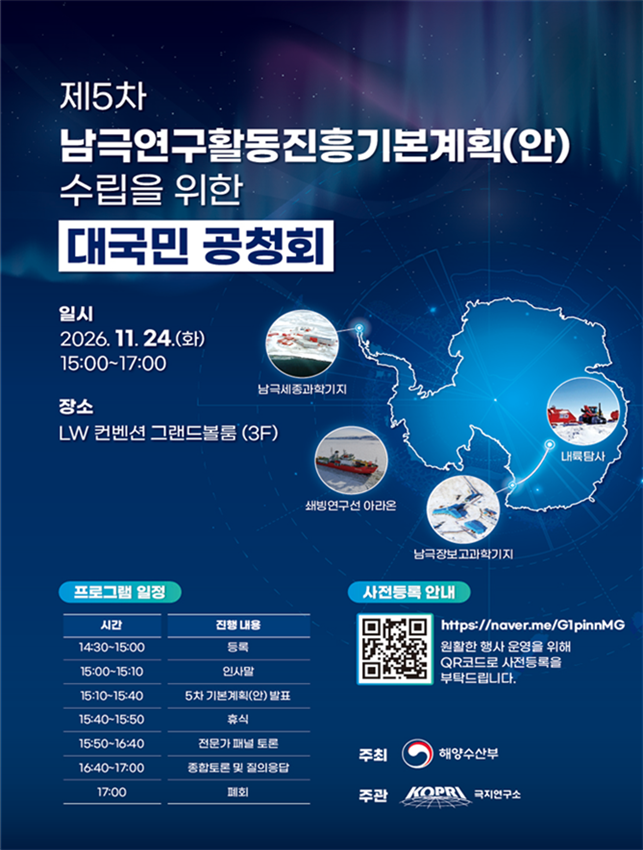
The Ministry of Oceans and Fisheries announced Monday that it will hold a public hearing in Seoul on Tuesday at 2 p.m. on the draft fifth Antarctic Research Activity Promotion Basic Plan.
The Antarctic Research Activity Promotion Basic Plan is a statutory plan established every five years under the Act on Antarctic Activities and Environmental Protection. It reviews research achievements from the preceding five years and sets goals and directions for the period ahead. With the fourth basic plan (2022–2026) concluding this year, the government is preparing the fifth plan, which will cover 2027 through 2031.
The new plan will be pursued along three directions: leading key research to prepare for future challenges, expanding research infrastructure, and broadening international cooperation in Antarctic research while raising public awareness of its value.
In the area of core research, the plan calls for studies to predict the loss of Antarctic sea ice and ice sheets driven by global warming. It also includes research to reconstruct past climates and project future climate change by analyzing geological and sediment samples from Antarctica.
Research infrastructure will also be strengthened. The government plans to build an unmanned observation and exploration system linking robots and aircraft, and to modernize the Sejong Antarctic Research Station, which has been in operation since 1988.
On the international cooperation front, South Korea aims to lead large-scale joint research as part of the fifth International Polar Year, scheduled for 2032–2033. Public engagement programs to deepen understanding of Antarctic research will also be expanded.
The public hearing is open to anyone with an interest in Antarctic research. Experts in Antarctic policy, research facilities and public outreach will hold a panel discussion, followed by an open session for attendees to share their views. Registration is available in advance via a QR code on the hearing poster posted on the Korea Polar Research Institute website, or on-site on the day.
The ministry said it will review feedback from the hearing along with input from relevant agencies, and finalize the plan after deliberation by the National Science and Technology Advisory Council.
Yoo Eun-won, director general for ocean policy at the ministry, said that since field research began at the Sejong Antarctic Research Station in 1988, South Korea has grown into a leading Antarctic research nation with an icebreaking research vessel and two permanent stations. "Building on 40 years of achievements, we hope this plan will serve as a foundation for our Antarctic research to take another leap forward," Yoo said, calling for broad public interest and participation.
adastra@heraldcorp.com