Spanish fashion giant Inditex backs 4.5 billion won restoration effort running 2027–2029
About 40 hectares of disused aquaculture facilities to be cleared; salt marsh habitat to be created
Five public and private organizations to collaborate on carbon sink expansion and marine ecosystem recovery
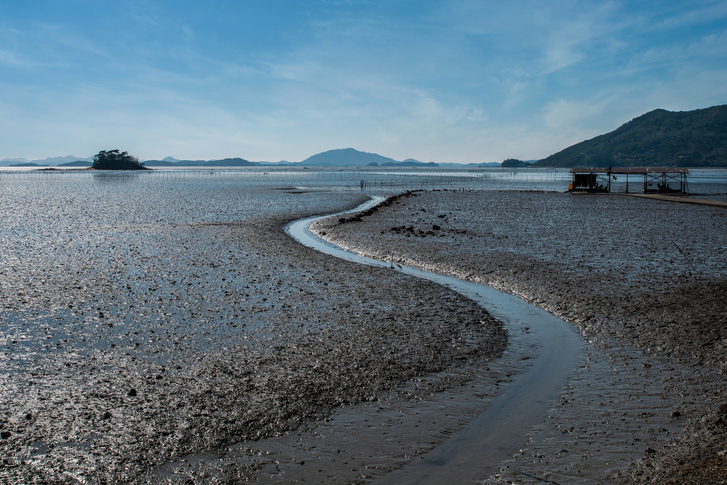
South Korea will clear abandoned aquaculture facilities that have sat idle for more than a decade at Garolim Bay in Taean-gun, South Chungcheong Province, and restore the tidal flat ecosystem there. Inditex, the Spanish fashion conglomerate behind the Zara brand, will provide about 4.5 billion won ($3.36 million) in funding. The government, local authorities and environmental groups will work together to clear roughly 40 hectares of disused fish-farm structures and establish salt marsh habitats capable of absorbing carbon.
The Ministry of Oceans and Fisheries announced Thursday that it will sign a five-way MOU with South Chungcheong Province, WWF-Korea, Taean-gun and the Korea Fisheries Infrastructure Public Agency (FiPA) to advance the public-private partnership Garolim Bay tidal flat restoration project. The signing ceremony will take place Friday at Peace & Park Convention in Seoul.
The project will run for three years, from 2027 to 2029, in the Mandae Port area of Iwon-myeon, Taean-gun. The total budget is 3 million euros ($3.3 million), which Inditex will fund in full under a separate agreement it has concluded with WWF-Korea.
The restoration target is the Garolim Bay tidal flat, where long-disused aquaculture structures remain in place. Abandoned poles and other fish-farm equipment left for more than a decade have obstructed tidal flows, caused environmental pollution and damaged the landscape, creating problems for local residents and visitors alike.
The government plans to remove and clear about 40 hectares of the disused facilities to improve seawater circulation and restore the tidal flat's natural self-purification capacity. Alongside this, halophyte habitats will be established to expand carbon sinks and improve living conditions for marine species including the spotted seal.
The project will proceed in phases. In the first year, 2027, crews will begin dismantling the abandoned structures and conduct baseline surveys to identify suitable plant species and restoration sites. In 2028, demolition and tidal flat clearing will continue while about 10 hectares of salt marsh habitat are actively developed.
In the final year, 2029, the remaining dismantling work will be completed and vegetation establishment and overall restoration outcomes will be assessed. After the project concludes, Taean-gun will oversee follow-up management for five years.
The project will also examine the tidal flat's value as a carbon sink, not just its ecological functions. Specialist institutions will verify changes in sediment carbon storage and vegetation cover before and after restoration, and the findings will be used to calculate blue carbon — the carbon absorbed and stored by marine ecosystems — sequestration volumes.
Under the project's operational structure, WWF-Korea will commission the Korea Fisheries Infrastructure Public Agency to carry out the work, with the agency handling surveys, design, construction and accounting. The project is also significant as an example of public-private collaboration in marine protected area restoration, bringing together the government, local authorities, a global corporation, an environmental organization and a public institution.
The signing ceremony Friday is expected to be attended by Deputy Minister of Oceans and Fisheries Nam Jae-heon, South Chungcheong Province Governor Park Soo-hyun, WWF-Korea Secretary General Park Min-hye, Taean-gun Mayor Yun Hui-sin and Korea Fisheries Infrastructure Public Agency Chairman Hong Jong-uk.
"It is deeply meaningful to be carrying out this public-private partnership project with Inditex and WWF-Korea," Deputy Minister Nam said. "We hope companies will continue to take an active interest and participate so that we can protect our precious seas together."
adastra@heraldcorp.com