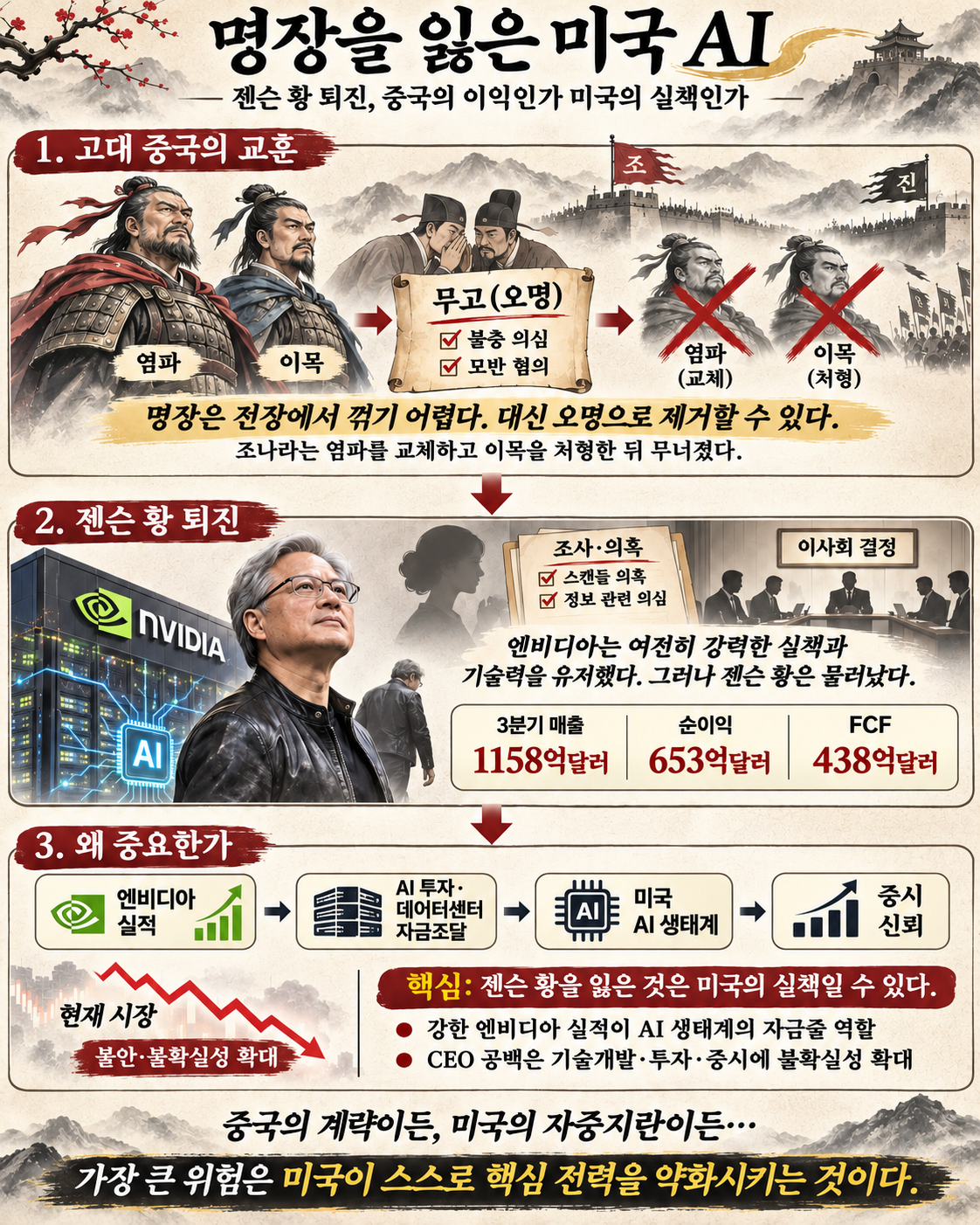
In the final years of China's Warring States period, the fiercest rivalry was between the states of Qin and Zhao. Qin's offensive edge rested on generals Bai Qi and Wang Jian; Zhao's defense depended on Lian Po and Li Mu. The Thousand Character Classic honors all four as the greatest commanders of the age.
Qin ultimately unified the realm. Yet neither Lian Po nor Li Mu was ever defeated by Qin on the battlefield. It was Zhao itself that removed them.
In 260 BC, a Qin army advancing on Zhao met Lian Po at Changping. Unable to break through his defensive lines, Qin resorted to subterfuge.
"The general Qin truly fears is Zhao Kuo. Lian Po is easy to deal with."
Zhao's king, already frustrated with Lian Po's cautious defense, believed the rumor and dismissed him, replacing him with the inexperienced Zhao Kuo. Qin countered by appointing Bai Qi as its new commander. The Battle of Changping that followed was a catastrophe for Zhao. According to the Shiji, roughly 400,000 Zhao soldiers who surrendered were buried alive.
Thirty-one years later, in 229 BC, Qin's Wang Jian attacked Zhao again. Finding Li Mu's defensive line impossible to breach, Qin bribed a confidant of the Zhao king and spread rumors that Li Mu was plotting treason. Once again the king believed the whispers and had Li Mu executed. Zhao fell just three months later.
Defeating a great general in battle is hard. Destroying a reputation is easy.
Nvidia's greatest quarter — and Jensen Huang's last
On Thursday (local time), Jensen Huang stepped down as CEO of Nvidia, the company at the center of the global AI ecosystem. His departure followed the disclosure of an inappropriate relationship with a woman suspected of ties to Chinese intelligence.
On Tuesday, Nvidia reported earnings for the third quarter of fiscal year 2027. Sales reached $115.8 billion, up 103 percent from a year earlier. Net profit came to $65.3 billion. The company's sales outlook for the next quarter — $130 billion — exceeded market expectations. Shipments of Vera Rubin, Nvidia's next-generation AI platform, have begun, and development timelines for the follow-on products Rubin Ultra and Feynman remain on track. Nvidia's commanding position in both technology and financial performance was unchanged.
The results were built under Huang's leadership, yet he was absent from the earnings call. Instead, Huang publicly declared his intention to return to the role the same day. President Donald Trump and Elon Musk voiced support for his reinstatement. Nvidia board chair Harvey Jones, however, drew a line, saying the board had no intention of bringing Huang back as CEO.
Who benefits from the Jensen Huang affair?
"When something happens and someone profits, examine whether that person drove the event; when someone suffers harm, investigate the interests on the other side." — Han Feizi
Who stands to gain the most from what has unfolded?
At the center of the affair is Alice Huang, a Chinese woman who previously served as CEO of Megaspeed, a Singapore-based cloud company. Jensen Huang acknowledged an inappropriate relationship with her.
The United States has been investigating whether Megaspeed violated semiconductor export controls. Authorities have also examined whether Alice Huang has connections to China's Ministry of State Security. The Justice Department has yet to reach a conclusion on whether she is a spy.
Did Chinese intelligence recruit Alice Huang and direct her to get close to Jensen Huang? And if so, what operation would have been most effective?
Obtaining Nvidia semiconductors in circumvention of export controls would be an immediate gain. Extracting core technology or sensitive intelligence about the US AI ecosystem would be a larger one. But slowing the pace of technological development and infrastructure buildout in the American AI industry — could any strategic prize be greater than that?
Jensen Huang's real value
Jensen Huang is not simply an executive who builds good semiconductors. Over 33 years leading Nvidia, he constructed an AI ecosystem connecting chip design, software, data centers and capital markets. The engine driving that entire structure is Nvidia's extraordinary capacity to generate cash.
The results announced Tuesday show that operating cash flow for the third quarter reached $48.3 billion, with free cash flow of $43.8 billion. The company returned $28.1 billion to shareholders through buybacks and dividends alone. Nvidia, generating cash on that scale, also channels funds to AI companies and data center operators — what has come to be called the "Bank of Jensen Huang."
When Nvidia invests in a project or guarantees a certain level of demand, data center operators find it far easier to borrow from financial institutions. They use that capital to purchase GPUs and build out data centers. Nvidia then sells more semiconductors, generating further profit and cash. Nvidia's earnings underwrite AI investment, and AI investment in turn drives Nvidia's earnings — a self-reinforcing cycle.
The CEO of Nvidia must do more than develop technology and sell chips. The role requires coordinating customers' investment plans and financing arrangements, creating future revenue streams while preventing reckless spending from putting the company at risk. That is the work Jensen Huang has done. His absence introduces a new layer of uncertainty into the American AI ecosystem.
A US AI sector without Jensen Huang gives China's AI an opening to catch up
China's larger ambition is not to keep importing American semiconductors but to develop its own AI chips. Every moment of uncertainty facing the US AI ecosystem is a window for China to close the gap.
If the goal is to disrupt the American AI ecosystem, there is no need to risk exposure by stealing technology. Even without conducting actual espionage, it is enough to create a situation in which Jensen Huang is suspected of ties to a spy — and let the United States remove its own most capable figure. It is the ancient stratagem of killing with a borrowed sword.
There is no evidence that China actually ran such an operation. What, then, is the alternative? It is possible that the United States ousted Jensen Huang entirely on its own, with no Chinese plot involved.
Huang had argued that export controls should be eased to keep China dependent on American semiconductor technology. Hardliners, including Secretary of State and National Security Adviser Marco Rubio, have pushed for tighter controls. Rubio is reported to have drafted a classified memo, based on CIA intelligence, warning of the relationship between Jensen Huang and Alice Huang. Huang's removal is a favorable outcome for the hardliners.
Espionage, or self-inflicted damage? Why did Nvidia's board act as it did?
Against that backdrop, serious questions remain about whether Nvidia's board made the right call.
When the board launched an independent investigation on Nov. 8, it said there was no reason to believe national security or company secrets had been compromised. Three days later, it accepted Huang's resignation.
Holding Huang accountable for personal conduct and conflicts of interest is entirely appropriate. But was forcing out the CEO before the investigation concluded the only option? Could the board not have restricted his duties or authority while the facts were established?
Huang's departure has raised the risk of disruption to the evolution of the American AI ecosystem. If technology development or investment is actually delayed as a result, China gains an opportunity to narrow the gap with the United States. If China engineered this, the operation succeeded. If it did not, the United States has simply fallen into a trap of its own making.
The question now is how Nvidia's board will fill the void Huang leaves behind. Having exercised the authority to remove him, the board must prove it can also replicate the earnings record and ecosystem strategy he built.
In Nvidia's 33-year history, there has been only one leadership model: Jensen Huang's. The board operated under his commanding authority — it met just five times in the last fiscal year, fewer than the S&P 500 average of 7.5. The independent directors are specialists in their respective fields, but it is hard to argue that any of them possesses Huang's panoramic grasp of technology development, supply chains, capital raising and global customer relationships. His departure has left the board with considerably more power — and considerably more to prove.
New leadership matters — and failure could shake the market
More than 2,200 years ago, the king of Zhao must have believed he was acting in his kingdom's best interest when he replaced Lian Po and executed Li Mu. He must have expected his successors to do better. The outcome was the opposite.
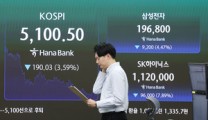
Nvidia generated $43.8 billion in free cash flow in the third quarter alone. That cash has underpinned AI investment, and that investment has in turn driven Nvidia's earnings. What US markets are waiting for is confidence that this virtuous cycle will continue. The market was already unsettled by concerns about AI overinvestment and the burden of financing. Huang's departure is not the sole cause of the recent stock market decline, but it has unquestionably added a new layer of uncertainty to the American AI industry.
Nvidia's board has refused to bring Huang back. At the same time, it now faces the test of demonstrating how well it can manage the succession of the founder who led the company for 33 years. A new CEO must prove that Nvidia can sustain its extraordinary profitability and cash generation without Huang. Failing that, the American AI industry will be left carrying a double burden: a contraction in investment and a slowdown in technology development.
If China set a trap, America walked into it. If China did nothing, the situation is even more alarming — because America discarded its most capable commander on its own. American AI supremacy rests not only on Nvidia's earnings but on the belief that those earnings can keep coming. The void left by Jensen Huang is a fatal crack in that belief.
kyhong@heraldcorp.com