63.6% of participants in Korea Forest Service pilot program showed improvements in interpersonal relations and emotional vitality
Forest therapy has been found to reduce social isolation and support emotional recovery among middle-aged men, according to new research from the Korea Forest Service.
The National Institute of Forest Science said Wednesday that a pilot forest therapy program conducted in partnership with a local mental health service produced positive changes in participants' social interaction and emotional vitality.
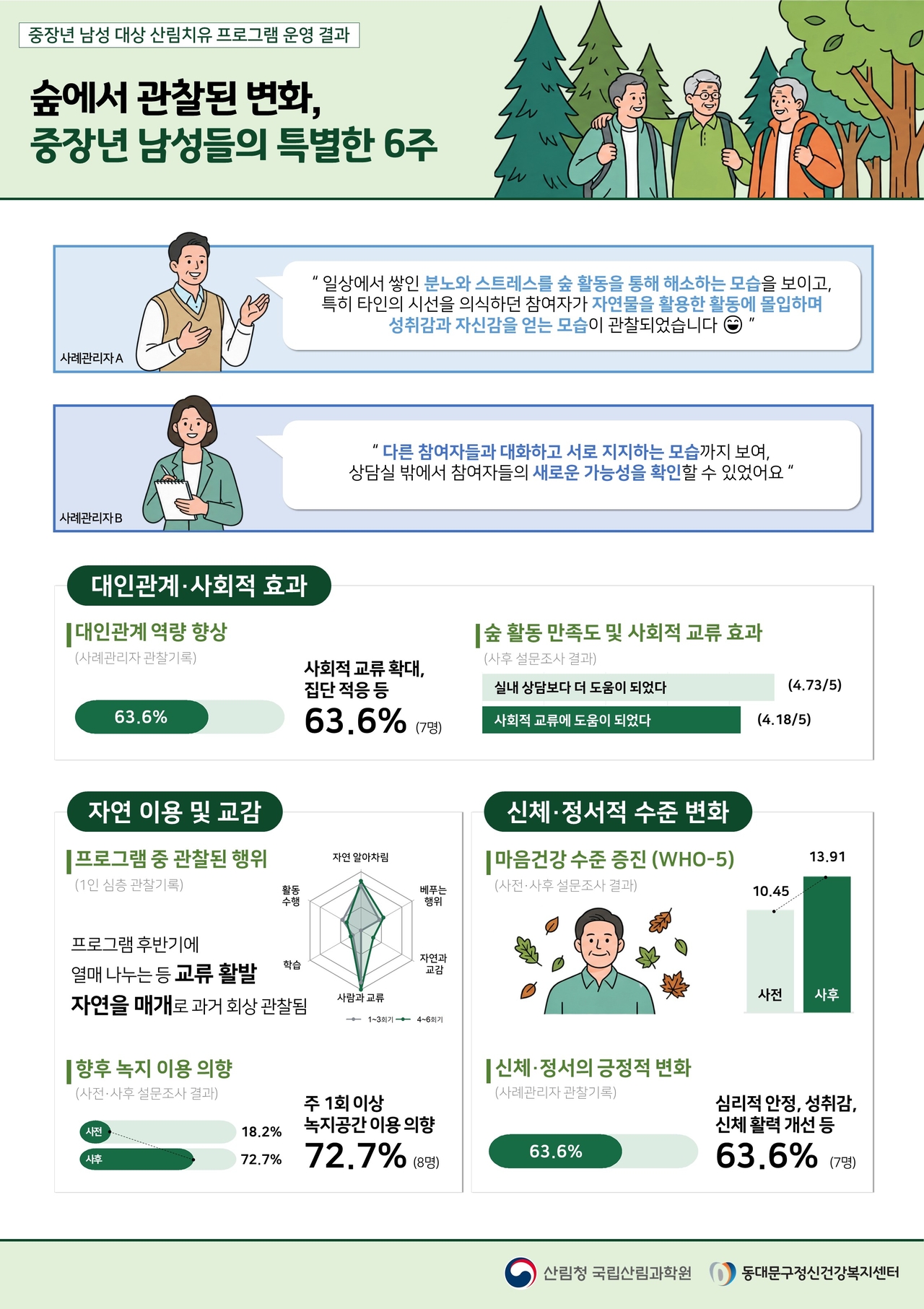
The institute ran the six-session pilot in collaboration with the Dongdaemun-gu Mental Health Welfare Center from Aug. 24 to Sept. 28 at Hongneung Experimental Forest, with 11 middle-aged men taking part in activities including forest-path walking, sensory experiences and nature-based creative projects.
Analysis of observation records kept by three case managers found that seven of the 11 participants — 63.6 percent — showed positive changes in interpersonal relations, including greater social interaction and improved group adaptation. The same seven participants also showed signs of psychological stability, a sense of achievement and increased physical vitality. Researchers noted that sharing and communication among participants grew noticeably more active as the program progressed.
A survey found that participants' mental well-being scores, measured on the WHO-5 scale, rose from an average of 10.5 before the program to 13.9 afterward. Participants rated forest activities as more helpful than conventional indoor counseling at an average of 4.7 out of 5, while the program's contribution to social interaction averaged 4.2 out of 5. Eight participants, or 72.7 percent, also said they intended to visit forests or other green spaces at least once a week going forward.
"Watching participants talk with and support one another during forest activities, we saw new possibilities for them to form and build relationships with others," said Jang Jun-ha, a clinical psychologist at the Dongdaemun-gu Mental Health Welfare Center.
The pilot was notable for going beyond simple surveys to analyze actual changes in participants' behavior and relationships. The findings suggest that forest therapy, when integrated with local mental health services, can be an effective tool for addressing social isolation among middle-aged men.
"Forests can be more than a place to rest — they can become spaces where people naturally connect and interact with one another," said Lee Yeon-hee, a researcher at the institute's Forest Human Services Research Division. "We will continue working with local health and welfare organizations to expand the foundation for forest welfare services that help alleviate social isolation and promote mental well-being."
kwonhl@heraldcorp.com