
Markets on alert ahead of Nvidia earnings, Anthropic IPO in 'AI big week'
S&P 500 falls 1.92%, Nasdaq drops 2.49%
Tech and financial stocks drag broader selloff
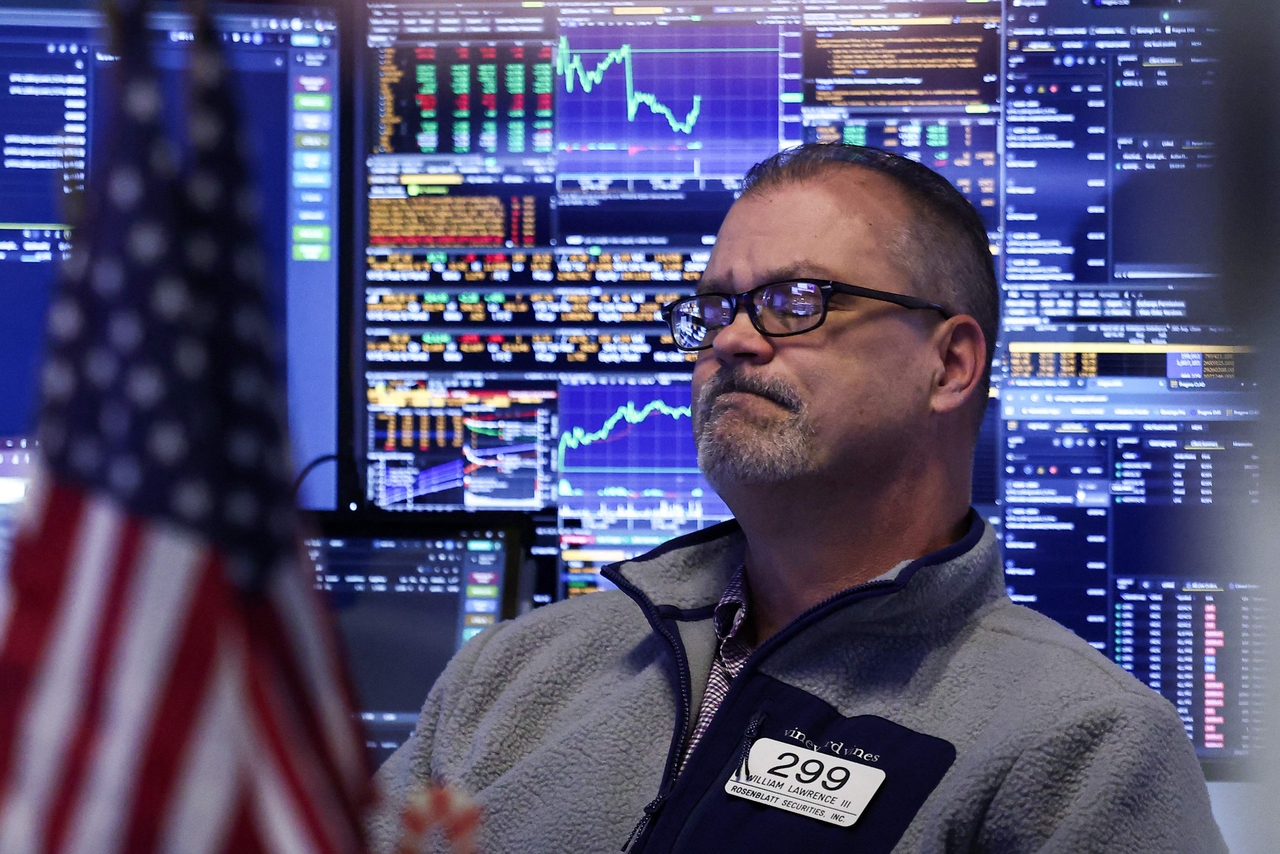
US stocks fell across the board Monday (local time) as markets continued to reel from Jensen Huang's resignation as Nvidia's CEO, while investor nerves frayed ahead of a string of major AI-sector events including Nvidia's earnings release and the Anthropic initial public offering.
The Dow Jones Industrial Average closed down 739.38 points, or 1.41 percent, at 51,608.17 on the New York Stock Exchange.
The S&P 500 shed 145.08 points, or 1.92 percent, to finish at 7,416.59, while the Nasdaq Composite tumbled 626.52 points, or 2.49 percent, to 24,509.76.
Both the S&P 500 and the Nasdaq posted their third consecutive session of losses, underscoring how heavily Nvidia-related news continues to weigh on the broader market.
Speculation surfaced Monday that Huang could return to Nvidia, but reports that the company's board was not considering a comeback — combined with US Treasury Secretary Scott Bessent's call for the company to recruit outside leadership — deepened uncertainty.
Adding to the pressure on technology stocks, the US Commerce Department announced new export controls designed to block Chinese companies from remotely accessing advanced American AI semiconductors through data centers in third countries.
Nvidia's share price fell 4.12 percent, pulling its market capitalization down to around $3.8 trillion. The stock has now dropped roughly 35 percent from its Oct. 6 peak, erasing more than $2 trillion in market cap.
"There's a lot to digest," said Mike Mussio, chief investment officer at FBB Capital Partners. "It seems like a lot of investors don't want to jump to conclusions too quickly."
The shock waves from Nvidia spread across the semiconductor and AI infrastructure sectors.
Micron and Intel tumbled 7.59 percent and 6.92 percent, respectively, while AMD fell 5.58 percent, SanDisk 8.65 percent, Dell Technologies 7.38 percent, Oracle 5.03 percent and SK hynix's American depositary receipts 7.29 percent.
The Philadelphia Semiconductor Index dropped 5.28 percent.
Financial stocks also struggled. JPMorgan Chase fell 2.31 percent after an internal technical issue delayed transaction processing for some customers. Bank of America, Wells Fargo, Morgan Stanley and Goldman Sachs also declined amid a surge in reported system outages and a broader risk-off mood.
Market-wide volatility surged. The CBOE Volatility Index, known as the VIX or 'fear gauge,' jumped 18.7 percent to 22.91, having soared as high as 24.05 during trading.
The US Dollar Index, which measures the greenback against a basket of six major currencies, rose 0.17 percent to 103.59 — its highest level in 19 months since April 2025.
In commodities, silver was the standout loser. Silver futures tumbled 4.38 percent to $46.88 per ounce, pressured by dollar strength and elevated interest rates, giving back all of the past year's gains.
Gold also edged down 0.82 percent to $3,854.60 per ounce.
Crude oil prices fell sharply on growing expectations that global supply could outpace demand. Brent crude for January delivery settled down 3.55 percent at $92.44 per barrel on the London ICE Futures Exchange.
West Texas Intermediate crude for December delivery closed down 3.21 percent at $85.72 per barrel on the New York Mercantile Exchange — its lowest level since Aug. 28.
The International Energy Agency said in its monthly report last week that global oil supply had exceeded demand for the first time since the outbreak of the Iran war, and projected a surplus of roughly 1.7 million to 2 million barrels per day in the fourth quarter.
Markets are treating Nvidia's third-quarter earnings, due after Tuesday's close, and Anthropic's IPO on Thursday as key tests of whether enthusiasm for AI remains intact.
Seo Sang-young, an analyst at Mirae Asset Securities, said the Korean stock market was likely to open lower, extending the previous session's decline amid the broad selloff in US semiconductor-related stocks and concerns over tightened export controls on chip sales to China. However, Seo noted that because the Korean market had already fallen sharply the previous day in response to those developments, the odds of a rebound buying wave were higher than they had been.
"In particular, we expect factors such as prior pricing-in, falling oil prices and lower interest rates to provide some support," Seo added. "However, risk aversion ahead of Nvidia's earnings will likely amplify intraday volatility. The Korean market is expected to open lower before bargain hunters step in to narrow the losses, though elevated volatility during the session will be unavoidable."

jiyun@heraldcorp.com




