Council to review 1.01 trillion won budget proposal for 2027; administrative audit and policy questions to cover full scope of district governance
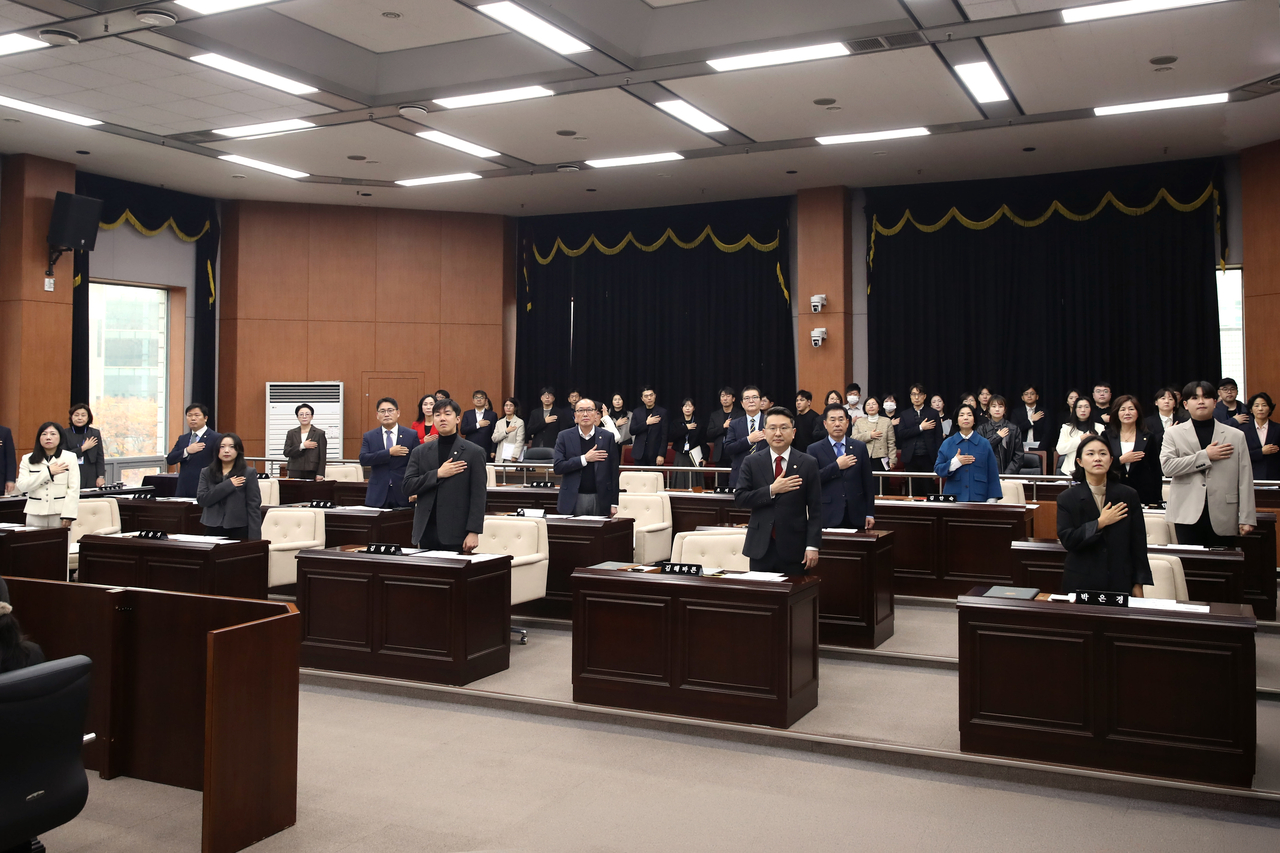
The Seocho-gu Council convened the first plenary session of its 354th regular session Monday, kicking off a 29-day legislative schedule that runs through Dec. 14.
The session marks a historic first for the district: the proposed base budget has exceeded 1 trillion won ($750 million) for the first time. The council will scrutinize the 2027 budget proposal alongside a 2026 administrative audit and policy questioning sessions covering the full range of district affairs.
The 2027 budget submitted by the executive branch totals 1.01 trillion won, a 7.5 percent increase — or 70.7 billion won — from the previous year's base budget of 941.7 billion won. The general account stands at approximately 974.7 billion won and the special account at approximately 37.7 billion won. While the final budget including supplementary appropriations has previously topped 1 trillion won, this is the first time the base budget itself has crossed that threshold.
With the expanded budget comes greater scrutiny, the council said, pledging to examine each item closely for necessity, urgency, whether it is a one-off or showcase project, cost-effectiveness and long-term fiscal impact. The council said it will particularly focus its review on livelihood spending directly tied to residents' daily lives, including support for small business owners, youth development and public safety.
Council Speaker Yu Ji-ung said in his opening remarks that a larger budget does not automatically make a better one. "A good budget is one that is spent where residents truly need it and delivers real benefits to their lives," Yu said. "We will carefully examine whether it provides genuine help to small business owners, whether it gives young people a foundation to pursue their dreams and grow, and whether it keeps residents safe in their daily lives — and we will return that effort to residents as tangible results."
Yu also stressed cooperation between the council and the executive branch ahead of the first administrative audit since the 10th council took office. Drawing an analogy to the soccer concept of "tiki-taka," Yu said the audit is "not a process to find fault with the executive branch, but a process to examine administration from the residents' perspective and find solutions." He urged both sides to "keep in step toward the shared goal of serving residents, each fulfilling their own roles and responsibilities."
The administrative audit will be conducted by standing committees from Tuesday through Sunday. On Friday, audit teams will visit the 18 neighborhood community centers across the district for on-site inspections. The second plenary session on Nov. 26 will take up policy questions, and the executive branch will deliver consolidated responses at the third plenary session on Dec. 3.
The 2027 budget proposal will go through standing committee and budget review committee deliberations beginning Nov. 27 before a final vote at the fourth plenary session on Dec. 14.
Monday's plenary session also featured five-minute free-speech addresses by lawmakers An Jong-suk and Park Seong-jun.
An proposed introducing a "Seocho-style school security manager" program to help open school playgrounds to the public on weekends. The proposal calls on the district office to hire and manage dedicated staff, provide liability insurance, link the positions to mid-career and senior employment programs, and split operating costs 50-50 with the education office through a pilot project.
Park proposed incorporating a "shade zone" concept into urban planning to address heat waves in an era of climate crisis — moving beyond individual shade structures to connect natural and artificial shade along pedestrian routes from home to destination. Park said the district should establish "Seocho-style shade standards" from the urban planning stage, covering street trees, awnings and public open spaces in reconstruction and road improvement projects.
Both lawmakers said they would take the lead in drafting related ordinances to strengthen the effectiveness of their proposed projects.
The plenary session also approved the formation of a budget review special committee, a request for the district mayor and relevant civil servants to appear before the council, consent motions for contributions to the Seocho Culture Foundation and the Korea Institute of Local Finance, and a public property management plan.
seouldream01@heraldcorp.com