Real wages rise 0.3% in first half; 53.2% of workers in sectors where real wages fell
Semiconductor productivity up 8.5% annually in 2021–2025; non-semiconductor down 0.4%
KDI calls for sector-by-sector restructuring and retraining support for workers

Average real wages for workers in South Korea rose just 0.2 percent over the four years from 2021 to 2025, according to a new report by the Korea Development Institute. Although economic growth rebounded in the first half of this year, real wages grew only 0.3 percent from a year earlier, and more than half of all workers were employed in sectors where average real wages declined. KDI identified weak productivity outside the semiconductor industry as a key factor behind the stagnation.
Bonuses inflate the average — regular real wages actually fell 0.3%
In a report released Monday, titled "Background and Implications of Real Wage Stagnation: An Analysis of Corporate Productivity," KDI found that per-worker real wage growth stayed below 1 percent in the first half of this year, following gains of 0.5 percent in 2024 and 0.9 percent last year. Nominal wages in the first half of this year rose sharply in a handful of high-paying sectors — most notably electronic components manufacturing, which includes semiconductors, up 21.6 percent, and finance and insurance-related services, up 12.3 percent — driven largely by special bonuses.
During the same period, workers employed in sectors where average real wages fell accounted for 53.2 percent of all workers and 44.4 percent of full-time employees. Regular fixed wages — the base pay workers receive on a recurring basis — shrank 0.3 percent in real terms after adjusting for inflation.
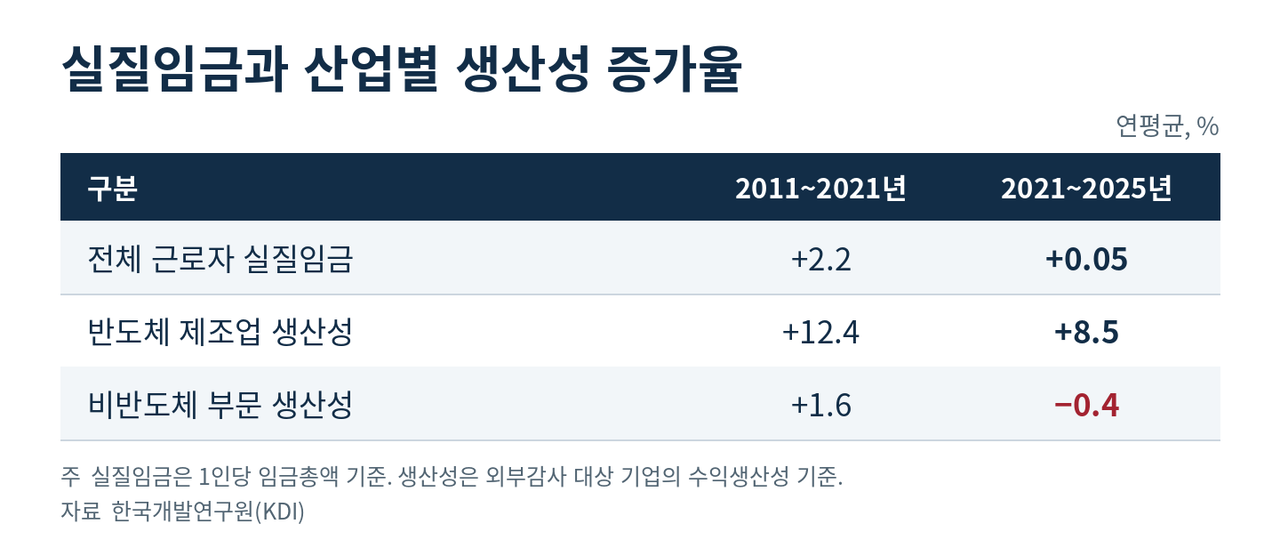
The stagnation has persisted since 2021. Real wages for all workers rose 24.0 percent, or an annual average of 2.2 percent, between 2011 and 2021, but climbed only 0.2 percent in total — an annual average of 0.05 percent — between 2021 and 2025. Growth in real hourly wages, which accounts for changes in working hours, also slowed from an annual average of 3.1 percent to 1.2 percent over the same comparison periods. KDI attributed the drag primarily to rising inflation in 2021–2022 and, from 2022 onward, to a slowdown in nominal fixed-wage growth.
Productivity retreats outside semiconductors as share of marginal firms doubles
An analysis of financial statements from externally audited companies showed that revenue productivity in semiconductor manufacturing rose an annual average of 8.5 percent between 2021 and 2025, while the non-semiconductor sector contracted 0.4 percent. Revenue productivity measures how much value added a company generates from its labor and capital inputs, and reflects both technological capability and market conditions such as product prices and demand.
When non-semiconductor companies were divided each year into three groups by productivity level, the top third saw their productivity index rise just 0.8 percent over the 2021–2025 period. The middle and bottom thirds fell 2.5 percent and 9.7 percent, respectively.
The productivity gap fed through to wages. Across 44 industries analyzed by KDI, sectors with a 10-percentage-point higher cumulative productivity growth rate between 2021 and 2025 also posted cumulative real fixed-wage growth for full-time workers that was 0.9 percentage points higher on average. About one-third of the roughly 9-percentage-point gap in real fixed-wage growth between electronic components manufacturing — which includes semiconductors — and other industries was explained by differences in productivity growth.
The share of marginal firms — those unable to cover interest expenses with operating profit for three consecutive years — in non-semiconductor sector value added rose from 3.2 percent in 2021 to 6.2 percent last year. In the bottom third of industries by productivity growth, the share of marginal firms rose an average of 7.0 percentage points, of which KDI estimated 6.6 percentage points were attributable to productivity factors.
KDI said that for real wage growth to spread across the broader economy, South Korea must support the upgrading of existing key industries toward higher value-added activities and facilitate the entry and growth of new industries. The institute recommended that sectors facing specific headwinds — such as petrochemicals grappling with a supply glut from China, and construction squeezed by weakening demand and rising costs — pursue restructuring tailored to their circumstances, while workers receive retraining and job-transition support to move into growing industries.
fact0514@heraldcorp.com