Return rate hits all-time high of 54.4% in Q3
More cash flowed back than out in July and August
Rate hike cycle drives people to deposit idle cash
Same pattern seen in late 2022 tightening cycle
Final rate decision of the year set for Nov. 26
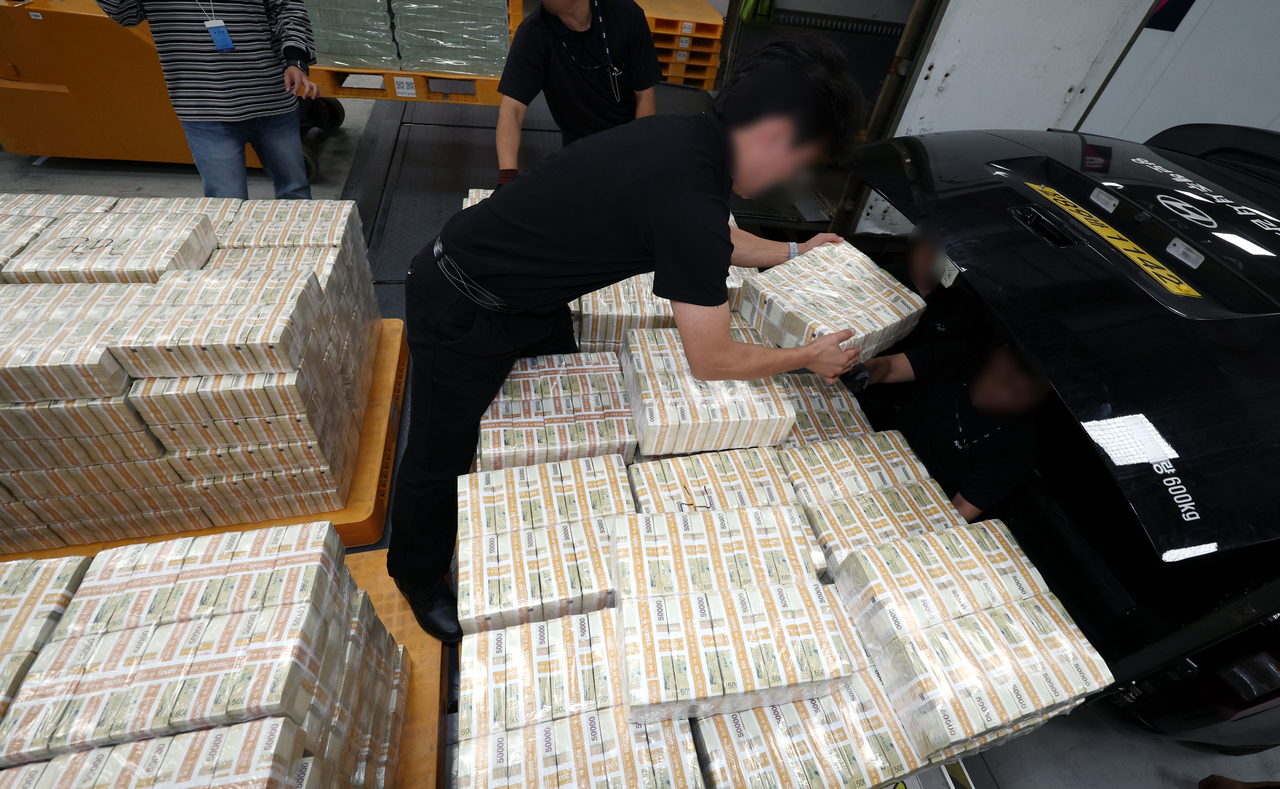
The share of 50,000-won ($38) notes returned to the Bank of Korea in the third quarter of this year hit an all-time high for any third quarter on record. Analysts attribute the trend to a growing number of people depositing cash they had kept at home after the central bank shifted to a rate-hiking stance for the first time in three and a half years and raised rates in consecutive months.
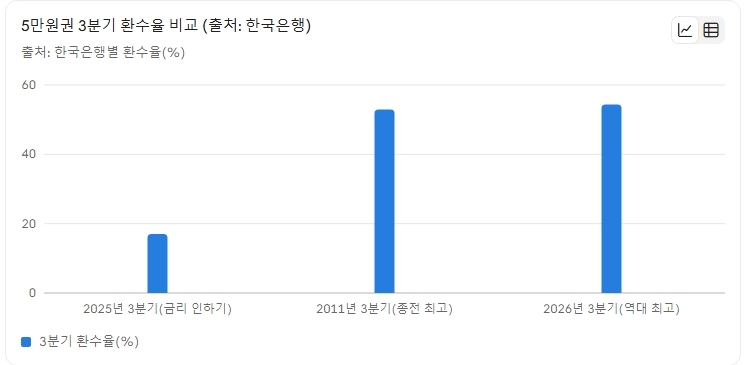
According to the Bank of Korea, the total value of 50,000-won notes issued in the third quarter reached 7.18 trillion won, while 3.91 trillion won worth of notes were returned. The return rate — calculated by dividing the amount returned by the amount issued — came to 54.4 percent. In simple terms, for every two 50,000-won notes the Bank of Korea put into circulation during the quarter, one came back.
The return rate surpassed the previous record of 52.9 percent set in the third quarter of 2011, marking a new all-time high after 15 years. It was more than three times the 17 percent recorded in the third quarter of last year, when the central bank was in a rate-cutting cycle.
Net issuance — the difference between notes issued and notes returned — shrank to 3.27 trillion won in the third quarter, just 40 percent of the 8.25 trillion won recorded in the same period last year. On a third-quarter basis, it was the lowest since 2013, when net issuance stood at 2.58 trillion won.
The shift is even more pronounced on a monthly basis. The return rate exceeded 100 percent for three consecutive months — June (135.2 percent), July (146.2 percent) and August (100.9 percent).
That is unusual, given that months with return rates above 100 percent have historically been concentrated in February, March and October, when cash distributed for the Lunar New Year and Chuseok holidays flows back to the central bank. Of the 37 months on record when the return rate topped 100 percent, 31 — or 83.8 percent — fell in February, March or October. July and August have never before seen returns outpace issuance.
Also striking is that this year marks only the second time on record that the return rate has exceeded 100 percent for three consecutive months, the first being October through December 2022. That period coincided with the Bank of Korea's aggressive post-COVID rate hikes: the central bank raised rates seven times in a row from April 2022 to January 2023, including two "big step" increases of 0.5 percentage points each in July and October of that year.
This year has followed a similar pattern. The Bank of Korea formally signaled a shift to a rate-hiking stance in its May monetary policy statement and raised the benchmark interest rate in two consecutive months, July and August. The August move in particular was widely described as a surprise, with Governor Shin Hyun-song himself calling it "a departure from convention."
The common thread between this year and 2022 — both periods of unusually high return rates — is that both were rate-hiking cycles.
"Recent net currency issuance appears to be heavily influenced by interest rates," a Bank of Korea official said. "Last year the return rate was low, but this year, as rates have risen, we are seeing significantly more cash come back compared to last year."
The reason return rates rise during rate-hiking cycles is straightforward: cash earns no interest. If someone keeps 100 million won in 50,000-won notes at home when the deposit rate is 1 percent annually, they forgo 1 million won in interest over a year — but if the rate rises to 3 percent, that foregone amount grows to 3 million won. As the opportunity cost of holding cash rises, more people deposit their money at banks, which in turn remit surplus cash to the Bank of Korea, boosting the return figure.
Looking at the cumulative figures for January through September, the return rate stood at 51.9 percent, up 19.1 percentage points from 32.8 percent in the same period last year. While the total value of notes issued fell 12.5 percent — from 23.02 trillion won to 20.15 trillion won — the value of notes returned surged 38.6 percent, from 7.55 trillion won to 10.46 trillion won.
The annual return rate trend also shows interest rates and return rates moving in the same direction. The return rate fell to 24.2 percent in 2020 and 17.4 percent in 2021 during the COVID-19 period, then climbed to 67.1 percent in 2023 as the Bank of Korea tightened policy. It has since eased back, falling to 47.7 percent in 2024 and 38.2 percent last year as rates came down again.
With the Bank of Korea's rate-hiking stance expected to persist, the return rate is forecast to remain elevated. The central bank believes that income growth driven by semiconductor exports will begin to exert upward pressure on demand-side inflation from next year. At a press briefing last month, Governor Shin said he expected consumer prices to "approach the target level the year after next," suggesting the tightening cycle could continue at least through next year.
The Bank of Korea will set the benchmark interest rate at its final monetary policy meeting of the year on Nov. 26. Markets expect the rate to be raised to 3.25 percent.
kimstar@heraldcorp.com