Seoul Metropolitan Government holds first creative presentation contest of the ninth elected term
Employees' ideas seek solutions to raise quality of life across the city
Eight proposals presented on 24-hour economy and AI-driven administrative innovation
Panel of 100 experts, citizens and staff voted on site
Top prize goes to Seoul Arisu Headquarters for AI water-rescue service 'Pungdeong'
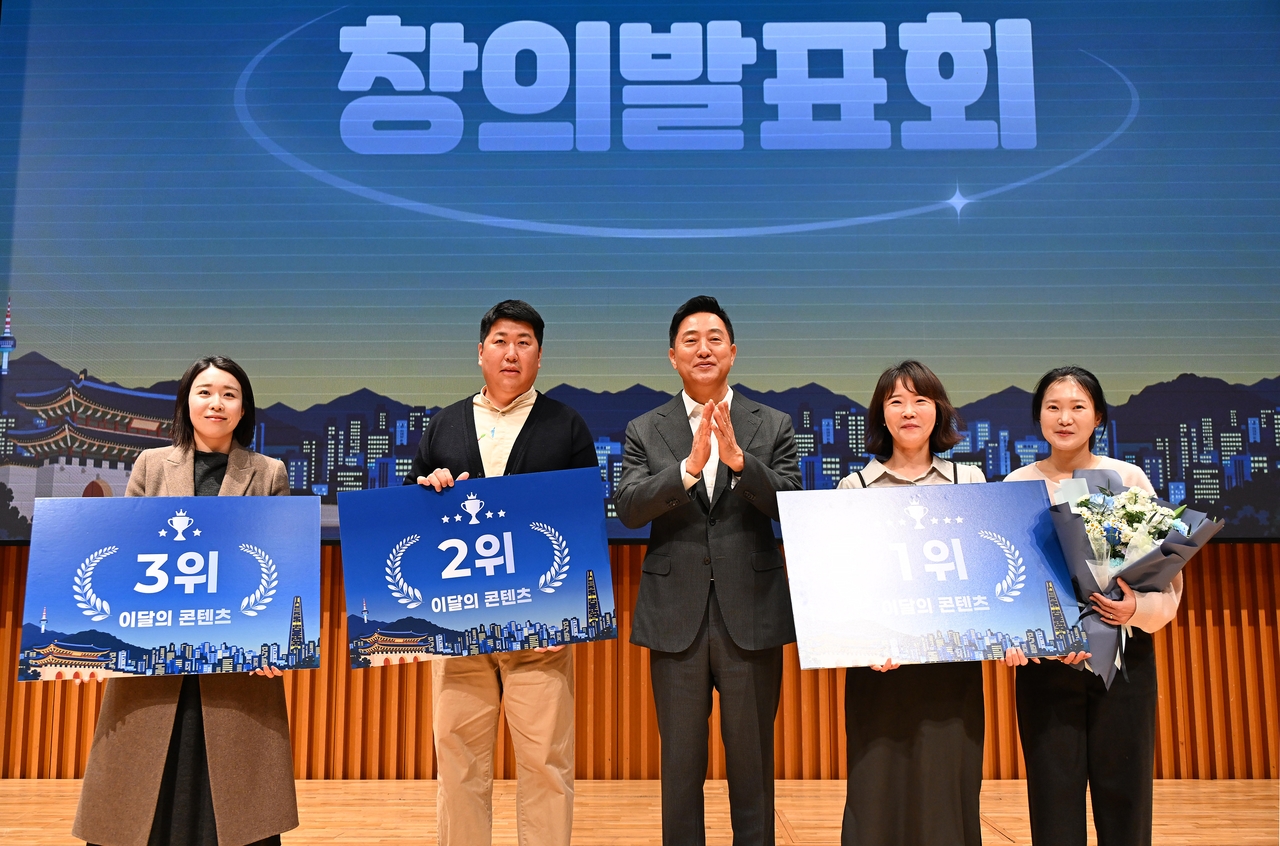
The Seoul Metropolitan Government held the first creative presentation contest of the ninth elected term Monday morning at the multipurpose hall of Seoul City Hall, showcasing employee-generated ideas that citizens helped evaluate for potential adoption as city policy.
Of 699 employee submissions, eight were selected for presentation. The top prize went to the Seoul Arisu Headquarters for its AI water-rescue service concept called "Pungdeong" — Korean for "splash."
Since formally introducing "creative administration" in 2023, the city has worked to translate frontline employee experience and fresh thinking into improvements in public services. This year's contest centered on two themes: a 24-hour vitality economy and AI and big data-driven administrative innovation — both aimed at raising the quality of life for Seoul residents.
The two themes reflect priorities the city is actively pursuing: making Seoul a round-the-clock economic hub through nighttime economy activation, and building a data-driven city through AI and big data. Four proposals addressed each theme.
In the nighttime economy category, the four proposals were: using 24-hour convenience stores as nighttime tourism hubs that provide travel information and safe-return assistance for foreign visitors; creating a workcation village in the hanok neighborhood of Eunpyeong-gu where people can blend work and leisure in an urban setting; linking Nodeul Island's global arts hub and Han River ferry service to alleyway commercial districts to energize waterfront nightlife; and replacing costly, frequently malfunctioning crosswalk floor signal lights with signal-synchronized logo projectors as a more reliable alternative.
In the AI and big data category, the four proposals were: the "Pungdeong" AI water-rescue service, in which AI detects the sound of a person falling into the Han River and immediately dispatches an AI-equipped drone to the scene; an AI-powered leak detection system that uses accumulated big data on pipe-leak sounds to precisely locate underground water main leaks; a data analysis system that cross-references tax delinquency records with social welfare and national health insurance data to identify households in welfare crisis; and "Welfare Link Seoul," an AI platform that integrates public welfare, private donations, volunteer services and care resources, then recommends the most suitable support options for each recipient.
The city accepted submissions from May through August this year, drawing 699 proposals from employees across the Seoul Metropolitan Government, autonomous districts and affiliated public institutions. Eight finalists were chosen through internal review and expert screening.
An on-site panel of about 100 people — comprising influencers, AI company executives, professors and other experts alongside city employees and citizens — voted to award the top prize to the Seoul Arisu Headquarters' "Pungdeong" AI water-rescue service. The excellence award went to the Future Space Planning Division for its proposal to link Nodeul Island to alleyway commercial districts as part of Seoul's nighttime economy.
The city plans to move quickly to implement any of the presented proposals that can be applied to policy, so that residents can feel a tangible difference in their daily lives.
Since introducing creative administration in 2023, the city has held 16 creative presentation contests in total, collecting 8,700 ideas and selecting 156 outstanding proposals that have fed into public services residents can experience firsthand.
Landmark outcomes from the initiative include a subway re-entry transfer benefit allowing free re-boarding within 15 minutes, and the Ongi Warehouse — a community support facility for residents of low-income lodging houses that expanded to four locations as of last year. The heated bus-stop bench, which Seoul introduced in 2009 as the first local government in the country to do so as a transit welfare service, is also cited as a representative example of creative administration.
"It was truly encouraging to see employees thinking hard about how to use AI in their work, trying new approaches and refining their ideas," Seoul Mayor Oh Se-hoon said. "I hope we can all work together to make good use of today's ideas so that their warmth reaches all the way to our neighborhood commercial districts."
ikson@heraldcorp.com