Speech recognition, translation and synthesis combined in one system, debuting at a May 18 history tour broadcast

AI technology that listens to a Korean-language live broadcast and instantly renders it in natural-sounding Vietnamese is being deployed in an actual broadcast for the first time.
The Gwangju Institute of Science and Technology (GIST) announced Friday that AunionAI, a startup founded by Kim Hong-kuk, a professor of electrical engineering and computer science at the institute, will apply its real-time AI dubbing and multilingual translation technology to a live program on Global Gwangju Network (GGN) on Saturday.
The deployment is part of Gwangju Technopark's 2026 startup product demonstration support project, with the core objective of validating an AI-based multilingual broadcast system in a real live-broadcast environment.
The program, titled "Boy's Road: K-Democracy Humanities Radio Tour," is a participatory broadcast and cultural event in which residents, migrants and international students walk together through historic sites in Gwangju that form the backdrop of Human Acts, the novel by Nobel laureate Han Kang.
Participants set off from Chonnam National University and make their way through Gwangju Station and the former intercity bus terminal to May 18 Democracy Square, sharing the history of the May 18 Democratization Movement and reflecting on the meaning of democracy, human rights and peace.
The live broadcast runs from 3 p.m. to 5 p.m. Saturday, conducted in Korean and English, with AI-powered real-time dubbing into Vietnamese. It will be streamed on GGN's official YouTube channel.
The broadcast marks the first deployment of AunionAI's AI dubbing solution, AunionAI-DUB Plus.
The technology is an automated dubbing solution that uses AI to recognize broadcast speech in real time, translate it into another language and convert it into synthesized voice output. It can deliver foreign-language dubbed broadcasts without requiring any changes to existing broadcast transmission infrastructure.
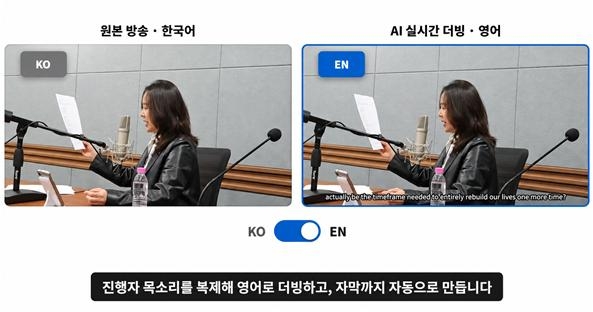
A real-time AI interpretation and translation platform called eduRST will also be used alongside the dubbing system. Participants can access real-time translated subtitles in their preferred language through a web browser via QR code, with no app installation required. A text-to-speech function also allows users to listen to the translated content as audio.
The demonstration is drawing particular attention because it applies AI dubbing and translation technology to a live broadcast rather than pre-recorded footage, making it an opportunity to verify that real-time speech recognition, translation and voice synthesis can operate reliably in an actual broadcast setting.
AunionAI plans to use the results of this demonstration as a springboard to expand its AI multilingual communication technology beyond broadcasting into education, international conferences and cultural events.
"This event is significant in that it applies real-time AI dubbing and translation technology to an actual live broadcast environment," Kim said. "We will continue to advance our technology so that people from diverse countries and cultural backgrounds can communicate more freely by lowering language barriers through AI."
AunionAI is a GIST faculty startup established in 2023, built on more than 30 years of speech and audio AI research accumulated by Kim. The company is developing an AI dubbing solution, a real-time interpretation and translation platform, and a personalized voice service called dajeongVOX.
nbgkoo@heraldcorp.com