October exports surge 93.7%; semiconductors lead gains
Equipment investment expands, business sentiment improves
Youth employment remains weak amid high-oil-price inflation pressure
The government said South Korea's economy is maintaining solid growth momentum, driven by strong exports and rising investment, upgrading its assessment from last month's characterization of a "recovery trend" to "robust growth." It also revised its investment outlook in a more positive direction.
On the external front, the government for the first time cited AI industry policy direction as a new source of uncertainty in the global economy.
South Korea's Ministry of Economy and Finance said in its November Greenbook — a monthly economic assessment released Friday — that "the Korean economy has recently shown robust growth, with exports rising sharply and investment momentum expanding, while consumption is improving gradually."
The ministry replaced the phrase "recovery trend," which it had used since the May edition, with "robust growth," signaling greater confidence in the economic outlook. Compared with the previous month, its assessment of investment was also upgraded from "solid growth" to "expanding growth momentum," while the characterization of consumption as "gradually improving" was kept unchanged.
The upward revision was partly driven by third-quarter GDP growth that exceeded expectations. The Bank of Korea's advance estimate put real GDP growth at 1.0 percent quarter-on-quarter in the third quarter, more than three times the initial forecast of 0.3 percent.
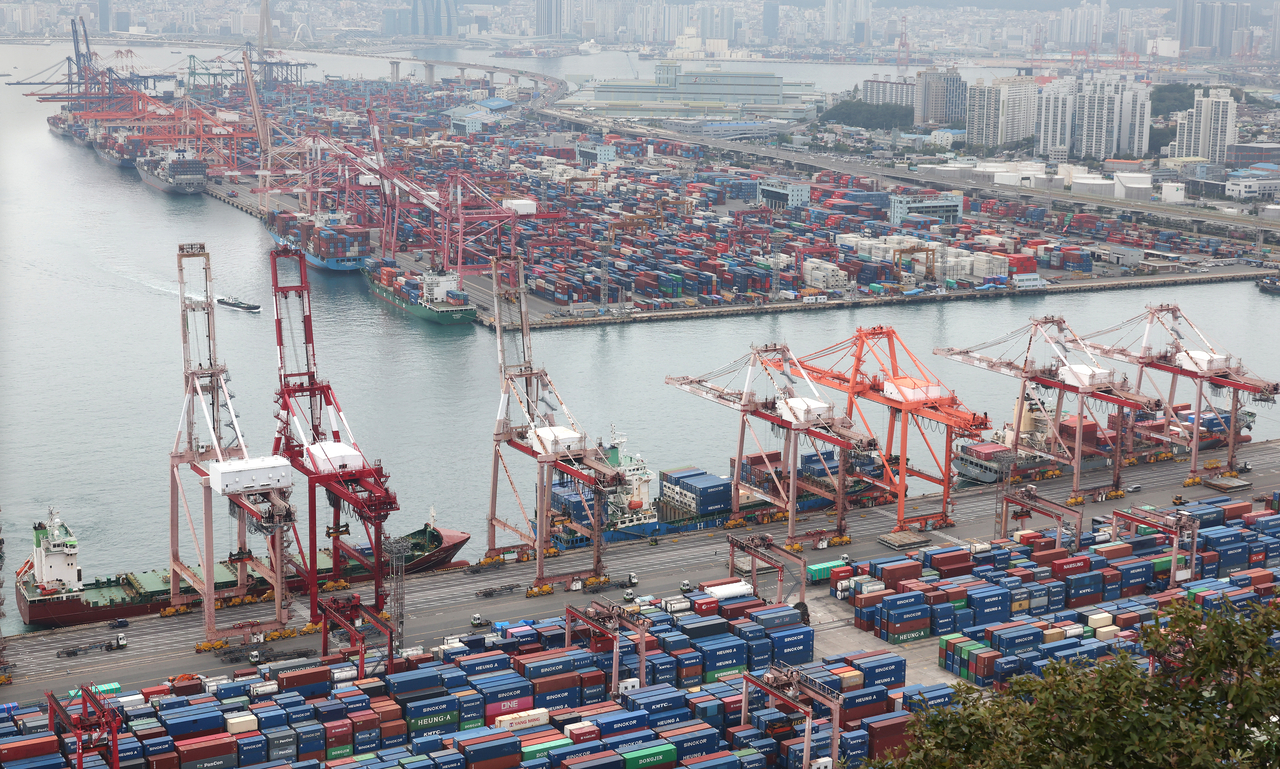
Exports, the main engine of growth, continued to expand sharply. October exports on a customs-clearance basis rose 93.7 percent from a year earlier, with average daily export value climbing 76.1 percent to $5.24 billion. By product, computers surged 497 percent and semiconductors jumped 259 percent, while cosmetics posted a 58 percent gain.
Equipment investment in the third quarter rose 4.1 percent from the previous quarter and 9.4 percent from a year earlier. The equipment investment index for September also climbed 5.3 percent from the prior month, rebounding from a decline in August, led by gains of 4.7 percent in machinery and 7.4 percent in transport equipment.
Consumption indicators were mixed. Private consumption in the third quarter fell 0.2 percent from the previous quarter but rose 1.1 percent from a year earlier. Retail sales in September increased 3.6 percent month-on-month but edged down 0.4 percent from a year ago.
The consumer sentiment index fell 1.2 points from the previous month to 105.4 in October. Domestic credit card spending growth widened to 5.9 percent from 2.3 percent the month before, though department store card spending declined 3.1 percent.
Total industrial output in September rose 3.0 percent from the prior month, with manufacturing up 9.0 percent and services and construction output gaining 0.5 percent and 5.8 percent, respectively. Business sentiment also improved: the composite business sentiment index for all industries came in at 104.2 in October, up 5.1 points from the previous month, while the November outlook reading rose 2.2 points to 101.8.
The government said living conditions remain difficult in terms of prices and employment. The ministry noted "ongoing uncertainty from the war in the Middle East, upward price pressure from high oil prices, and difficult employment conditions for vulnerable groups and sectors."
Consumer prices rose 2.8 percent year-on-year in October, a slight slowdown from 2.9 percent in September. Core inflation, excluding food and energy, held steady at 2.8 percent. Agricultural, livestock and fishery prices fell 1.7 percent, while petroleum product prices surged 14.9 percent. The living cost price index rose to 2.6 percent in October from 2.5 percent in September.
The number of employed people increased by 139,000 year-on-year in October, a wider gain than the 113,000 added the previous month. However, while the number of full-time workers rose by 287,000, temporary and daily workers fell by 107,000 and 53,000, respectively. Youth employment — covering those aged 15 to 29 — dropped by 196,000.
The government's assessment of the global economy also shifted. The ministry said the global economy "continues to grow at a moderate pace, but uncertainty persists, including the trajectory of the war in the Middle East and policy directions related to the AI industry." The reference to AI industry policy is new; last month, the ministry had cited US tariff measures as a key source of uncertainty.
A ministry official said that since the US midterm elections, regulatory risks surrounding the American semiconductor industry have come sharply into focus, widening volatility in US equity markets — including the Philadelphia Semiconductor Index — and in turn increasing volatility in Korean markets as well.
The ministry said, however, that the impact has not yet spread to the real economy. The official said there are no signs of cutbacks in US data center investment or investment plans, adding that "at present, the concern is confined to financial market participants and has not reached the real economy."
The ministry said it will work to broaden the growth base through three mega-projects, seven SEED initiatives, the Korean Green Transformation program and efforts to develop the services industry, while also stepping up policy efforts to stabilize living conditions and ease polarization.
y2k@heraldcorp.com