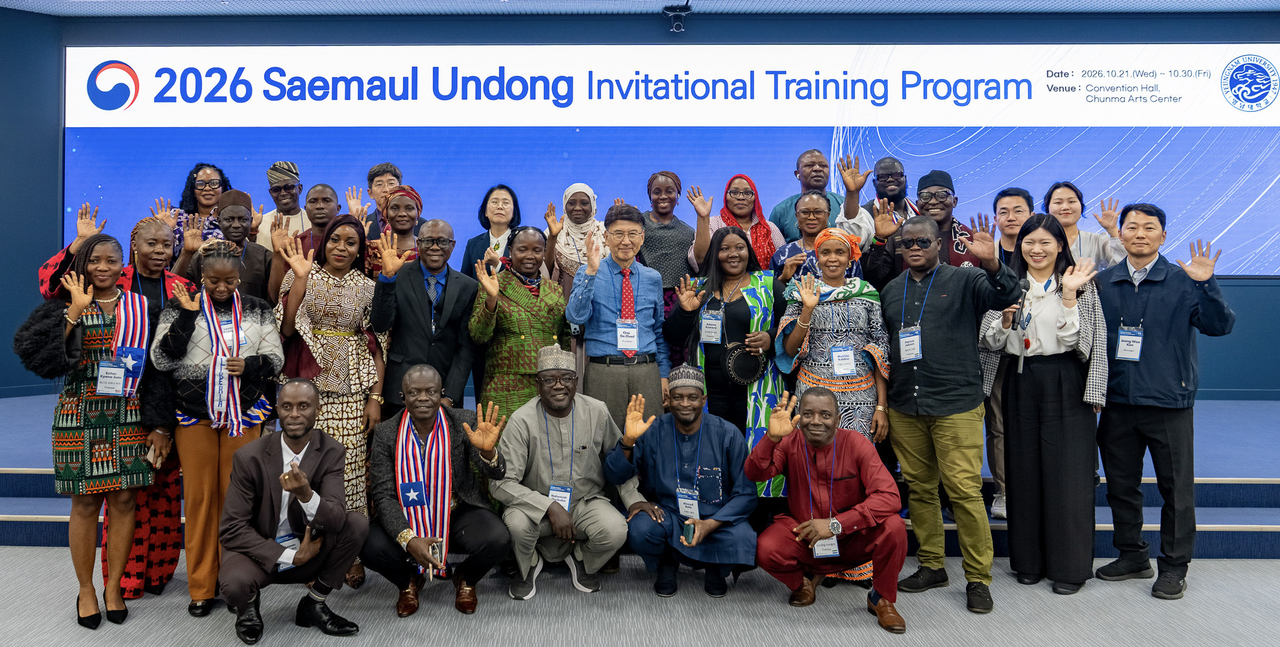
Senior civil servants from three African countries gathered at Yeungnam University to explore national development and rural revitalization strategies grounded in the Saemaul Movement and saemaul studies.
Yeungnam University's Institute for International Development Cooperation ran the "2026 Ministry of Interior and Safety Africa (English-speaking) Saemaul Movement Invitation Training" program from Oct. 21 to Oct. 30, bringing together 27 senior government officials from Liberia, Nigeria and Sierra Leone.
The program was designed to share South Korea's economic and social development experience and to strengthen participants' policy-making and practical skills in rural development and farm-income growth.
Trainees studied the principles of the Saemaul Movement and South Korea's economic development experience, along with rural finance, agricultural policy governance and public leadership.
Yeungnam University President Choi Oe-chul delivered a special lecture on the principles and strategies of the Saemaul Movement, presenting it as a development model for overcoming poverty and building self-reliance in developing countries.
The program also included field visits. The group toured the Saemaul Movement Origin Memorial Park and the Cheongdo Agricultural Technology Center in Cheongdo, local farms, and the Uiseong Dain Agricultural Cooperative's rice processing complex, observing firsthand how agricultural technology is disseminated and how crops are produced, processed and distributed.
Participants also drew up country-specific action plans tailored to their own agricultural environments and administrative systems, mapping out concrete ways to apply South Korea's development experience to local policy.
Lee Sang-ho, director of Yeungnam University's Institute for International Development Cooperation, said the program linked lectures, field learning and action-plan development so that what participants learned could translate into higher farm incomes and stronger communities back home.
President Choi said helping each country find a development strategy suited to its own conditions, drawing on saemaul studies, is a defining strength of Yeungnam University's training programs. "I hope this training helps cultivate leaders who can drive change in their countries and contributes to overcoming poverty and improving residents' quality of life," Choi said.
Yeungnam University's Institute for International Development Cooperation has to date run saemaul development training programs for 3,586 civil servants and community leaders from 57 countries as part of its international development cooperation work.
kbj7653@heraldcorp.com