
Four consecutive limit-up sessions outpace common shares by wide margin
Thin float amplifies short-term demand imbalance
Analysts warn funds may rotate back to common shares as proxy fight nears
Amid a rekindled battle for control of Hanjin KAL, the company's non-voting preferred shares have surged far beyond the gains of its common stock. Analysts attribute the rally to a thin float that has amplified volatility, combined with investor expectations that the preferred shares could be included in a tender offer or have their voting rights restored. However, market watchers caution against chasing the rally, noting that preferred shares fell sharply when a shareholder vote drew near during a previous dispute.
According to Korea Exchange, Hanjin KAL preferred shares — which had been suspended Tuesday after being placed under an investment warning — hit the daily upper limit as soon as trading resumed Wednesday.
News that Hoban Group had overtaken the stake held by Hanjin Group Chairman Cho Won-tae's side to become the largest shareholder drove the buying. Investors piled in as a fresh battle for shares erupted, following earlier disputes — a 2020 fight with a three-way shareholder alliance comprising KCGI, Bando Construction and Cho Hyun-ah, and last year's stake competition with Hoban.
Hanjin KAL preferred shares, which stood at 26,300 won ($20) on Oct. 30, hit four consecutive daily upper limits starting Thursday, soaring 417.5% to 136,100 won. The gain far outpaced the rise in Hanjin KAL's common shares.
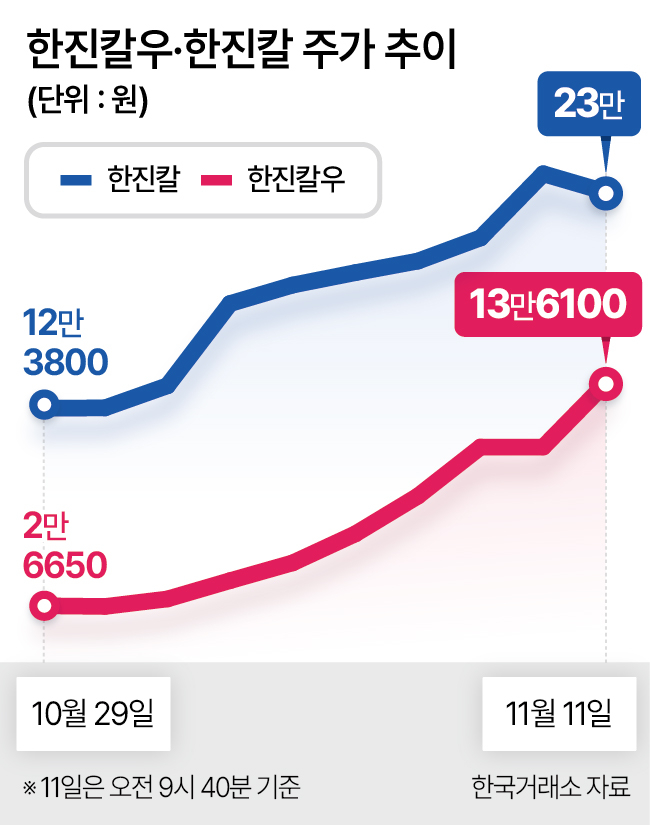
Hanjin KAL's common shares surged 92.9% from 123,900 won on Oct. 30 to 239,000 won on Tuesday, but were down more than 3 percent as of 9:40 a.m. Wednesday.
Industry observers point to the preferred shares' thin float as the main driver of the surge. As of the end of last year, only 536,766 preferred shares had been issued — roughly 0.8 percent of total shares outstanding.
Daily trading value in the preferred shares reached 14.8 billion won on Monday, equivalent to about 27 percent of the stock's total market capitalization of 55.5 billion won. The figure signals an overheated short-term supply-demand imbalance, with more than a quarter of the entire market cap changing hands in a single day.
Securities analysts broadly expect the frenzy to cool as the shareholder meeting approaches. During the 2020 Hanjin KAL control dispute, preferred shares climbed steeply ahead of the proxy fight but fell once the general meeting was imminent.
According to Hanwha Investment & Securities, Hanjin KAL preferred shares rose 129.8% in the five trading sessions after KCGI first disclosed its stake on Nov. 15, 2018, dwarfing the 18.4% gain in common shares. Just after the three-way shareholder alliance disclosed its joint-holding agreement on Feb. 3, 2020, the ratio of the preferred share price to the common share price soared to 194.3% — meaning the preferred shares were trading at nearly twice the value of the common shares.
As the shareholder meeting on March 27, 2020 drew closer, however, market funds quickly rotated into common shares, which carry actual voting rights. Between Feb. 3 and March 4 of that year, Hanjin KAL common shares more than doubled — rising 109.7% from 40,400 won to 84,700 won — while the preferred shares fell 23.8%.
By June, after the shareholder meeting had concluded, the preferred-to-common share price ratio had dropped to 50.5%, returning to pre-dispute levels. The tender offer conducted by KCGI in July of that year did not include preferred shares.
"If the 2020 pattern — where funds shifted to common shares as the proxy fight neared — repeats itself, Hanjin KAL preferred shares are likely to peak and reverse within two to three weeks of being placed under the investment warning," said Park Se-yeon, an analyst at Hanwha Investment & Securities. "For a control premium to attach to the preferred shares, there would need to be a tender offer that includes them, or their voting rights would have to be revived so they could be used in the proxy contest."
Meanwhile, buying interest has spread to other Hanjin Group affiliates and aviation stocks more broadly in the wake of the Hanjin KAL control dispute. Korean Air preferred shares hit the daily upper limit for two consecutive sessions starting Monday, and Jin Air also closed at the upper limit Tuesday. On the same day, Korean Air (up 11.5%), Asiana Airlines (up 11.6%) and Air Busan (up 17.2%) all posted double-digit gains.

jiyun@heraldcorp.com




