SK Group chairman proposes 3-, 5- and 10-year action plan at Seoul conference
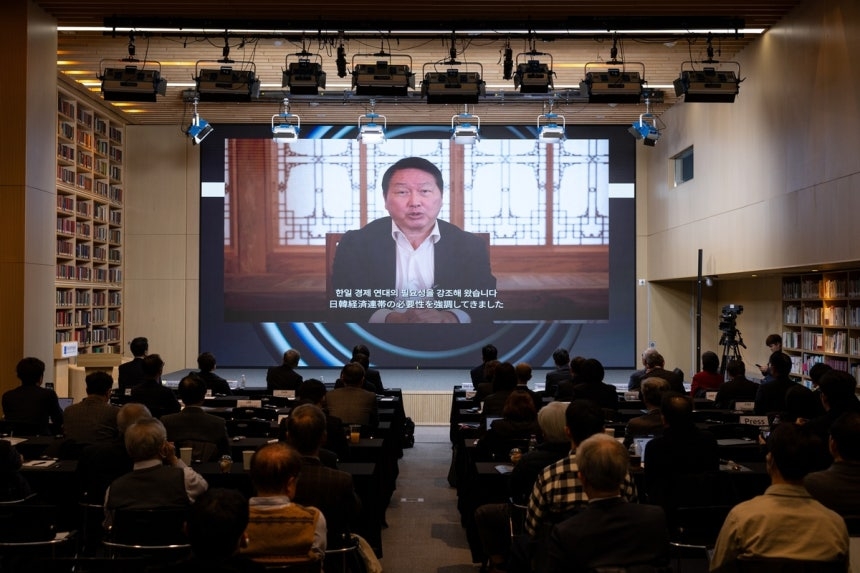
Chey Tae-won, chairman of SK Group and head of the Chey Jong-hyun Academy, said he is preparing a permanent "big tent" cooperation platform to sustain and advance Korea-Japan economic solidarity.
Chey delivered a video keynote address Thursday at the "Korea-Japan Economic Solidarity Roadmap Conference," jointly hosted by the Chey Jong-hyun Academy and the East Asia Institute at the Korea Foundation for Advanced Studies conference hall in Gangnam-gu, Seoul, according to the academy.
Chey proposed laying out a concrete, phased vision for the partnership: the level of economic cooperation to be achieved in three years, the industries poised to generate shared results and the institutional barriers to be dismantled in five years, and the tangible benefits that businesses and citizens should feel within a decade. He said the two countries should start by expanding cooperation in areas where progress is achievable — identifying sector-by-sector opportunities and lowering barriers to the movement of people and capital — and build that work into a concrete execution strategy.
"If the roadmap shows us the path forward, the platform will be the foundation that gathers the strength to walk that path together," Chey said, calling for a consolidation of the capabilities of all parties committed to realizing the Korea-Japan economic solidarity vision.
Chey has argued that combining South Korea's $1.8 trillion economy with Japan's $4.2 trillion economy would create a $6 trillion market, and that synergy effects could push that figure to $7 trillion. He also sees a Korea-Japan economic partnership as a cornerstone for an eventual Asian Union.
The event was also attended by the Modern Japanese Studies Association of Korea and Japan's Nakasone Peace Institute, drawing diplomacy, security, economics and industry experts from both countries. Researchers at the conference proposed three pillars of cooperation: a "solidarity of survival" centered on economic security and supply chain cooperation, a "solidarity of innovation" focused on advanced technology and industrial innovation, and a "solidarity of attraction" built on cultural and people-to-people exchange.
Son Yeol, a professor at Yonsei University, said the two countries face structural challenges including a relative decline in economic standing and shrinking populations, and described the next decade as a decisive period that will determine the course of the economic partnership. Son proposed modeling the Korea-Japan partnership on the ASEAN Economic Community approach, calling for a roughly 20-year roadmap running from this year through 2045 that would gradually accumulate bilateral cooperation and link sector-specific systems.
keg@heraldcorp.com