- XYZ CEO Hwang Sung-jae, a KAIST graduate, donates collaborative robots and workstations
- Two institutions to collaborate on physical AI research and talent development for five years
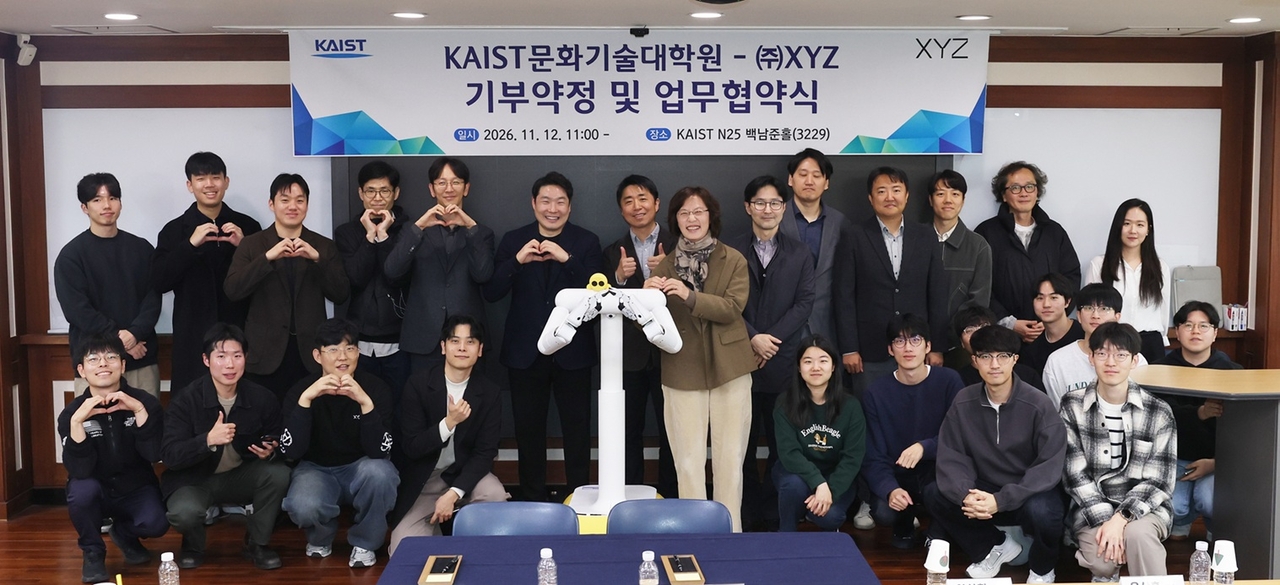
KAIST has received 100 million won ($74,800) worth of robot research equipment from an alumni-founded company and will use the donation to advance next-generation human-robot interaction research combining AI, robotics and the arts.
KAIST announced Friday it had signed a research equipment donation agreement and a physical AI-based joint research MOU with AI robotics company XYZ.
The donation was arranged by XYZ CEO Hwang Sung-jae, a master's and doctoral alumnus of KAIST's Graduate School of Culture Technology, to support research and talent development at his alma mater.
The donated equipment — valued at around 100 million won — includes five Doosan Robotics E0509 collaborative robot arms and two desktop workstations for robot experimentation.
The E0509 is a collaborative robot capable of handling objects weighing up to 5 kilograms, with a working radius of 900 millimeters. It can be used for a wide range of robot motion and human-robot interaction experiments.
KAIST plans to use the equipment to build a physical robot-based HRI research environment at the Graduate School of Culture Technology. Students will design robot movements and behaviors and develop technology that allows robots to respond naturally to human intentions and actions.
The research scope will extend into the arts, including performances and exhibitions. The school envisions new artistic experiences — such as stage performances featuring human artists and robots together, and interactive exhibitions that respond to audience movements.
The setup is also expected to evolve into an interdisciplinary research and education platform shared by laboratories working in AI, human-computer interaction, music and media art.
Over the next five years, the two institutions plan to pursue joint research on robot interaction using real-world behavioral data, develop next-generation service robot user experience technology, and collaborate on researcher exchanges and education.
"The quality of a service robot improves when it can carry out tasks accurately while responding naturally to human requests and interventions," Hwang said. "I hope this donation provides a foundation for students to bring new ideas to life."
Nam Ju-han, head of KAIST's Graduate School of Culture Technology, said the donation had created an environment where students could immediately test robot UX concepts — previously explored only in theory — using commercial-grade equipment. "By combining real-world industry data with the graduate school's interdisciplinary research capabilities, we will produce meaningful HRI technology outcomes," Nam said.
nbgkoo@heraldcorp.com