Two-month campaign starting Monday to use tax and insurance data to identify violators; preventive inspections also planned for workplaces with fewer than 30 employees
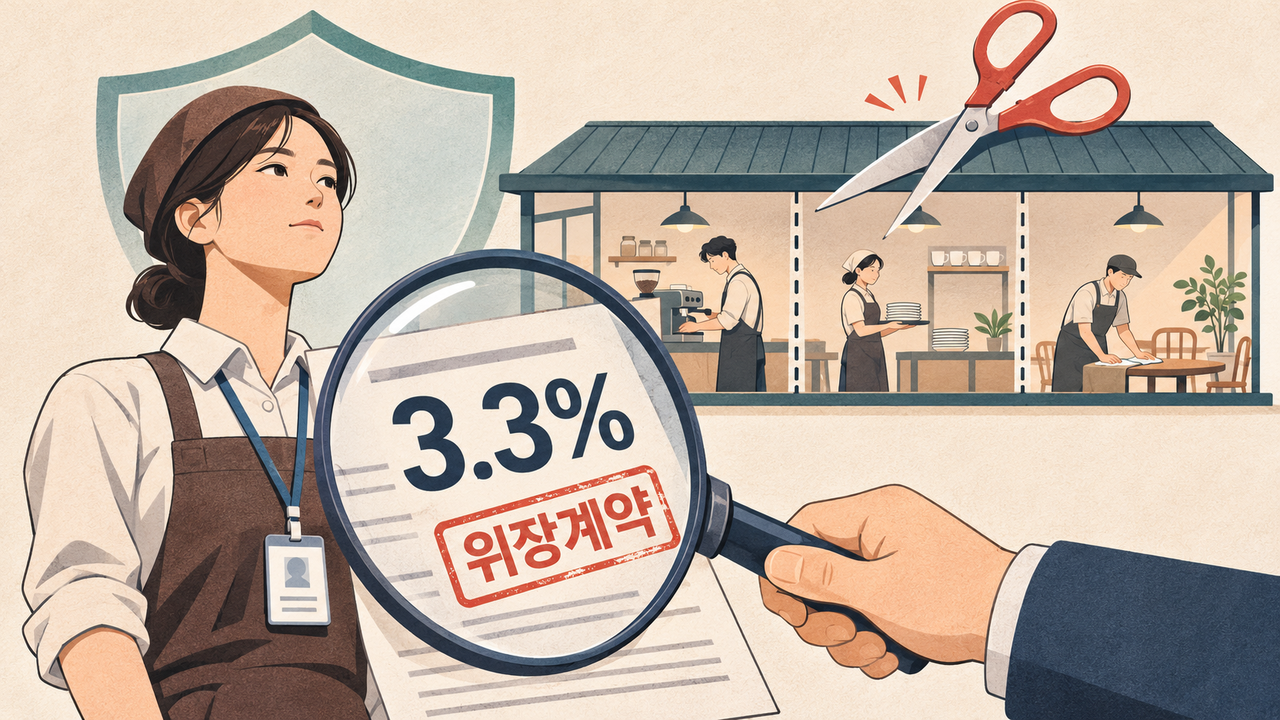
More than 140 workplaces suspected of misclassifying employees as self-employed contractors or artificially splitting their operations to evade labor law will face a government-led inspection campaign.
Authorities plan to use income tax filing records from the National Tax Service and social insurance enrollment data to identify violations, then require offending workplaces to enroll workers in the four major social insurance programs and correct income filings.
The Ministry of Employment and Labor said Friday that it will conduct a targeted inspection campaign starting Monday and running for about two months, focusing on workplaces suspected of "fake 3.3 disguised employment" and "workplace splitting."
A "fake 3.3 contract" refers to an arrangement in which a worker who qualifies as an employee under the Labor Standards Act is instead classified as a self-employed contractor — excluded from the four major social insurance programs and taxed at the 3.3 percent self-employment income rate — to help the employer avoid labor law obligations. "Workplace splitting" refers to a practice in which a single employer divides operations across two or more registered workplaces, each made to appear as if it has fewer than five employees, in order to sidestep statutory obligations such as overtime pay.
Last year's inaugural nationwide inspection targeting fake 3.3 disguised employment uncovered unpaid overtime, night-shift and holiday wages totaling about 685 million won ($512,000) owed to 1,070 workers at 72 workplaces. The ministry corrected those violations and took steps to ensure the affected workers received the protections of labor law, including enrollment in the four major social insurance programs.
This round, the ministry will identify suspect workplaces using anonymous tips from current employees and insurance and pension enrollment data from the Korea Workers' Compensation and Welfare Service and the National Pension Service. Final targets will be selected after a comprehensive review of National Tax Service income tax filings, employment insurance records, previously reported cases and inspection histories, and job postings.
The campaign will focus on industries where self-employed contractors make up a large share of the workforce, including food service and lodging, manufacturing, wholesale and retail trade, facility management, and mobile telecommunications. Particular attention will be paid to workplaces where the number of workers registered as wage earners falls below five but the total — including those classified as self-employed — reaches 20 or more.
Workplaces found to be in violation will be dealt with according to law. The ministry will notify the Korea Workers' Compensation and Welfare Service and the National Pension Service of workers excluded from the four major social insurance programs under fake 3.3 contracts, so they can be enrolled. Cases in which employment income was incorrectly reported as self-employment income will be referred to the National Tax Service for correction.
Starting next year, certified labor attorneys and other specialists will visit industries with high numbers of self-employment income earners and small workplaces directly under a voluntary working-condition improvement program. Education and outreach targeting employer associations will run in parallel. The ministry will also work with the National Tax Service and the Korea Workers' Compensation and Welfare Service to screen suspect workplaces for periodic checks, with workplaces employing fewer than 30 people subject to joint central and regional preventive inspections.
"Evading labor law through fake 3.3 contracts or by splitting workplaces is unlawful conduct that cannot be tolerated," Employment and Labor Minister Kim Young-hoon said.
fact0514@heraldcorp.com