Seocho-gu Council holds youth parliament class for Yeongdong Middle School students
Electronic device ordinance passes 10-6; dress code freedom bill defeated
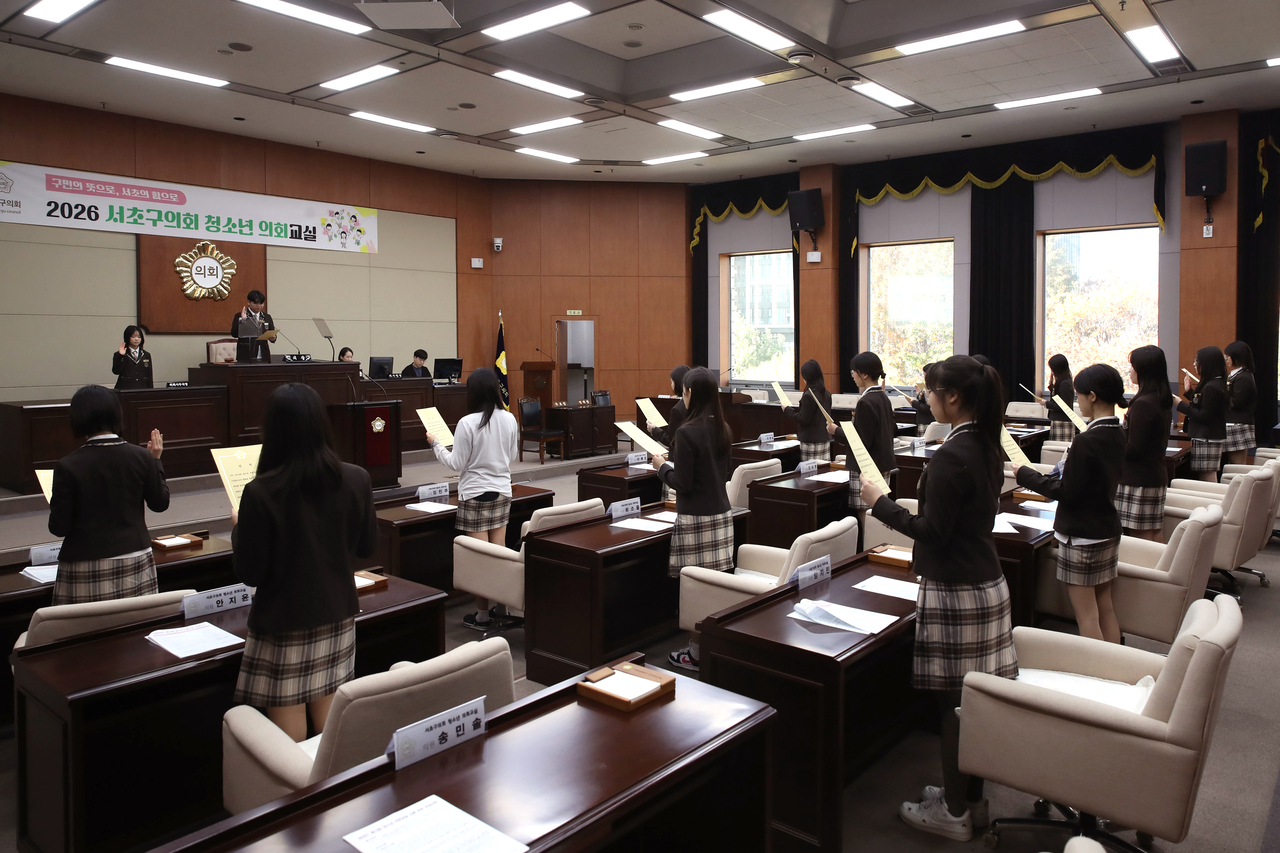
How far should smartphone use be restricted at school? And should students be required to wear uniforms?
Students from Yeongdong Middle School in Seoul's Seocho-gu took on the roles of district council members and debated those very questions in a lively session last week. They voted in favor of regulating electronic devices on school grounds but rejected a proposal to make school uniforms optional — deciding the issues themselves through debate and electronic ballot.
Seocho-gu Council held its 2026 Youth Parliament Class on Friday at the council's third-floor main chamber, with students from Yeongdong Middle School as participants.
The students transformed into one-day council members, experiencing the full legislative process firsthand — from electing a presiding officer to proposing ordinances, holding debates and casting electronic votes.
The session's most hotly contested item was a proposed ordinance on the use and management of electronic devices in schools.
Introduced by student Kim Min-ju, the bill aimed to prevent the harmful effects of unchecked smartphone use and establish clear guidelines for managing devices on school grounds.
Supporters argued that school-level oversight and regulation were necessary to protect students' right to learn and rest. Opponents countered that a blanket ban on smartphones would infringe on students' autonomy, and that it was more important to help them develop the self-discipline to manage their own device use.
When the votes were counted, the ordinance passed 10 to 6. The majority agreed that some form of management standard for electronic devices at school was needed.
The second bill — on guaranteeing students' freedom and right to choose their own clothing at school — produced the opposite result.
Those in favor of making uniforms optional said students should be free to express their individuality and have the right to choose what they wear. Those opposed argued that uniforms help verify student identity, foster a sense of community belonging and prevent economic disparities among students from showing through their clothing.
The bill was defeated, with 6 votes in favor, 9 against and 1 abstention. In reaching that verdict, the students showed they weighed not only personal freedom but also the order and shared values of the school community.
The youth parliament class was held for the second time this year, following an earlier session at Sindong Middle School on Nov. 2. The program went beyond a simple tour of the council chambers, with students taking the lead through every stage of the legislative process.
Lee Jong-yun, a student who took part, said it was "a special experience to learn in detail about the role of the council and try it out firsthand," adding, "I want to use the democratic procedures I learned here to build a more fulfilling school life with my friends."
Kim Min-hyeong, the teacher who accompanied the students, said it was "a meaningful experience that went beyond the textbook, allowing students to truly absorb the value of listening and debate in a real setting."
Seocho-gu Council Speaker Yoo Ji-ung said he was proud to see the students reach conclusions through debate and discussion, adding that adults had much to learn from them as well. "We will be a warm Seocho-gu Council that always listens to the voices of our children, who are our future," Yoo said. He added that the council would actively support a range of hands-on programs to help young people grow into engaged democratic citizens.
seouldream01@heraldcorp.com