KITA, K-SURE, Korea Creative Content Agency among signatories
AI platform to integrate fragmented export certification systems
Industry-specific review standards to be streamlined
Verified export data to expand access to trade finance
Service exporters in sectors such as shipping, tourism, software and content will soon face less hassle proving their export records, as the Korea International Trade Association moves to consolidate fragmented certification channels and link the resulting data to trade insurance and export guarantee programs.
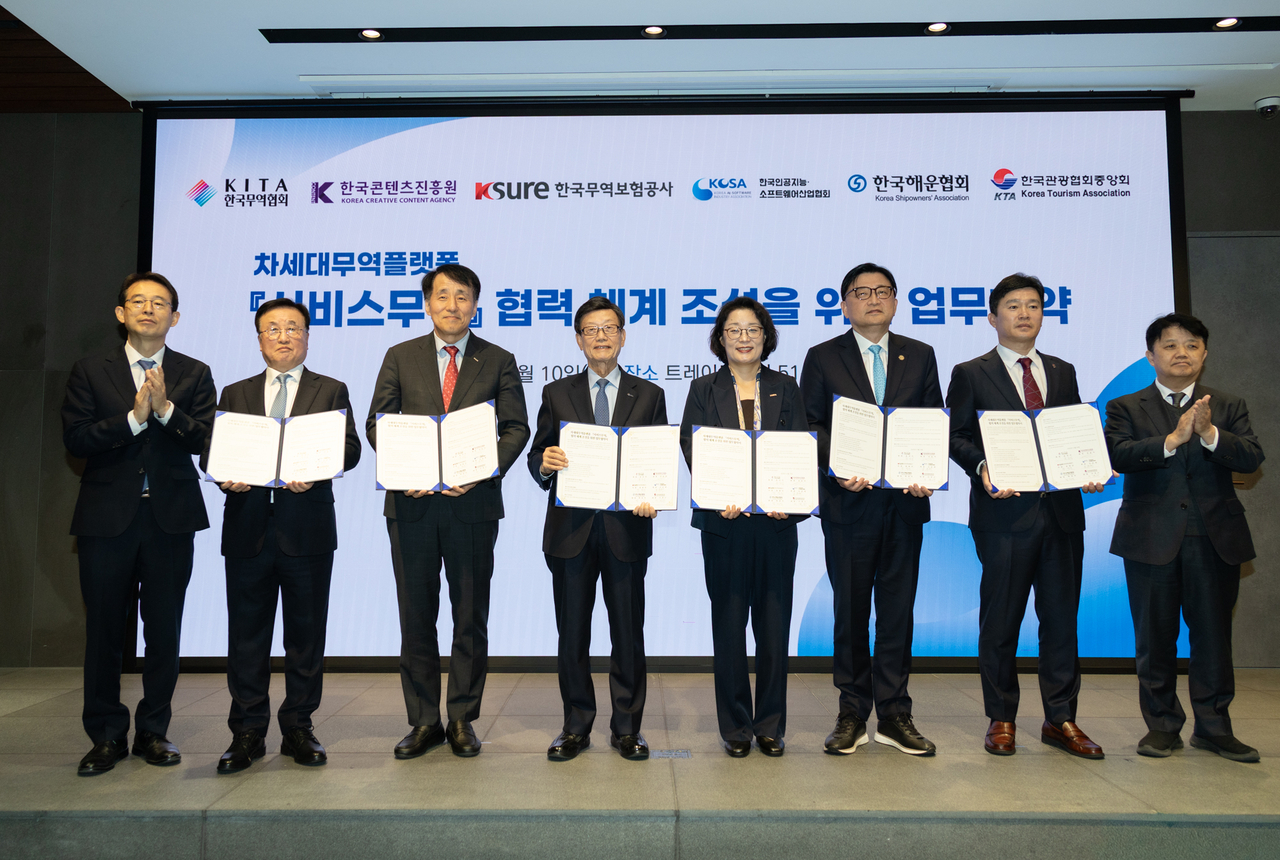
KITA signed a memorandum of understanding Tuesday with the Korea Creative Content Agency, Korea Trade Insurance Corporation, the Korea AI & Software Industry Association, the Korea Shipowners' Association and the Korea Tourism Association at Trade Tower in Gangnam-gu, Seoul. The agreement aims to build a cooperative framework for service trade based on a next-generation trade platform.
The signing ceremony was attended by KITA Chairman Yoon Jin-sik, Korea Creative Content Agency President Kim Yun-ji, K-SURE President Jang Yeong-jin, Korea AI & Software Industry Association Chairman Jo Jun-hui, Korea Shipowners' Association Chairman Park Jeong-seok and Korea Tourism Association Chairman Lee Gyeong-su.
Government officials also attended to underscore the need for cooperation, including Min Gyeong-seol, director general for innovation and growth at the Ministry of Economy and Finance, and Kang Gam-chan, director general for trade and investment at the Ministry of Trade, Industry and Resources.
The MOU was driven by the need to connect the separate export performance management systems that exist across different service industries.
Unlike conventional goods exports, service exports have long operated under varying recognition standards and certification procedures depending on the sector. Companies applying for trade finance or trying to verify their export records have had to submit different sets of documents to different agencies.
Service exports cover not only intangible services delivered abroad — such as transportation and tourism — but also exports of non-physical products like software and digital content.
KITA plans to link export certification data from these sectors through its AI-based next-generation trade platform, which is currently under development.
The initiative will consolidate the multiple issuing channels now spread across different agencies and establish a joint AI-powered review system that reflects the characteristics of each industry. The goal is to assess companies' submitted materials against sector-specific standards so that export records can be recognized more accurately.
Each participating organization has been assigned a distinct role. KITA will oversee the overall platform development and integration of the export certification system, with the data collected to be used later to improve service export support policies and related statistics.
The Korea Creative Content Agency will refine export classification standards to reflect the characteristics of K-content industries such as gaming and video. The Korea AI & Software Industry Association will develop a review framework for advanced IT and software. The Korea Shipowners' Association and the Korea Tourism Association will each establish export recognition standards suited to their respective sectors.
K-SURE will apply the verified export data to trade insurance and export guarantee programs, extending financial support to companies that supply software or content overseas so they can secure funding and protect against the risk of unpaid export proceeds.
The participating agencies will also work together to align export classification standards with national standards and identify regulatory pain points that companies encounter, with a view to improving the relevant systems.
The push comes as pressure mounts to strengthen South Korea's service trade competitiveness. Data released by the Bank of Korea on Thursday showed that the country's service account posted a deficit of $3.35 billion in September, driven mainly by travel and other business services — a stark contrast to the large surplus recorded in goods trade.
The government has also been paying closer attention to building export competitiveness in services beyond the goods-heavy export structure. The unified certification framework to be established under the MOU is expected to serve as a foundation for systematically managing service companies' export records and connecting them to various support programs.
"Securing competitiveness in intangible-based service trade has never been more important, amid the reshaping of global supply chains and the intensifying race for technological supremacy," KITA Chairman Yoon said. "If manufacturing has led our exports until now, the time has come for high-value-added service trade to establish itself as a new core pillar and drive a fresh leap forward for our economy."
kwater@heraldcorp.com