LH's first modular bid in North Gyeongsang Province draws no contractors
4.8 trillion won in orders over 5 years aimed at cutting production costs
Namyangju Wangsuk 2, Goyang Changneung bids this month seen as key test
High construction costs, stalled special law cloud project viability
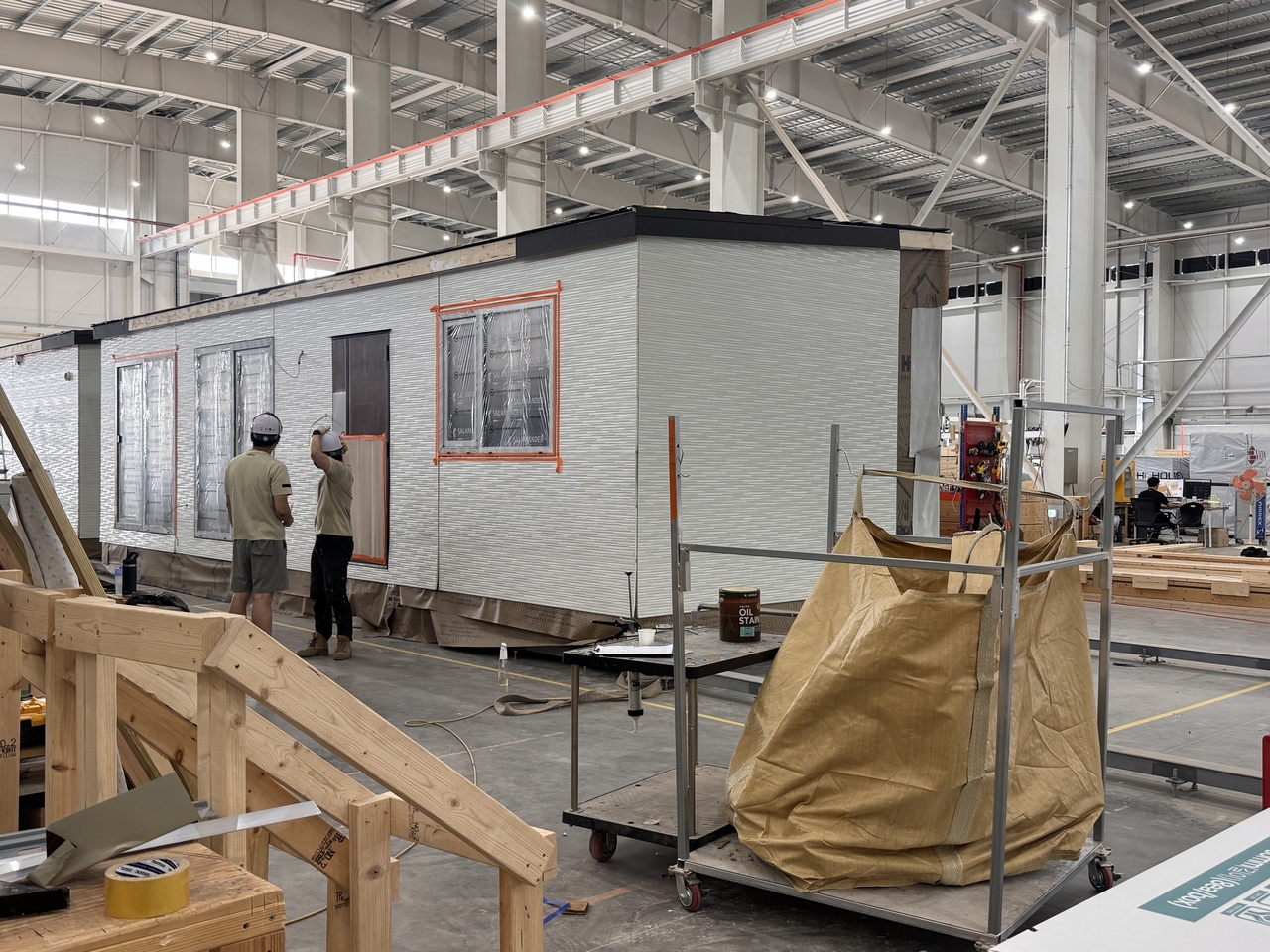
Modular housing — a method President Lee Jae Myung has championed as a fast-track tool to accelerate housing supply — failed to attract a single contractor at its first tender. Despite government pledges of construction cost subsidies and long-term contracts to kick-start the modular housing market, critics say high building costs, uncertain project viability and an underdeveloped regulatory framework are proving too steep a barrier for industry participation.
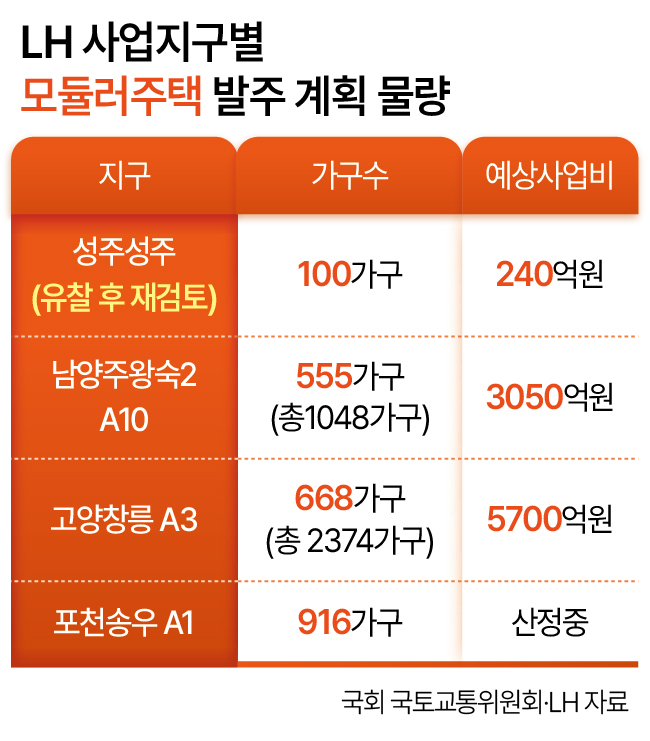
According to data obtained from the Korea Land and Housing Corp. (LH) through the National Assembly's Land, Infrastructure and Transport Committee, LH's first modular housing tender this year — a 100-unit project in the North Gyeongsang Province Seongju district — drew no bidders last month and was declared void. The project, budgeted at 24 billion won ($17.7 million), had been scheduled for completion by the first half of 2029, but the search for a contractor stalled at the opening bid.
The Seongju district site was selected in 2024 under the Ministry of Land, Infrastructure and Transport's first-half public rental housing competition and is slated to provide employment-linked public rental units.
An LH official said the market appeared to be in a wait-and-see mode, noting that large-scale modular housing orders for Namyangju Wangsuk and Goyang Changneung are already in the pipeline. "It seems less a matter of the project's size or budget and more that contractors are holding back in anticipation of the bigger orders ahead," the official said.
LH plans to review the Seongju project's viability before relaunching the tender. According to LH's submitted data on modular housing order volumes by district, the total number of units either already tendered or in planning stands at roughly 2,200. This month, LH is set to open contractor bids for 555 units at the Namyangju Wangsuk 2 A10 district and 668 units at the Goyang Changneung A3 district — both part of the third-generation new town program. Whether those follow-on large-scale bids succeed is expected to serve as a key gauge of the market's appetite for modular housing overall.
Within the industry, high construction costs remain the single biggest obstacle to modular housing. The modular method — in which major structural components are fabricated in a factory and then assembled on site — can cut construction time by roughly 20 to 30 percent compared with conventional methods. However, the additional costs of factory production, transportation and installation push overall construction expenses about 30 percent above those of traditional building, making it difficult to secure project viability on the strength of shorter timelines alone.
The government is working to ease the cost burden. The Ministry of Land, Infrastructure and Transport has announced it will provide a subsidy of 35 million won per unit to cover the extra construction costs modular housing incurs over conventional methods, and is in talks with the Ministry of Economy and Finance over expanding the budget.
President Lee visited the Incheon Gyeyang third-generation new town site on Oct. 20 and directed officials to "comprehensively review" modular housing "from the standpoint of creating a modular housing market." He also flagged the potential to shorten construction timelines and proposed using long-term supply contracts to bring down unit production costs.
An inadequate regulatory foundation is also deterring market participation. Because modular housing separates factory fabrication from on-site construction, it requires design and supervision frameworks distinct from conventional site-centered building standards. Clear rules on liability for defects or accidents arising during the manufacturing process, along with certification standards to guarantee quality, have yet to be established. A special bill addressing these issues has not cleared the National Assembly. A special act on supporting the revitalization of modular construction, jointly introduced by the ruling and opposition parties in late last year, has remained stuck at the committee review stage of the Assembly's Land, Infrastructure and Transport Committee for nearly a year.
"Modular construction has real advantages in construction time, quality and safety thanks to prefabrication, but the higher costs compared with conventional methods still weigh on project viability," an official at a major contractor said. "Public-sector orders keep coming, but the modular market needs to grow to a certain scale — backed by the special law, design supervision and certification systems — before the economics improve enough for the private sector to participate in earnest."
hss@heraldcorp.com