Ministry of SMEs and Startups holds third meeting of payment innovation TF
Discussion targets deadline unchanged since 1975
Annual benefits of up to 21.6 trillion won estimated from financial cost savings
Direct payment system expansion also under review
Cutting the legal deadline for paying small and medium-sized enterprises from 60 days to 30 days could generate annual economic benefits of up to 21.6 trillion won ($15.9 billion), primarily through reduced financial costs, according to new research.
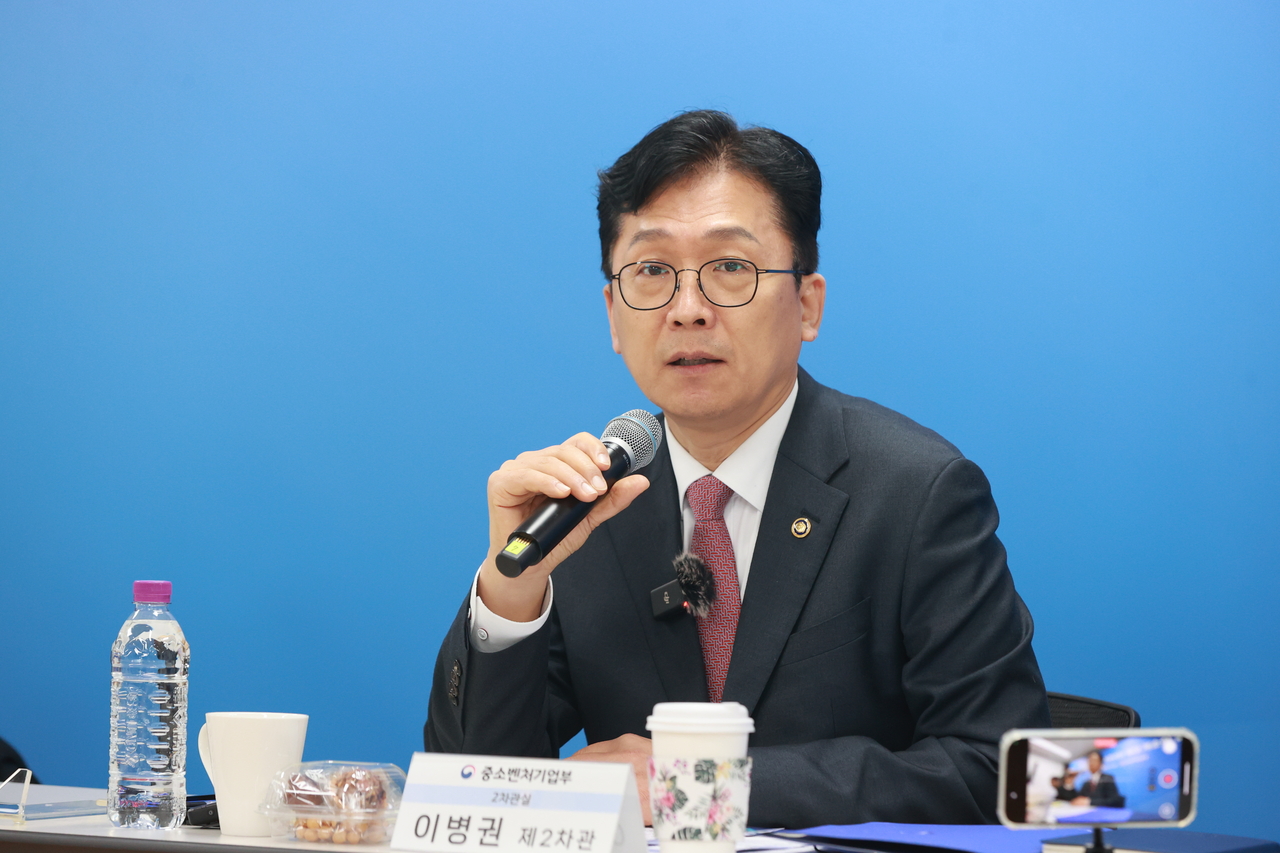
The Ministry of SMEs and Startups held the third meeting of its Large and Small Business Payment Innovation Task Force in Seoul on Tuesday, where officials discussed ways to improve payment practices for SMEs.
The government has been pushing to overhaul payment practices that have remained largely unchanged for more than 50 years, pursuing measures including a shorter payment deadline and an expansion of the direct payment system. The meeting featured the presentation of research analyzing the economic impact of reducing the payment deadline.
Research by Lee Jeong-hwan, a professor at Myongji University, estimates that cutting the legal deadline from 60 days to 30 days would generate annual social benefits of 13.9 trillion won based on companies subject to external audits. Expanding the analysis to include SMEs not subject to external audits raises the projected annual benefit to as much as 21.6 trillion won.
The social benefits referred to in the research represent the economic gains companies would realize from receiving payment sooner, including reduced financing costs and improved asset returns. The 21.6 trillion won figure is not a direct cash transfer to businesses but an estimate of the broader economic effect of shortening the payment deadline.
The study drew on financial data from 32,000 externally audited companies as of 2024. It found that subcontractors receiving payment more quickly could reduce interest expenses and improve asset returns, yielding measurable financial benefits.
Shortening the payment deadline would ease the cash-flow burden on SMEs. A shorter gap between delivery and payment means companies would need to borrow less to cover operating costs. For smaller firms with limited financial reserves in particular, the timing of payment collection can directly affect business stability, underscoring the need to reform existing payment practices.
The current 60-day legal deadline has been in place since 1975. Recent legislative activity — including an amendment to the Large-Scale Distribution Business Act and proposed revisions to the Win-Win Cooperation Act and the Subcontracting Act — reflects growing momentum to shorten the deadline.
The Ministry of SMEs and Startups has operated the payment innovation TF since June, bringing together relevant government agencies, business groups and experts. The TF is led by the ministry's second vice minister and includes the Ministry of Land, Infrastructure and Transport, the Financial Services Commission, the Korea Fair Trade Commission, the Korea Federation of SMEs, the Korea Mid-sized Company Federation and the Korea Enterprises Federation.
The TF has held five meetings in total through Tuesday's session — three plenary meetings and two working-level meetings. Discussions have focused on finding ways to effectively shorten payment periods across business-to-business transactions while minimizing the burden on the companies making the payments.
The TF is also reviewing an expansion of the system under which project owners pay subcontractors directly. A recent amendment to the Framework Act on the Construction Industry strengthened direct payment requirements in the construction sector, and the TF is examining whether to extend that model to other subcontracting transactions and to the broader range of consignment arrangements.
At Tuesday's third meeting, participants gathered industry feedback on the reform proposals developed so far and discussed the direction for future action.
"The TF was launched to break the mold of long-entrenched payment practices between businesses and to work together on creating a trading environment where large and small companies can grow together," Second Vice Minister of SMEs and Startups Lee Byeong-gwon said. "We will work to institutionalize a transaction structure in which SMEs — the backbone of the national economy — can receive the right payment at the right time, and to ensure that structure takes root in practice."
boo@heraldcorp.com