Support restructured from single-year grants to multi-year projects
Consortiums of businesses, farms and local governments may apply through Dec. 8
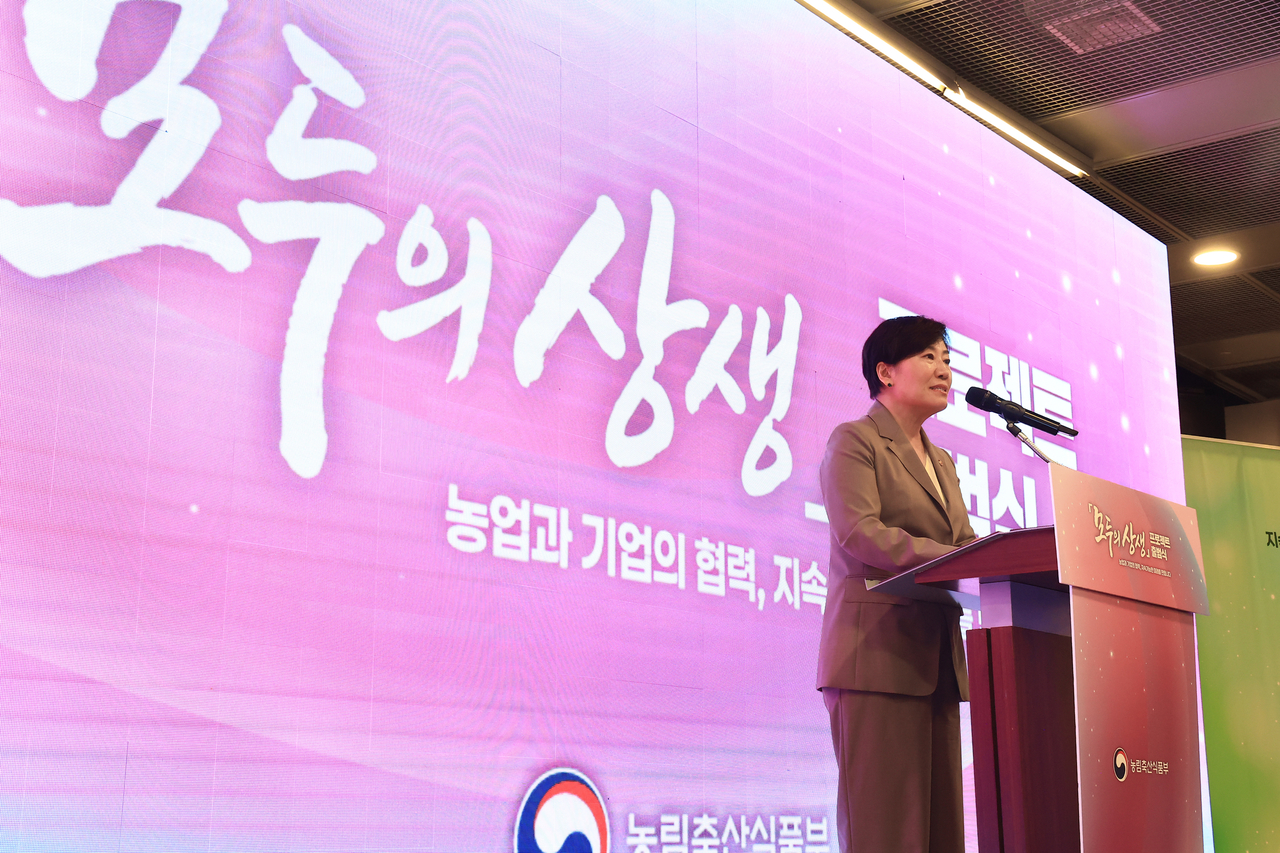
The government will overhaul its support program for farm-business cooperation, shifting from single-year grants to a multi-year framework of up to three years. Consortiums of companies, farming households and local governments that jointly pursue projects will be eligible for up to 500 million won ($368,000) in annual project funding.
The Ministry of Agriculture, Food and Rural Affairs announced Tuesday that it will open applications for the 2027 Everyone's Mutual Growth Project starting Friday.
The program is a privately led cooperative initiative that combines agricultural and rural resources with corporate technology, ideas and distribution networks to expand market access and income for farming households while creating new business opportunities for companies.
Starting with this round of applications, the ministry is replacing the previous model of individual, one-off grants with a project-based multi-year support framework centered on shared objectives. The change is intended to underpin long-term contract farming arrangements and the development of stable agricultural supply chains — goals that were difficult to achieve under single-year funding.
Companies, producer and distribution organizations, and research institutions may participate by forming a consortium with a local government. Projects can be proposed across five categories — production-focused, product development, full-cycle integrated, large and small business cooperation, and marketing and exports — tailored to local conditions and project goals.
Selected consortiums will receive up to 500 million won in annual project funding, comprising 200 million won in national government funds, 200 million won in local government funds and 100 million won in self-financing. Projects may be funded for up to three years, bringing the maximum total project cost to 1.5 billion won. However, continued support and funding levels will be determined each year based on performance evaluations.
Eligible activities span a wide range, from trial cultivation, quality management and raw-material suitability testing to product and menu development, pilot production, market research, online and offline distribution channel development, and exports.
The ministry held a launch ceremony for the program at the Korea Chamber of Commerce and Industry on July 27, where it shared cooperation cases with the agricultural and business communities. In September, it ran a promotional booth at the 2026 Social Value Festa, and around Chuseok it unveiled a gift set featuring domestically grown produce developed through the program.
Concrete examples of farm-business cooperation are already emerging. Hyundai Green Food developed corporate cafeteria menus using green onions from Taean in South Chungcheong Province and lotus leaves and chestnuts from Buyeo. CJ CheilJedang is working to open up the traditional liquor market by applying branding and global distribution networks to makgeolli produced by regional breweries in Wonju.
Gyulmedral, a youth-run company from Jeju, collaborated with Uniqlo, CU and Baemin B-mart to launch fashion content and dessert products featuring citrus fruit. Hanul Agricultural Corporation diversified its sweet potato and rice flour product lines and expanded its distribution channels, growing its purchases of domestically grown produce from 1.8 billion won in 2023 to 5.8 billion won last year — an increase of 4 billion won over two years, or roughly 222 percent.
Consortiums wishing to apply must first consult with their lead metropolitan or provincial government, then submit an application and project plan to that government by 6 p.m. on Dec. 8. Applications will then be reviewed and recommended by the local government before being submitted to the Korea Agro-Fisheries and Food Trade Corporation for final receipt by 6 p.m. on Dec. 15. Further details are available on the ministry's website.
Jeong Gyeong-seok, the ministry's director general for food industry policy, said the program "will be a clear opportunity for growth for both companies seeking to boost market competitiveness using high-quality domestic produce and farming households urgently in need of stable sales channels." Jeong added that the ministry plans to ensure the selected projects "take root not merely as one-time support but as sustainable business models and long-term trading relationships."
adastra@heraldcorp.com