Rival camps split over how to read investigation results
Song Young-gil calls for mass membership revocations
Pro-Jung faction demands full public disclosure
Fatigue over prolonged infighting begins to surface
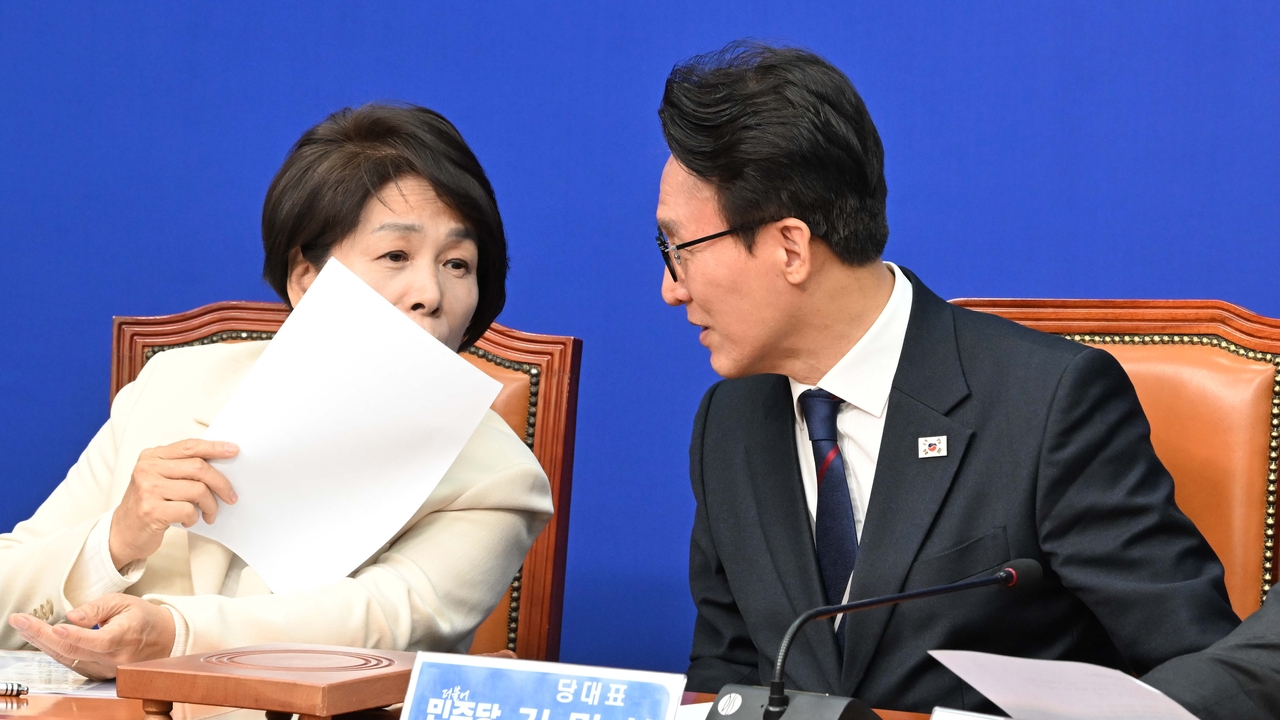
Factional divisions within the Democratic Party of Korea are showing no signs of easing as rival camps draw sharply different conclusions from an internal investigation into allegations that members of the Shincheonji religious group joined the party en masse.
According to political sources Monday, the pro-Lee Jae Myung faction that controls the party leadership says the probe confirmed a significant number of Shincheonji-linked membership registrations and is calling for institutional safeguards, while the pro-Jung Chung-rae camp argues the findings offer no evidence to support claims of interference in the party convention and continues to press for accountability from party leader Kim Min-seok.
The Democratic Party has been allowing sitting lawmakers and regional committee chairs to review the investigation results at the party secretary-general's office since Friday.
The probe found that roughly 14,000 rank-and-file members are suspected of being Shincheonji adherents, about 8,000 of whom hold full voting rights. The party leadership is understood to have determined that approximately 3,300 rights-holding Shincheonji members were eligible to vote during the Aug. 17 party convention.
Party Spokesperson Cho Gye-won, aligned with the leadership faction, appeared on the party's YouTube channel Monday and said the findings showed that "a pseudo-religious organization systematically joined the Democratic Party in order to interfere with its democratic decision-making and electoral processes."
"In South Jeolla Province, Gwangju and North Jeolla Province — the Honam region — the pattern is clearly visible, but there are also areas with only one or two members, or none at all," Cho said. "If anything, I think that more clearly points to the hallmarks of an organized membership drive."
Cho added that the party must seize the moment to resolve the issue at an organization-wide level, calling for "strong measures to prevent and punish dual party membership and registrations designed to distort the party's democratic decision-making."
Lawmaker Song Young-gil, who ran for the party leadership at the last convention, held a press conference after reviewing the findings Monday and said the probe had "confirmed the circumstances of Shincheonji's organized, collective membership," lending support to the Kim Min-seok leadership's position.
"This matter must not end as a blame game between specific factions," Song said. "If coercion using religious authority and organized mobilization encroach on a political party's free decision-making, that is a threat to the entire system of party democracy in South Korea."
Song urged the leadership to conduct a full investigation of all confirmed Shincheonji members in the party, suspend their membership and give them a chance to prove they are not Shincheonji adherents, revoking the membership of anyone who fails to do so. Song also called for amendments to the Political Parties Act and the party's own constitution and bylaws to block organized illegal political interference.
Lawmaker Park Beom-gye, after completing the review, wrote on Facebook that "it is difficult to judge the credibility" of the findings, but added that "as a candidate who was in the thick of a fierce primary, I think it was reasonable to have doubts and raise the issue" — a comment seen as defending Kim Min-seok.
The pro-Jung faction, by contrast, questioned both the credibility and the interpretation of the findings and kept up its offensive against Kim, who first raised the allegations.
Supreme Council member Lee Sung-yoon, aligned with the pro-Jung camp, said at a Supreme Council meeting held in Gumi, North Gyeongsang Province, on Monday that the confidential review had confirmed "no evidence of a secret three-way alliance between anti-Lee forces, separatists and Shincheonji, nor of organized interference — which, as the party leader himself admitted, is a clear falsehood and a political operation that succeeded."
Lee said media reports showed Shincheonji members with voting rights at the convention numbered about 3,300 — "a mere 0.4 percent of total voters" — and asked: "Are you telling me that 0.4 percent has been used to tear this party apart for three months?"
Lee also pressed Kim to "fully disclose the investigation results as they are, acknowledge what went wrong, apologize directly to the affected members and promise to prevent a recurrence — only then will it be a genuine apology," and said Kim must "bear the correspondingly serious responsibility."
Supreme Council member Choi Min-hee took aim at Spokesperson Cho on Facebook, writing that "the party spokesperson calls it 'serious' while covert fabrications of numbers and rumors are circulating," and asking whether "it would not be better to fully disclose how the membership list was obtained and the investigation materials."
Supreme Council member Han Min-su also wrote on Facebook that "the party leader has apologized, yet some lawmakers holding party posts are openly hinting at the possibility and danger of Shincheonji's interference in internal party elections," and challenged Kim directly: "Why are you standing by while party-post lawmakers say something different behind the scenes?"
Han added that "this situation cannot be resolved without an apology and accountability for the reckless act of pushing the party toward division," and warned that "the moment you try to evade responsibility by obscuring the core issue, you will face even greater resistance."
In some corners of the party, fatigue is setting in over the prolonged dispute surrounding the investigation results.
Lawmaker Kim Eui-gyeom, who leads the Democratic Party's side on the Legislation and Judiciary Committee, said on KBS Radio Monday that he hoped Kim Min-seok would not "tack on unnecessary caveats like 'the facts are this way' or 'questions still remain' now that he has already apologized," adding that such remarks "only make things harder for the party leadership and I hope this issue stops leaving such a strange aftertaste."
Lawmaker Noh Jong-myeon wrote on Facebook: "If everyone sees what they want to see and says what they want to say, who resolves the conflict and who raises the party's approval rating?" He urged lawmakers to "pause their public statements for even a moment" and called on the leadership to "quickly wrap up this matter by managing the risks that the review process may generate."
Meanwhile, the party leadership says it will pursue internal institutional reforms based on the investigation findings through proper procedures.
Chief Spokesperson Park Sung-joon said at a briefing Monday that "there is a general consensus among Assembly members that the situation should move toward resolution," adding that "since we have said we will pursue self-correction and institutional reform on a broader level, we are now in the phase of proceeding in an orderly manner."
thanks@heraldcorp.com