About 100 students from 12 schools nationwide take part
Debates and research presentations aim to cultivate future mobility talent
1,800 students enrolled in high school credit-linked courses
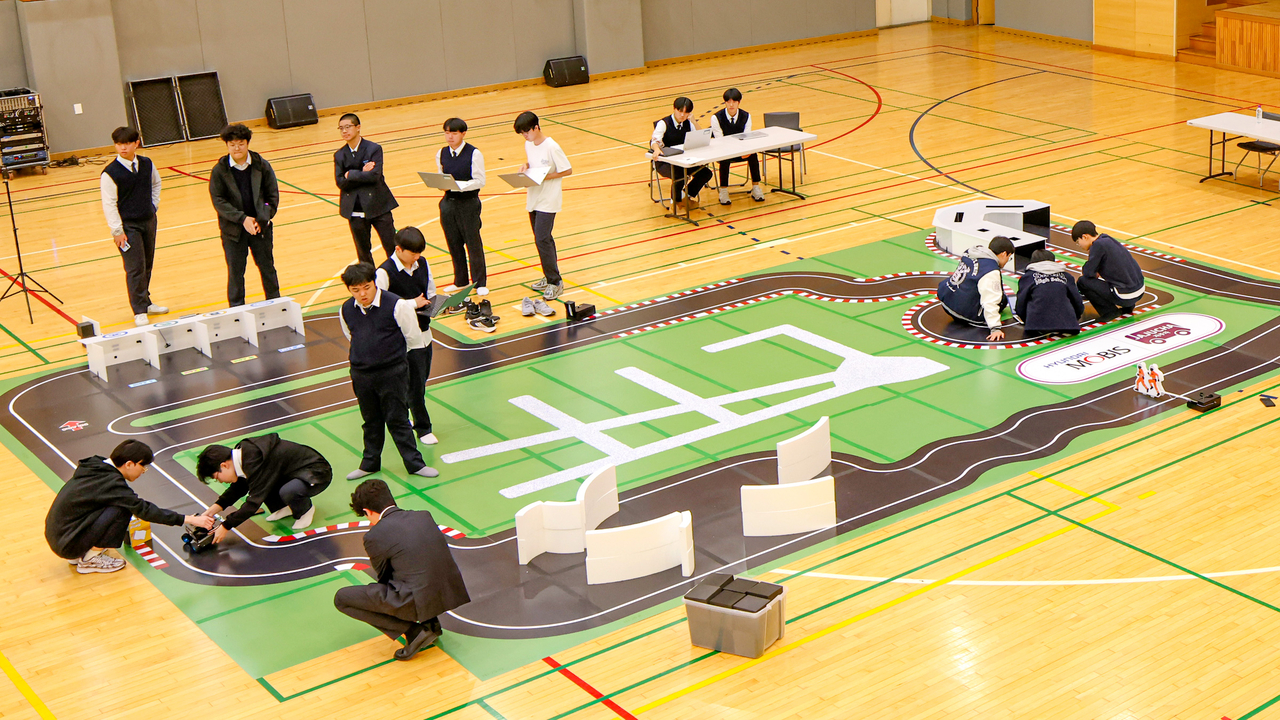
Hyundai Mobis held its "2026 Youth Engineering Leader Festival" at Hana High School in Seoul on Saturday, the company announced Monday. The event showcases the results of its Youth Engineering Leader curriculum, which operates as a superintendent-approved course.
About 100 students from 12 high schools across the country took part. The festival gave participants a chance to demonstrate and share the engineering skills they had built through the curriculum, with competitions held across three categories: an engineering debate contest, a self-driving car competition and a youth engineering academic conference. Students competed in engineering thinking, problem-solving and teamwork.
In the engineering debate contest, students who had completed the high school credit course "Engineering Communication" argued over major issues in engineering and technology. Participants analyzed the logic of opposing arguments from an engineering perspective, showcasing their reasoning and communication skills.
The self-driving car competition, held continuously since 2018, challenged students to develop driving algorithms capable of recognizing lanes and traffic signals while avoiding obstacles, then implement them in model vehicles. This year the contest was divided into two categories: a deep learning-based autonomous driving division and a physical AI vehicle division based on Robot Operating System 2 (ROS2). Judging assessed overall driving stability by tallying lane departures, obstacle collisions and lap times. Incheon Samsan High School won the deep learning division, while Incheon Songdo High School took the ROS2 division.
A youth engineering academic conference ran alongside the main competitions, giving students a platform to present their research. Participants shared findings across a range of topics including AI, autonomous driving, sensor technology and optimization algorithms. This year's event also featured studies examining future mobility from a humanities and social science perspective, broadening the scope of research presented.
Hyundai Mobis published a textbook titled "Engineering Communication" in 2024 to coincide with the full rollout of the high school credit system, and introduced an additional curriculum, "Exploring AI Autonomous Vehicles," last year. Fourteen general high schools nationwide have now adopted the program, with about 1,800 students building foundational skills in future mobility fields such as autonomous driving and robotics.
Han Seong-hui, head of Hyundai Mobis's sustainability management division, said the Youth Engineering Leader program "supports students in developing problem-solving capabilities grounded in the engineering knowledge they learn at school, and expanding into independent research activities." Han added that the company plans to "continuously expand support for nurturing creative engineering talent to lead the future mobility industry."
Meanwhile, Hyundai Mobis posted consolidated sales of 15.72 trillion won ($11.7 billion) and operating profit of 914.1 billion won in the third quarter of this year, up 4.6 percent and 17.2 percent, respectively, from the same period last year. Cumulative sales through the first three quarters reached 47.61 trillion won, with cumulative operating profit of 2.69 trillion won.
Hyundai Mobis also plans to accelerate its robotics push this month by producing prototype actuators for Atlas, the humanoid robot developed by Boston Dynamics.
eyre@heraldcorp.com