'Day robots work in unfamiliar settings is near — but precision tasks remain a challenge'
Wang Xingxing, founder of Chinese robotics company Unitree, has forecast that next year will mark a critical turning point in the technological development of the robot industry. He said the day is not far off when robots will be able to carry out diverse tasks in unfamiliar environments, but added that technical barriers to achieving precise movements must first be overcome.
According to Chinese media outlets including Yicai and Beijing Daily, Wang made the remarks Wednesday at the Internet Entrepreneurs Forum of the 2026 World Internet Conference Wuzhen Summit, held in Wuzhen, Zhejiang Province. "Next year has a strong chance of becoming a critical threshold for the development of the robot industry and robot AI models," he said.
Wang said that while robots operating in specific locations or on specific production lines can already achieve a near-perfect task success rate after sufficient training, their overall work efficiency still needs improvement.
He said robots deployed in factories still lag behind humans in productivity, and that output must rise before large-scale adoption becomes viable. He added that robots will eventually advance beyond fixed locations and production lines to operate across a wide variety of environments.
Wang described this as a "ChatGPT moment" for robotics — a technological leap that would dramatically expand the range of applications for robots, much as the emergence of ChatGPT in 2022 triggered the rapid spread of generative AI. The benchmark he set is a robot successfully completing 80 percent of tasks assigned by voice or text commands across 80 percent of unfamiliar environments.
Wang said the world's leading AI models have already come close to meeting that benchmark, but challenges remain. Robots currently perform well at picking up objects or moving simple items, he said, but still fall short on precision tasks such as disassembling and reassembling a mobile phone or threading a needle.
He described the remaining gap between an AI model's judgment and a robot's physical execution as "a problem of the last few millimeters." Errors arise when a robot tries to carry out movements that an AI model has determined, he said, and the technology for tactile recognition during contact with objects and the speed of control signal transmission are still not sufficient.
Wang said that if these problems are resolved within the next one to three years, the major technical obstacles blocking the real-world deployment of robots will largely be removed.
He also identified the effective use of data accumulated during robot development as a key challenge. "The data currently collected through robots is being underutilized," he said. "We need to advance the technology that allows AI models to learn on their own and improve their performance." He added that Unitree has recently begun testing autonomous learning technology in which an AI model writes its own code, trains in both virtual and real environments, and then applies the results directly to robots.
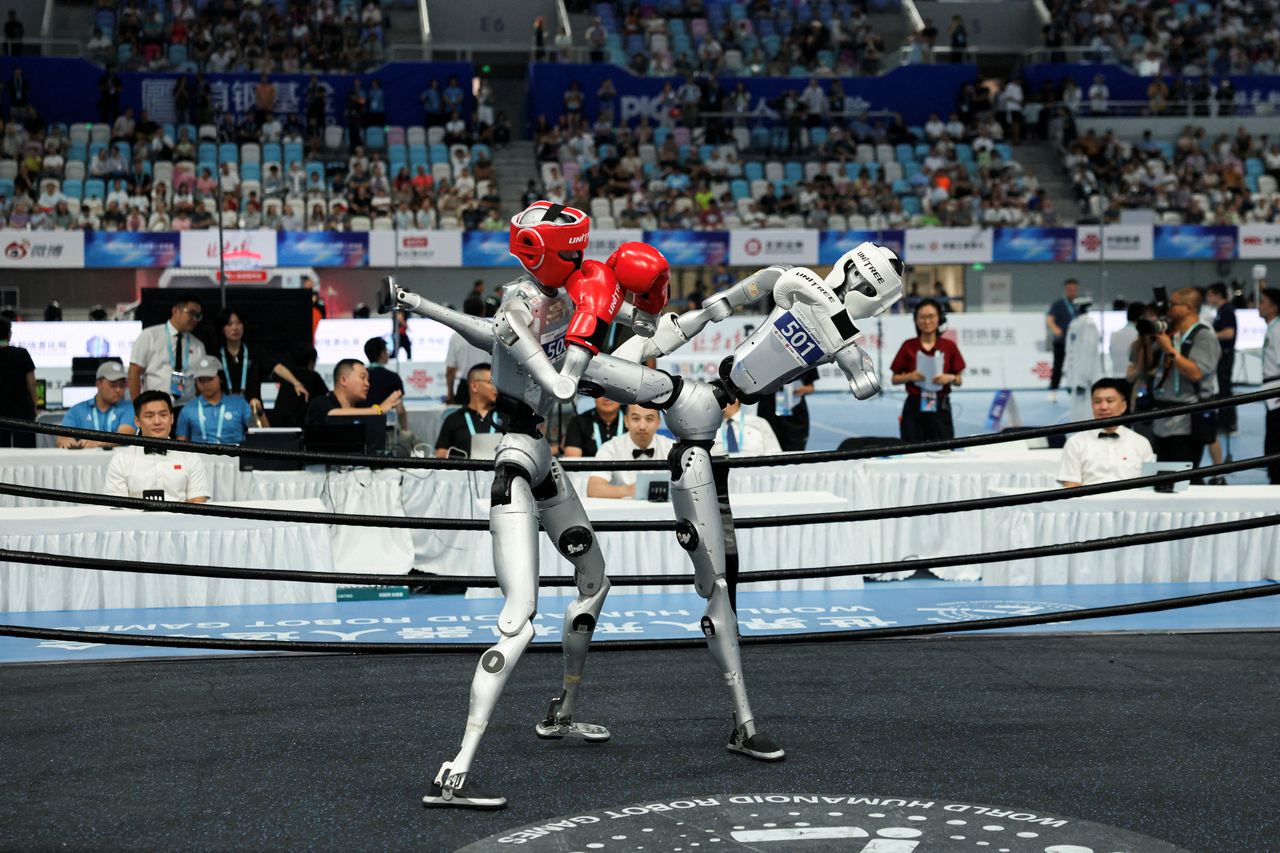
Founded in 2016, Unitree is one of China's leading robot manufacturers, developing and producing both bipedal humanoid robots that walk upright and quadruped robots that move on four legs.
yckim6452@heraldcorp.com