Busan city officials say it is 'not yet time' to take a position as signals mount that the relocation plan is unraveling
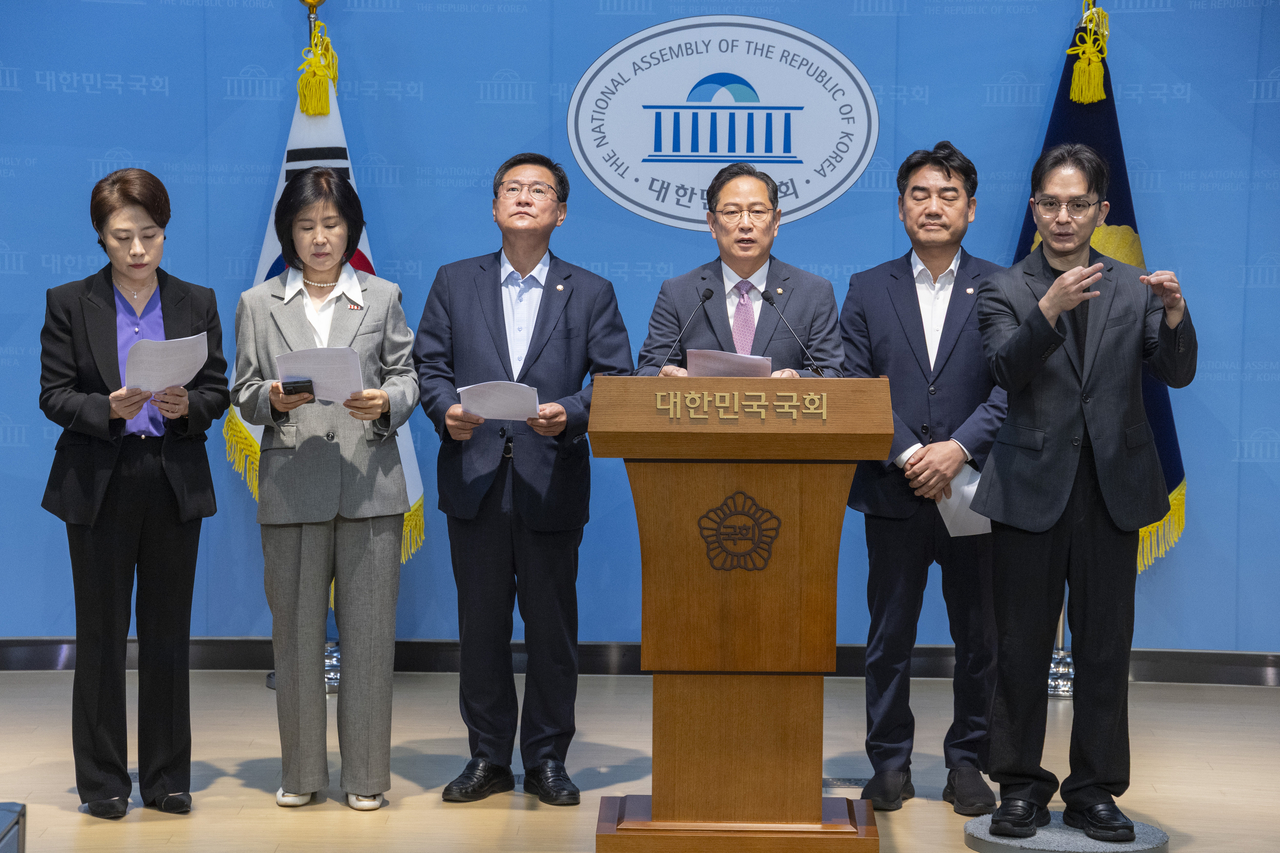
Uncertainty over the planned relocation of Korea Development Bank's headquarters to Busan is deepening after a ruling party lawmaker on the National Assembly's political affairs committee suggested the move may have been quietly shelved — echoing remarks made by the FSC chairman weeks earlier. Busan city officials are staying silent, fueling concern that the city is simply waiting on the sidelines for the government to announce its second round of public institution relocations.
At a forum co-hosted by The Herald Business and law firm Daelyuk Aju in Seoul on Wednesday, Democratic Party of Korea lawmaker Kang Jun-hyeon said it appeared a decision had been made not to relocate Korea Development Bank to Busan. Kang proposed instead consolidating Korea Development Bank, Industrial Bank of Korea, the Export-Import Bank of Korea and the Financial Supervisory Service in Yeouido to create a financial hub, while establishing regional investment corporations in areas such as the southeastern region.
The remarks amplified a controversy that erupted when FSC Chairman Lee Eok-won told the National Assembly's national audit on Oct. 22 that he understood the relocation had been "reviewed and then set aside." Lee later walked back the comment, saying the matter would be decided by the National Assembly. With a ruling party lawmaker now raising the possibility of the plan falling through, the fallout is growing.
A senior official in Busan city's political affairs office said Thursday, when asked about the city's response to Kang's remarks, that there was "no position to offer at this time." The official characterized Kang's statement as a personal remark by an individual Democratic Party lawmaker and said the city did not see it as a situation requiring a response, even if the mood was shifting in that direction. When pressed on whether the city was failing to act, the official said the city was not unable to respond but rather saw it as "not yet the stage to take a position," adding that it would be premature to speak out before the overall direction of the public institution relocation plan had taken shape.
On the broader pattern of voices within the ruling camp signaling opposition to the relocation, the official said the president's principle of minimizing institutions remaining in the greater Seoul area was supposed to be the overriding premise of the relocation policy, but that premise now appeared to be wavering. "Sending financial institutions while carving out the prized ones goes against the original intent," the official said.
In May 2023, the Ministry of Land, Infrastructure and Transport designated Korea Development Bank as a public institution to be relocated to Busan. The process has stalled because an amendment to the Korea Development Bank Act — which currently requires the bank to maintain its headquarters in Seoul — has been pending in the National Assembly for an extended period. President Lee Jae-myung's campaign pledge was not to relocate Korea Development Bank but to establish a "Southeast Investment Bank," and in September last year a Cabinet meeting shifted the plan further, changing the proposed entity from a bank to a public corporation.
Meanwhile, Busan city included Korea Development Bank on the list of institutions it submitted to the government for the second round of public institution relocations in March, during the tenure of then-Mayor Park Heong-joon. Current Mayor Jeon Jae-soo, responding to a city council member's question at a council session on Aug. 31 about why the city was not pushing more aggressively for the relocation, said the Korea Development Bank relocation and the Southeast Investment Corporation were separate issues and that the city was "mobilizing every official and unofficial channel" to pursue the matter.
But at a town hall meeting in eastern Busan on Oct. 27, Jeon appeared to soften his stance, saying that if Korea Development Bank were included in the second round of relocations it should come to Busan, but that "if the government ultimately decides against it, there is nothing to be done" — a comment that drew concern.
With the government's second-round relocation announcement expected this month and the ruling camp's signals against moving Korea Development Bank growing stronger, attention is now focused on how Mayor Jeon — who has championed Busan's identity as a maritime and financial hub city — will navigate the situation.
kaf2002@heraldcorp.com