Daegu has drawn up a budget proposal of more than 12 trillion won ($8.95 billion) for next year.
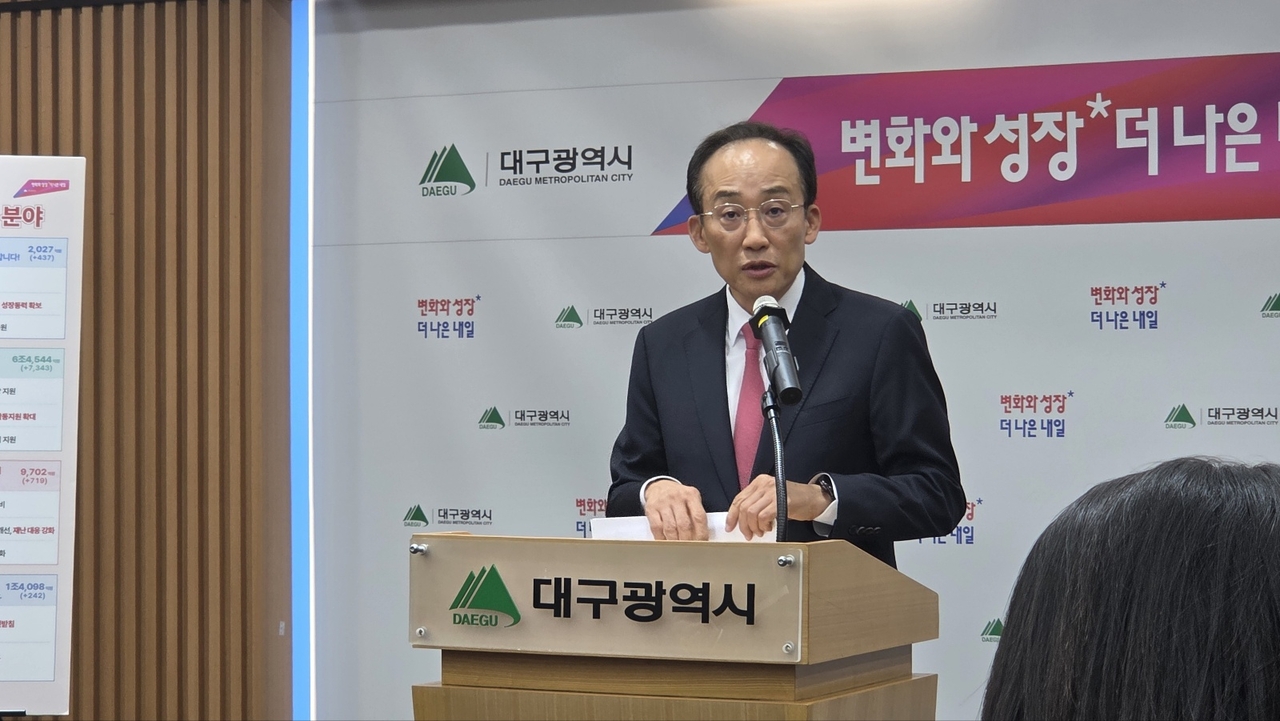
Daegu Mayor Choo Kyung-ho held a press briefing Thursday morning at the situation room on the second floor of the city hall's Dong-in-dong annex, announcing that the city had set its 2027 budget at 12.71 trillion won — the first full-year budget since the launch of the elected 9th-term administration.
The figure represents an increase of 997.3 billion won, or 8.5 percent, from this year's base budget of 11.71 trillion won.
Choo said the budget was built around three core priorities — livelihood stability, future growth and public safety — with resources concentrated on essential projects in each area.
Social welfare and public health account for 6.45 trillion won, or 51.5 percent of the total, marking the first time those sectors have exceeded half of the city's overall budget.
Of that, 2.09 trillion won goes to subsistence, medical and housing benefits, while 1.67 trillion won is earmarked for basic pensions and long-term care for the elderly. An additional 242.5 billion won has been set aside to support economic recovery for residents.
Support for consumer spending at traditional markets and neighborhood commercial districts will be expanded to 10 billion won, and 30 billion won will go toward issuing local gift certificates. The loan pool for small and medium-sized enterprise operating stabilization funds will also grow to 1.5 trillion won.
Future industry development receives 202.7 billion won. The city plans to build out the industrial base for AI adoption in manufacturing, secondary batteries and humanoid robots, and aims to establish an innovation-growth venture fund worth a total of 200 billion won by 2029.
Youth talent development and settlement support will receive 715.2 billion won.
The city will launch "Next Move," a program to cultivate young AI talent and support employment and startups, and will introduce new initiatives covering expanded monthly rent assistance for youth as well as subsidies for national technical qualification exams and language test fees.
Public safety receives 970.2 billion won to strengthen disaster response systems and fire department facilities, and to expand crime prevention and vulnerable-population protection programs.
Transportation, environmental and industrial infrastructure gets 2.36 trillion won to advance the Daegu-style D-Pass transit discount program, electric vehicle distribution and industrial complex infrastructure expansion.
The budget also includes 30.1 billion won for construction of a new Daegu City Hall building — 5 billion won for relocating the water quality research institute and 25.1 billion won in construction costs.
The city's fiscal position, however, remains tight.
Mandatory cost-matching requirements for central government funds and rising statutory expenditures limit room for discretionary spending, and local tax revenue is expected to grow by only 40 billion won due to a decline in acquisition tax receipts.
To secure funding for essential projects, Daegu plans to issue 168 billion won in new municipal bonds, with next year's debt ratio projected at 20.7 percent.
"Even under difficult fiscal conditions, we have put together a budget centered on essential projects for livelihood stability, future growth and public safety," Choo said.
Choo added that once the budget is finalized through the city council's deliberations, the administration will ensure efficient and productive execution so that taxpayers' money is well spent and residents can feel the results.
The 2027 Daegu city budget proposal is set to go through deliberations at the 330th regular session of the Daegu City Council and is tentatively scheduled for a vote on Dec. 14.
kbj7653@heraldcorp.com