220-km submarine cable project linking Saemangeum to Seo-Hwaseong
About 1.2 trillion won project targeting 2030 completion
Korea Electric Power to tender first phase in Q1 next year
LS Cable vs. Taihan Cable & Solution compete on production and installation capacity
Relaxed bidding rules allow joint bids, opening door to multiple participants
Power equipment makers accelerate localization of transformers, valves and controllers
The first project under South Korea's West Sea energy highway is set to move into full tendering next year. With about 1.2 trillion won ($895 million) in submarine cable work up for grabs, LS Cable & System is leveraging its production capacity and project experience to stake an early claim, while Taihan Cable & Solution is pressing ahead with factory expansion and cable-laying vessel procurement to mount a challenge. Power equipment makers, meanwhile, are accelerating efforts to localize the transformers and other hardware the transmission network will require.
Korea Electric Power Corporation plans to issue a tender for the first phase of a 525-kilovolt HVDC submarine cable project connecting Saemangeum to Seo-Hwaseong in Gyeonggi Province in the first quarter of next year, according to the power industry. The section spans about 220 kilometers and will establish a 2 GW direct-current transmission network, with a completion target of 2030. The tender — covering both cable manufacturing and installation — is estimated at about 1.2 trillion won, while the total cost of the entire West Sea energy highway is put at roughly 11 trillion to 12 trillion won.
Bidding requirements have been eased compared with previous tenders. Under Korea Electric Power's bidding framework, companies without a commercial track record in 525 kV submarine cables may still qualify if they have experience with high-voltage AC 500 kV systems. Joint and divided-performance bids are also permitted, leaving room for multiple companies to participate. Bidders may submit either a type-test certificate or a pre-qualification test report. However, successful bidders must obtain both a type-test certificate and a PQ test report meeting the applicable specifications by the initial delivery date of June 2028, and companies with similar project experience will be subject to a combined warranty period of 10 years — five years for performance and five years for defects.
Among domestic players, LS Cable & System is highlighting its production lead and submarine cable project experience. The company has built submarine cable manufacturing facilities at its Donghae site in Gangwon Province, and the completion of its fifth submarine cable plant in 2025 expanded its HVDC submarine cable production capacity more than fourfold. In July this year, it became the first company in South Korea to pass the PQ test for a 525 kV, 80-degree-Celsius-rated HVDC submarine cable — a technology that can increase transmission capacity by up to 25 percent over the existing 70-degree-Celsius product. Construction of a sixth submarine cable plant has also begun.
The company is also strengthening its offshore installation capabilities. Through its submarine cable installation subsidiary LS Marine Solution, LS Cable & System has secured an integrated capability spanning manufacturing through laying. LS Marine Solution has completed a refit of its existing cable-lay vessel GL2030, raising its cable-loading capacity from 4,000 tons to 7,000 tons — the largest in South Korea — and is building a new 13,000-ton HVDC cable-lay vessel targeting operations in 2028.
Taihan Cable & Solution is pursuing the contract through factory expansion and vessel procurement. Its second submarine cable plant, under construction in Dangjin, South Chungcheong Province, is targeted for completion in 2027 and will be equipped to produce HVDC submarine cables rated up to 640 kV and HVAC submarine cables rated up to 400 kV. A vertical continuous vulcanization tower standing 187 meters tall will be installed, and once operational the facility is expected to raise the company's submarine cable production capacity to roughly five times its current level. In January this year, the company also completed a dedicated test center capable of simultaneously testing two circuits of cables rated up to 640 kV.
Taihan Cable & Solution has also built out a two-vessel cable-lay fleet, adding the 11,000-ton Daihan Connector in May this year to the Palos, which it acquired in 2023. Through its submarine cable installation subsidiary Daihan Oceanworks, the company has assembled a full suite of maritime construction capabilities covering transport and laying. It has also been building a project track record, including winning a Korea Electric Power contract to construct a 500 kV HVDC transmission network linking the East Coast to eastern Seoul.
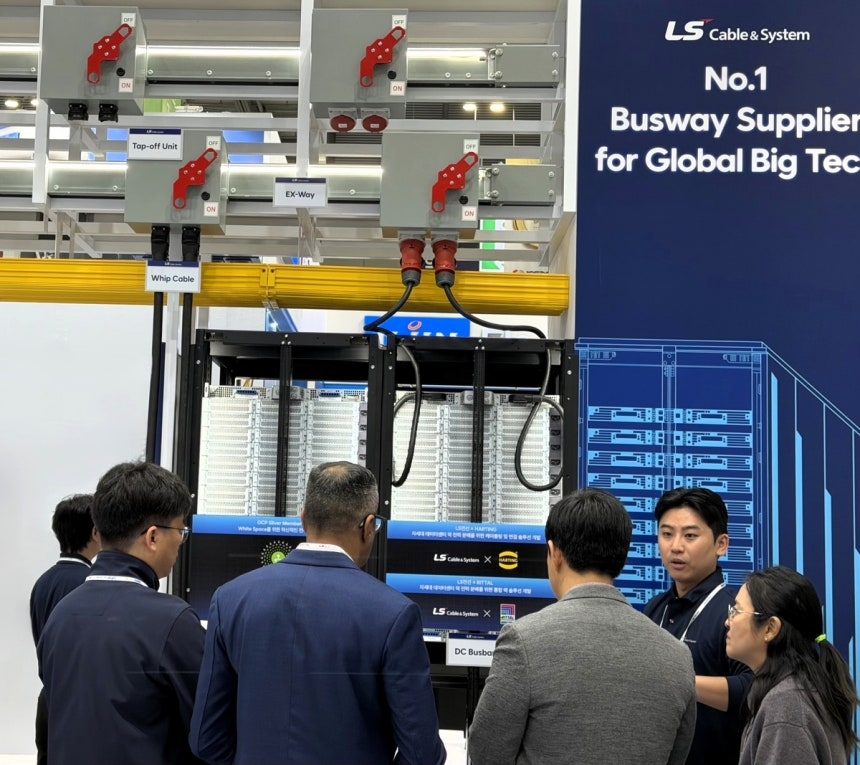
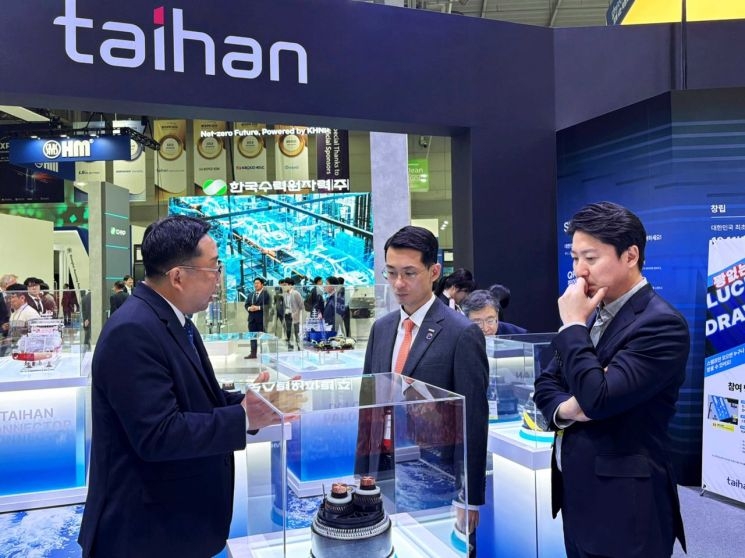
The competitive intensity was on display at BIXPO, which opened Wednesday. LS Cable & System and Taihan Cable & Solution both exhibited their 525 kV HVDC submarine cables and production and installation capabilities, signaling their intent to win the West Sea energy highway contract. Power equipment makers Hyosung Heavy Industries, HD Hyundai Electric and LS Electric also showcased HVDC localization achievements and direct-current distribution equipment at the expo.
HVDC transmission works by converting alternating-current power to direct current for long-distance transport, then converting it back to AC at the point of demand — a process that requires conversion transformers, valves, controllers and other power-conversion equipment. South Korea's Ministry of Trade, Industry and Energy selected four companies — Hyosung Heavy Industries, HD Hyundai Electric, LS Electric and Iljin Electric — in September last year to participate in a program to develop 500 kV voltage-source HVDC conversion transformers. The government plans to commit public funds to secure the design and manufacturing technology for large-capacity conversion transformers by 2027.

keg@heraldcorp.com