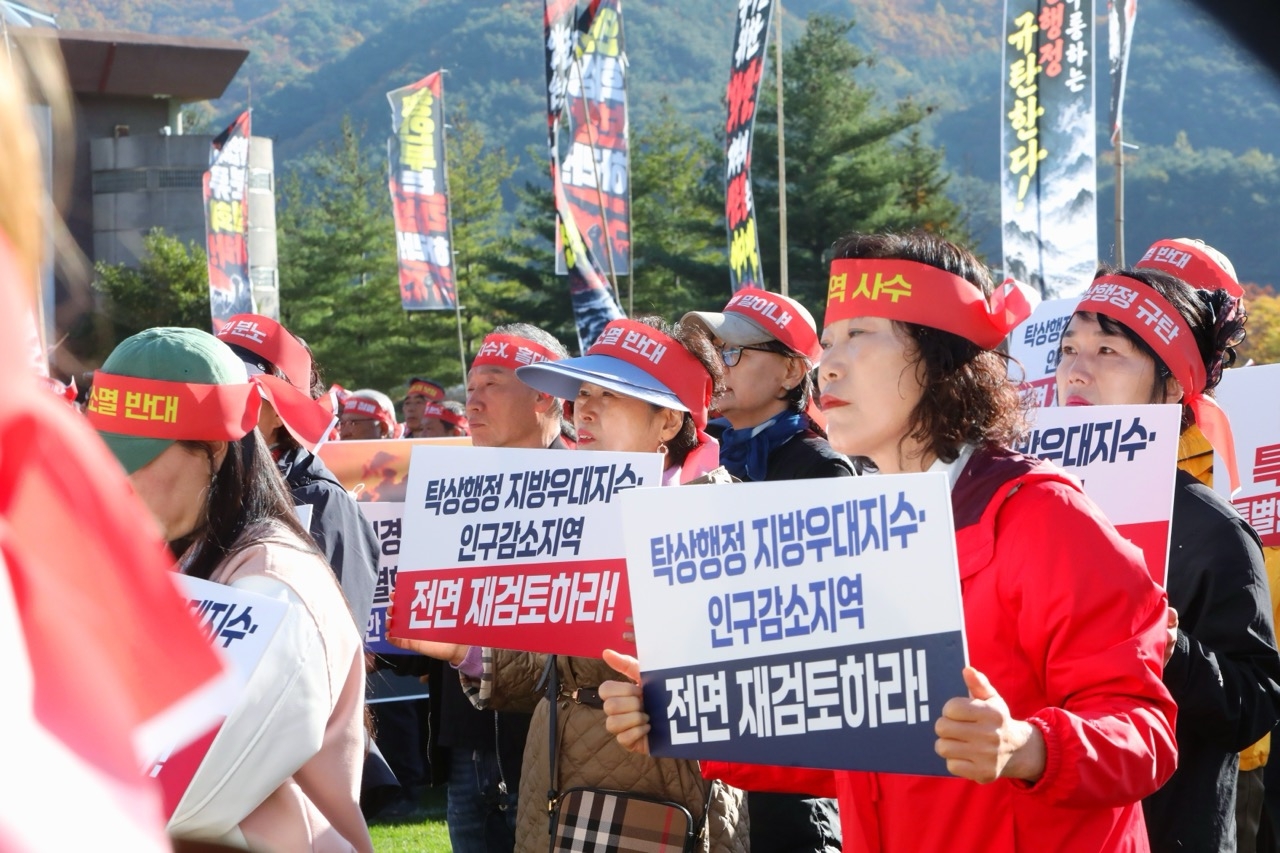
Residents of Inje-gun in Gangwon Province have won a partial policy victory after pressing the government through peaceful, democratic means to address what they called unfair treatment stemming from the county's classification under the regional preference index system.
The campaign drew participation equivalent — on a proportional basis — to about 1 million people rallying in Seoul, with roughly 10 percent of Inje-gun's residents halting their livelihoods to demand that the government correct its decision to classify Inje, a remote border county, at the same tier as a mid-sized city under the population-decline Zone 2 category.
According to central and local government officials Thursday, the Ministry of Interior and Safety on Tuesday put into effect the "Regulations on the Operation and Management of the Regional Preference Index" (Ministry of Interior and Safety Notice No. 2026-66), which includes a newly added clause providing additional support for population-decline attention areas.
The newly inserted Article 4, Paragraph 3 stipulates that heads of central administrative agencies may, when deemed necessary based on the characteristics of their respective policies and projects, provide additional support to population-decline attention areas.
The clause was absent from the draft notice pre-announced for public comment on Oct. 21, and its inclusion in the final notice reflects demands Inje-gun had consistently raised with the government — namely, closing the support gap and strengthening the institutional framework.
"The addition of this clause is highly significant as the first tangible result achieved through the collective efforts of our residents, civic organizations, the political community and the press," Inje-gun County Chief Choi Sang-gi said. "What matters now is ensuring that the newly established basis for additional support translates into real, felt benefits for our residents." Choi added that the county would continue working with the government to secure fair assessments and appropriate support suited to Inje-gun's realities, and would do its utmost to prevent residents from suffering any disadvantage.
Inje-gun's Zone 2 classification was left unchanged in the notice, but the development carries weight because it lays the groundwork for reducing the support gap that could arise before the regional preference index is recalculated, currently scheduled for March next year. With a full zone reclassification still requiring time, the new provision opens an institutional pathway for the county to receive additional support from individual central ministries based on the characteristics of their programs.
Earlier, Inje-gun's public and civic sectors submitted a formal opinion on Oct. 21 calling for improvements to the index calculation criteria and a reclassification to Zone 4. The following day, they held a press conference at the Gangwon Special Self-Governing Province office, urging a fair assessment that reflects the county's population decline and its status as a border region.
On Oct. 27 and 28, large-scale county-wide rallies were held in front of Inje-gun's county office and the National Assembly, and petitions were delivered to the Assembly's Interior and Safety Committee and its Special Committee on Budget and Accounts. Notably, a signature petition bearing 8,794 names — nearly half the county's civilian population — was submitted to the Ministry of Interior and Safety, conveying the community's collective will to the government.
On Friday, County Chief Choi met directly with Interior and Safety Minister Yun Ho-jung at the Government Complex Sejong to request a Zone 4 reclassification, additional designation as a population-decline area, and measures to prevent residents from being disadvantaged.
At the time, Minister Yun said the ministry was actively reviewing a zone reclassification and would pursue concrete steps — including interagency consultations and budget arrangements — to ensure that government support and resident benefits were not adversely affected by the current zone designation.
The county views the new clause not as a fundamental solution in place of a zone reclassification, and plans to concentrate its administrative efforts on securing a Zone 4 reclassification when the regional preference index is recalculated in March 2027.
abc@heraldcorp.com