Kospi opens down 2% as foreigners sell for 5th straight session
US semiconductor stocks tumble on data center construction delay fears
Analysts forecast divergence between AI and non-AI sectors
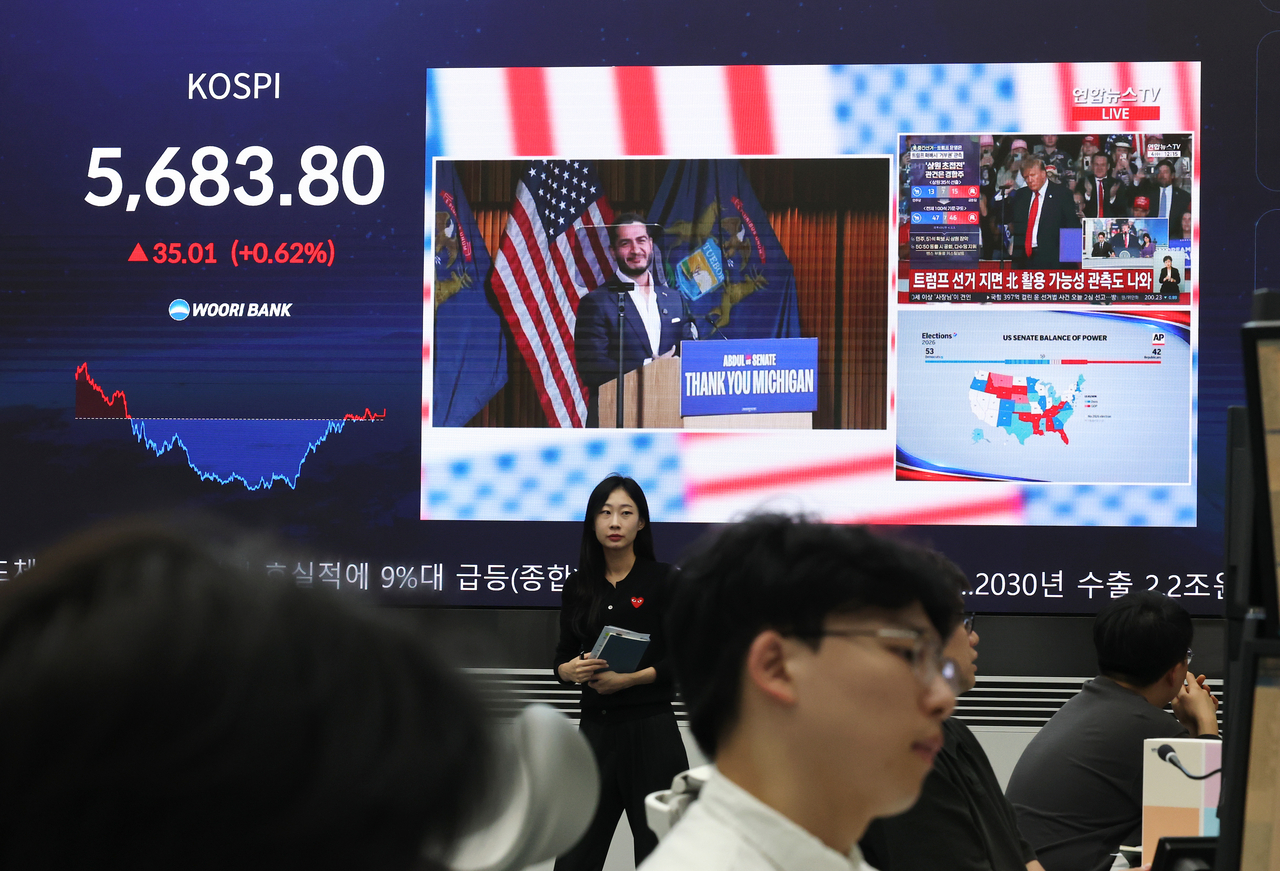
The Kospi fell more than 2 percent in early trading Thursday, sliding to the 5,550 level, as large-cap semiconductor stocks led the decline following an overnight plunge in US chip shares driven by fears of delays in American data center construction.
As of 9:15 a.m., the Kospi was down 124.77 points, or 2.22 percent, at 5,559.03.
The index opened 103.71 points, or 1.82 percent, lower at 5,580.09 and extended its losses through early trading.
On the Kospi market, foreign investors were net selling 258.5 billion won ($193 million), extending their selling streak to five consecutive sessions. Individual and institutional investors were net buying 161.5 billion won and 91.3 billion won, respectively.
Overnight on Wall Street, all three major indexes closed higher. The Dow Jones Industrial Average rose 1,569.40 points, or 3.03 percent, to 53,356.12. The S&P 500 gained 119.70 points, or 1.58 percent, to 7,688.62, while the Nasdaq Composite climbed 364.50 points, or 1.44 percent, to 25,736.51.
The gains were uneven, however, as memory and storage chip makers and neo-cloud companies tumbled sharply while big tech firms surged.
The Philadelphia Semiconductor Index fell 3.1 percent to its lowest level in six months. Nvidia (-3.17 percent), Broadcom (-2.00 percent), Micron (-7.00 percent) and SanDisk (-7.91 percent) all posted steep losses on concerns about slowing growth in memory chip demand.
Adding to the pressure on semiconductor stocks was the prospect of tighter regulation on data center construction and AI infrastructure expansion, after the Democratic Party won in Texas, Georgia and other states with heavy concentrations of data centers in the midterm elections.
The weakness in US chip stocks fed directly into the domestic market. Samsung Electronics was trading down 3.67 percent at 210,000 won, while SK hynix fell 6.45 percent to 1.306 million won. Samsung Electro-Mechanics (-9.15 percent) and SK Square (-5.90 percent) also declined sharply.
Hyundai Motor (6.53 percent), KB Financial Group (4.95 percent) and Samsung Biologics (3.21 percent) bucked the trend with strong gains, moving in sharp contrast to the semiconductor sector.
Han Ji-young, a researcher at Kiwoom Securities, said the market faces a dual dynamic: US stocks are benefiting from the resolution of midterm election uncertainty and expectations of policy shifts under Democratic leadership, while concerns about delays in new data center construction persist. "We expect a divergence between AI-related stocks — such as semiconductors and power equipment — and non-AI sectors including secondary batteries and renewable energy such as solar," Han said.
The Kosdaq was down 9.69 points, or 1.36 percent, at 705.26 at the same time.
On the Kosdaq market, individual and institutional investors were net buying 23.9 billion won and 19.8 billion won, respectively, while foreign investors were net selling 43.1 billion won.
Among the top Kosdaq stocks by market capitalization, semiconductor materials, parts and equipment makers were hit hard, with Jusung Engineering (-7.96 percent), Simtech (-10.98 percent) and EO Technics (-11.04 percent) all falling sharply.
Biotech stocks were a bright spot, with Alteogen up 6.13 percent and HLB gaining 2.84 percent.

moon@heraldcorp.com