Survey of 200 prospective and 500 young farmers
65.5% say they struggle to apply available information to their own situation
KREI calls for tailored decision-support system covering region and crop selection
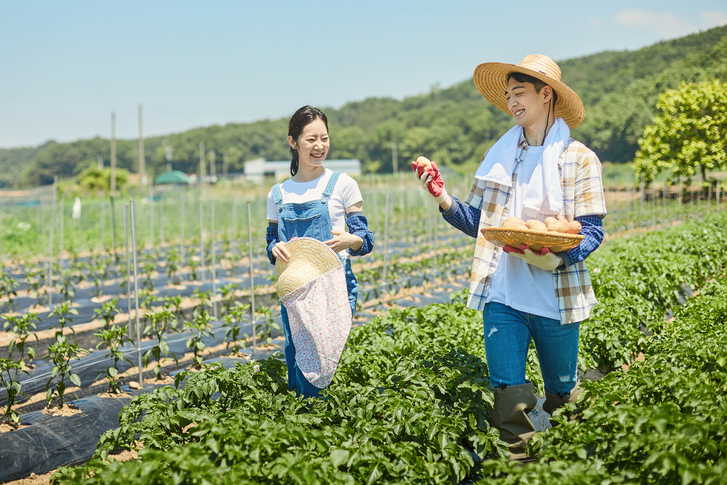
Despite the government's push to cultivate more young farmers, many who want to start farming still struggle to decide where to farm and what to grow. A survey found that nearly seven in 10 prospective farmers said there is no adequate system for comparing and synthesizing farming-related information. Researchers say what is needed — before farmland or financial support — is an information framework that helps individuals choose a region and crop suited to their own circumstances.
According to a report released Thursday by the Korea Rural Economic Institute titled "Designing a Decision-Support System for Young Farmers at the Entry Stage," a survey of 200 prospective farmers found that 67.0 percent said there is no system that allows them to compare and consolidate farming-related information to make decisions. Another 65.5 percent said that even when relevant information exists, it is difficult to apply or select based on their own capital, labor capacity, location and preferences.
The research surveyed 200 prospective farmers and 500 young farmers who had been farming for five years or less. The aim was to examine what information they need when choosing a region and crop before starting out, and to design an information system that could support that process.
The government has expanded settlement grants, policy loans, and farmland and education support to attract more young people into farming. The number of participants selected under the Young Farmer Settlement Support Program grew from 1,600 in 2018 to 5,000 in both 2024 and 2025. The cumulative number of participants selected from 2018 through last year reached 22,600.
Yet researchers say a gap remains in how young farmers find the information they need before starting out and translate it into an actual farming plan.
Information on farmland sales and leases, income by crop, cultivation technology and regional support programs is currently provided by multiple agencies. The problem is that the data is scattered and difficult to compare against an individual's specific circumstances. Even if a prospective farmer looks up land prices in a given area, determining which crops would generate a target income requires consulting several separate sources.
The choice of region and crop is particularly important for young farmers who are building their own farming base independently rather than inheriting a parent's operation. An analysis of 2024 Young Farmer Settlement Support Program participants cited in the report found that only 16.7 percent had taken over a parent's farming operation. Some 36.0 percent had started entirely from scratch with no parental farming base, while 47.3 percent had a parental base but established a separate farm of their own.
Researchers found a statistically significant positive relationship between conducting information searches and planning during the preparation stage and a farmer's intention to continue farming. The degree to which farmers prepared in line with their own goals also showed a positive relationship with actual farming income relative to expectations and with overall farming satisfaction. However, the researchers noted this reflects a statistical association and does not mean that advance preparation directly causes higher income.
To address these gaps, the researchers proposed a tailored decision-support system that links regional and crop-specific information. The system would allow young farmers to enter details such as available capital, target income and farmland acquisition conditions, then compare combinations of regions and crops that match their situation.
For example, based on whether a farmer plans to buy or lease land, how much they can invest and what level of income they want, the system would narrow down viable regions and crops. It would then help them build a concrete farming plan by comparing factors such as housing conditions and transportation access in candidate regions, as well as profitability and labor demand by crop.
To support this, the researchers built a pilot database linking data from the Census of Agriculture, Forestry and Fisheries, farmland and housing transaction records, and agricultural income surveys. They noted, however, that operating it as a live service would require continuously updating the data and filling in gaps, including information on facility installation costs that is currently lacking.
Park Mi-seon, an associate research fellow at the Korea Rural Economic Institute who led the study, said it is necessary "to provide the information young farmers need so they can explore and decide on a region and crop that match their farming goals and circumstances."
adastra@heraldcorp.com