District mayor's first administrative order bears fruit as 14 neighborhood councils relaunch; 705 members selected from 1,004 applicants, ranging in age from 24 to 86
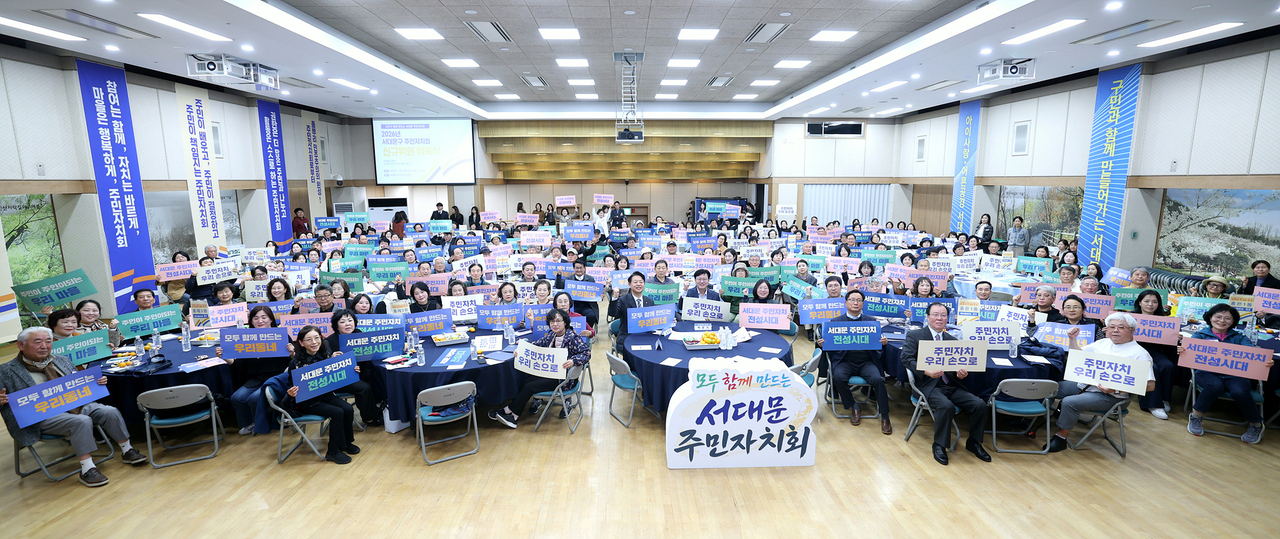
Seodaemun-gu's residents' autonomous councils, dormant for four years, are relaunching with 705 residents set to take part.
Under the revived system, residents will identify neighborhood issues and decide on solutions themselves, while the district office is formally required to respond to those decisions.
Seodaemun-gu held the first commissioning ceremony for council members from seven neighborhoods last Wednesday at the district office's sixth-floor auditorium. Once a second ceremony for the remaining seven neighborhoods takes place next Wednesday, all 14 neighborhoods in the district will have active councils.
The relaunch fulfills a campaign pledge by Seodaemun-gu District Mayor Park Un-gi and marks the fruition — four months later — of his first administrative order on his first day in office on July 1: a plan to revitalize the residents' autonomous councils.
Seodaemun-gu's councils were launched in 2018 as a Seoul Metropolitan Government pilot program covering five neighborhoods, then expanded to all 14 neighborhoods in 2020. They went dormant in November 2022 when members' terms expired, and have now been reconstituted for the first time in four years.
A public recruitment drive held from August through September drew 1,004 applicants, of whom 904 completed a civic governance training course. In the 11 neighborhoods where applications exceeded available seats, a public lottery was held, yielding a final roster of 705 members.
Particularly notable is the generational range: the youngest member is a 24-year-old resident of Hongeun 2-dong, while the oldest is an 86-year-old resident of Bukgajwa 1-dong — a gap of 62 years. From young adults to seniors, members will bring their own experiences and perspectives to shaping change in their neighborhoods.
Last Wednesday's afternoon ceremony included members from seven neighborhoods: Hongjae 3-dong, Hongeun 1- and 2-dong, Namgajwa 1- and 2-dong, and Bukgajwa 1- and 2-dong. The ceremony for the remaining seven — Chunghyeon-dong, Cheonyeon-dong, Bukahyeon-dong, Sinchon-dong, Yeonhui-dong, and Hongjae 1- and 2-dong — follows next Wednesday. Both ceremonies will be accompanied by a community workshop designed to foster communication and cooperation among members.
A defining feature of the relaunch is that it goes beyond simply restoring the organizational structure: institutional mechanisms have been put in place to ensure residents' decisions translate into actual administrative action.
The councils will identify neighborhood issues in areas such as welfare, the environment and transportation, and discuss solutions through subcommittees. Residents will then vote directly at a general assembly to set priorities for self-governance plans and neighborhood project proposals.
Once a self-governance plan adopted at the general assembly is submitted to the district mayor, the mayor must formally respond within two months on whether it will be incorporated. The requirement makes clear that the administration is accountable for answering residents' proposals — not simply receiving them as one-off suggestions.
Agenda items will be made public a month before each general assembly, with public briefings, early voting and online participation running in parallel. Residents who are not council members will also be able to join subcommittees, voice opinions and take part in votes, broadening the scope of civic participation.
The district will support the councils' stable operation through administrative and fiscal measures, including attendance allowances for regular meetings and the assignment of a coordinator for each neighborhood.
Regular neighborhood meetings will begin this month, with leadership positions such as council chairs to be filled by December. Next year, general assemblies are planned across all 14 neighborhoods, and the local agendas they adopt will be linked to participatory budgeting and Seoul Metropolitan Government grant programs to develop them into concrete projects.
Looking further ahead, the district plans to introduce a "resident-recommended neighborhood chief" system from 2028, under which residents would have a say in the appointment of neighborhood administrative chiefs. A special committee within the councils will establish the recommendation process, with the specific operating framework to be finalized after a review of relevant regulations. The district laid the legal groundwork for such a special committee in a revision to the Seodaemun-gu Residents' Autonomous Council Establishment and Operation Ordinance enacted in July.
"Residents' self-governance means residents themselves identifying local problems, deciding on solutions, and having the administration respond responsibly to that process and its outcomes," District Mayor Park said. "I will build a Seodaemun where residents' voices lead directly to decisions and action by the district, making residents the true owners of their neighborhoods."
seouldream01@heraldcorp.com