Combined share of CATL and BYD rises 7.8 percentage points year-on-year; South Korea's three battery makers lose 11.7 percentage points
Chinese electric vehicle battery makers CATL and BYD are rapidly expanding their influence in global markets outside China.
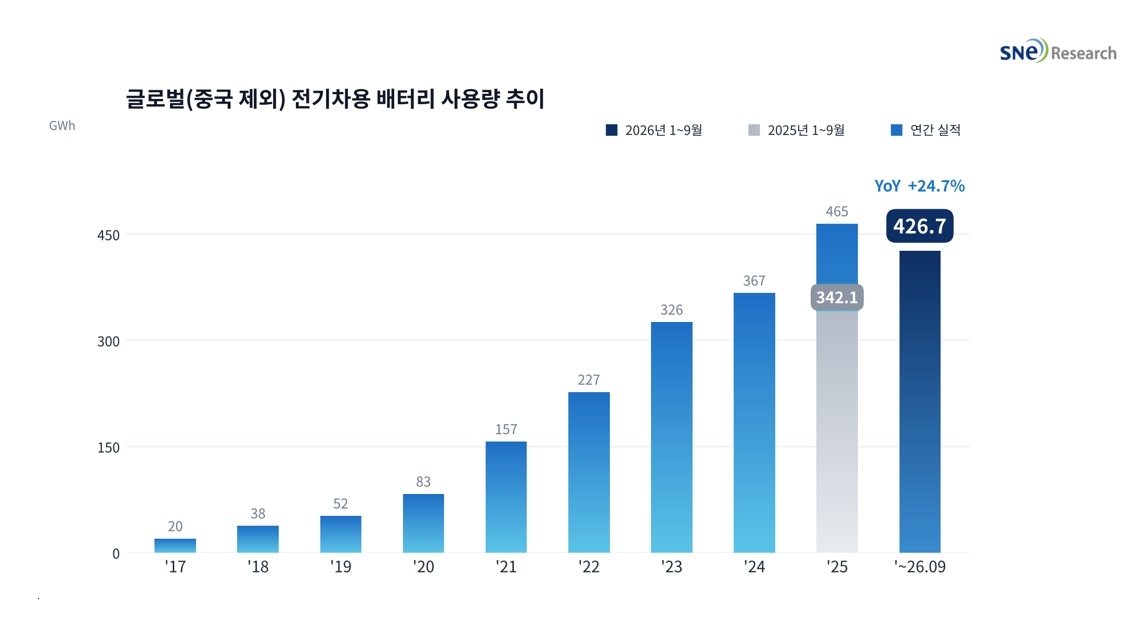
According to SNE Research, an energy-focused market research firm, total battery usage in electric vehicles — including plug-in hybrids and hybrids — sold in markets outside China reached approximately 426.7 gigawatt-hours in the first nine months of this year, up 24.7 percent from the same period last year.
Chinese manufacturers led the growth. CATL recorded 143.7 GWh, a 46.7 percent increase year-on-year, lifting its market share from 28.6 percent to 33.7 percent — a gain of 5.1 percentage points. Usage in Europe climbed 35.4 percent to 96.8 GWh from 71.5 GWh, while usage in Asia more than doubled to 27.1 GWh. On Sept. 22, the first two production lines at CATL's factory in Debrecen, Hungary — with a first-phase capacity of 34 GWh — entered trial production, a development expected to strengthen local supply to European customers such as Mercedes-Benz and BMW.
BYD held third place with 45.9 GWh, up 66.8 percent, as its share rose 2.8 percentage points to 10.8 percent from 8.0 percent. Growth was broad-based, with usage rising in Europe (17.4 GWh, up 68.8 percent), Asia (14.8 GWh, up 41.0 percent) and South America (7.1 GWh, up 135.7 percent). SNE Research projected that BYD's usage growth in non-China markets would continue for now, noting that the company's overseas EV sales in September reached roughly 180,000 units — more than double the figure from a year earlier — as exports and local production expand rapidly.
South Korea's three battery makers — LG Energy Solution, SK On and Samsung SDI — posted combined usage of 113.0 GWh, down 13.5 percent from the same period last year. Their combined market share fell 11.7 percentage points to 26.5 percent from 38.2 percent.
LG Energy Solution recorded 69.8 GWh, down 4.9 percent year-on-year, but retained second place in the non-China market. Usage in Europe rose 13.2 percent to 38.6 GWh and in Asia climbed 49.4 percent to 11.1 GWh, but North America fell 44.9 percent to 16.5 GWh from 29.9 GWh, dragging down overall performance. Its market share slipped 5.1 percentage points to 16.4 percent from 21.5 percent.
In the third quarter, the utilization rate at LG Energy Solution's North American ESS lines climbed to around 90 percent, generating record quarterly sales. The pace of ESS conversion at its North American factories and the expansion of its European customer base will be key to defending its market share.
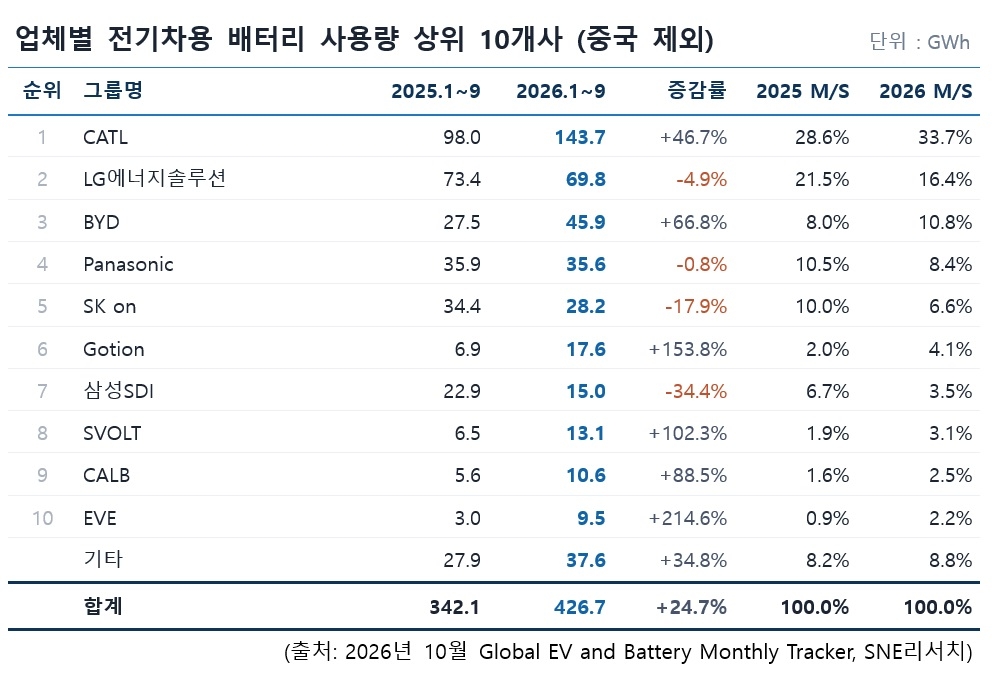
SK On's usage fell 17.9 percent to 28.2 GWh, with its share dropping 3.4 percentage points to 6.6 percent from 10.0 percent. The company supplies batteries to Hyundai Motor Group, Ford, Volkswagen and Mercedes-Benz, but usage declined 46.7 percent in North America and 2.2 percent in Europe. SK On is diversifying beyond electric vehicles by converting part of its Georgia factory to a lithium iron phosphate line for ESS applications and signing a contract to supply 9 GWh to a US ESS company over five years starting in 2027.
Samsung SDI posted the steepest decline among the top 10, with usage falling 34.4 percent to 15.0 GWh and its share shrinking 3.2 percentage points to 3.5 percent from 6.7 percent. European usage held roughly flat at 9.4 GWh, but North America plunged 66.2 percent to 4.1 GWh from 12.0 GWh. In the third quarter, strong sales of ESS products and battery backup units for data centers helped Samsung SDI post its highest operating profit in 12 quarters. With LFP cell mass production for ESS under way at its StarPlus Energy factory in the United States since October, attention is turning to how much ESS demand can offset the shortfall in EV orders.
"Going forward, regional policy and demand diversification will determine supplier competitiveness," SNE Research said. "In North America, EV demand has contracted following the end of tax credits, but LG Energy Solution and Samsung SDI found a path to earnings recovery through ESS sales growth in the third quarter. With SK On also set to begin reflecting ESS results from next year, the speed of EV-line-to-ESS conversion is now driving utilization rates."
The firm added that in Europe, discussions about softening the 2035 internal combustion engine phase-out target are proceeding alongside moves to tighten local-content requirements, while Chinese manufacturers are ramping up their local factories in earnest. "Local production capacity, price competitiveness and supply chain traceability ahead of the battery passport regulation taking effect in February 2027 will determine market position," it said.
likehyo85@heraldcorp.com