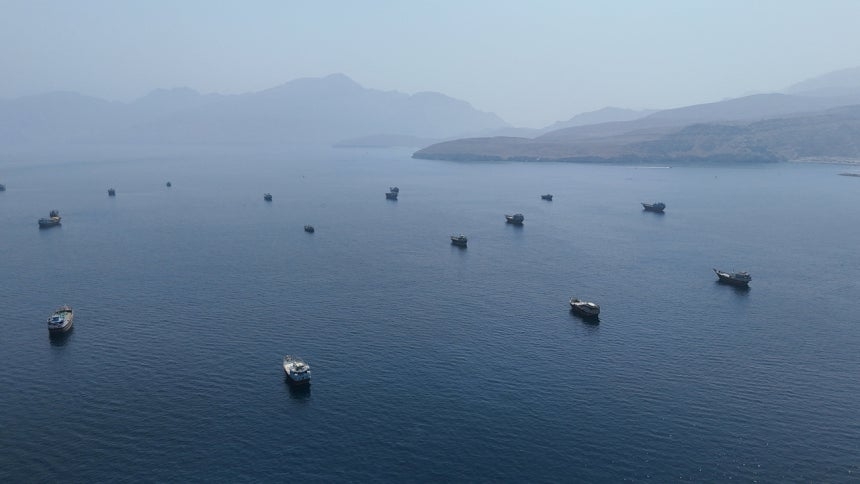
Iran's Islamic Revolutionary Guard Corps said Friday (local time) that two oil tankers caught fire and halted operations in the Strait of Hormuz.
The specific cause of the fires was not disclosed, but the vessels are believed to have come under Iranian attack, given that the IRGC claimed the ships had deviated from routes designated by Iran, Yonhap reported.
In a statement, the IRGC said "two rule-violating oil tankers that attempted to pass through unauthorized routes in the eastern and western parts of the Strait of Hormuz encountered an incident" and were "stopped in the southern waters of the strait."
The IRGC went on to say that "these oil tankers had switched off all navigation and position-tracking systems" and had "attempted to exit through unauthorized routes with the support of the terrorist US military."
The IRGC stopped short of specifying the exact nature of the incident. It said the vessels had received multiple radio warnings but continued sailing while ignoring them.
Iranian forces had also claimed on Thursday (local time) that at least four oil tankers were stationary in the same waters after striking mines.
Iran has been "weaponizing" the waterway to control maritime traffic since a Middle East war broke out following US and Israeli airstrikes on Iran — strikes that killed Supreme Leader Ayatollah Ali Khamenei on Feb. 28.
The United States has been controlling Iran's oil exports and trade activity through a naval blockade of Iranian ports.
Iran ramps up vessel attacks, but oil exports largely unaffected
Amid the escalating attacks, analysts say Iranian strikes on vessels transiting the Strait of Hormuz have surged of late but have had little impact on crude oil exports.
CNBC, citing energy analytics firm Kpler, reported that crude oil exports through the Strait of Hormuz this month averaged about 11.1 million barrels per day, Yonhap reported.
That figure represents a roughly 2 percent decline from last month.
The modest drop is notable given that Iran has sharply increased attacks on vessels in the strait this month, suggesting crude exports have faced little disruption.
The number of vessel attacks in the Strait of Hormuz this month stood at a minimum of 30 — the highest since the war broke out in late February.
The safety of oil tankers transiting the strait now depends heavily on air support from US fighter jets, helicopters and drones, though how long such protection can continue remains uncertain.
The United States has reportedly notified some Middle Eastern countries to prepare for military operations after Tuesday's midterm elections.
The US Navy, which enforces the maritime blockade against Iran, has also recently advised vessels with no need to transit the Persian Gulf, the Strait of Hormuz or the Gulf of Oman to avoid the area.
yul@heraldcorp.com