Kim Min-seok: 'No evidence of three-way secret alliance'
Jung Chung-rae: 'No basis, but a successful political operation'
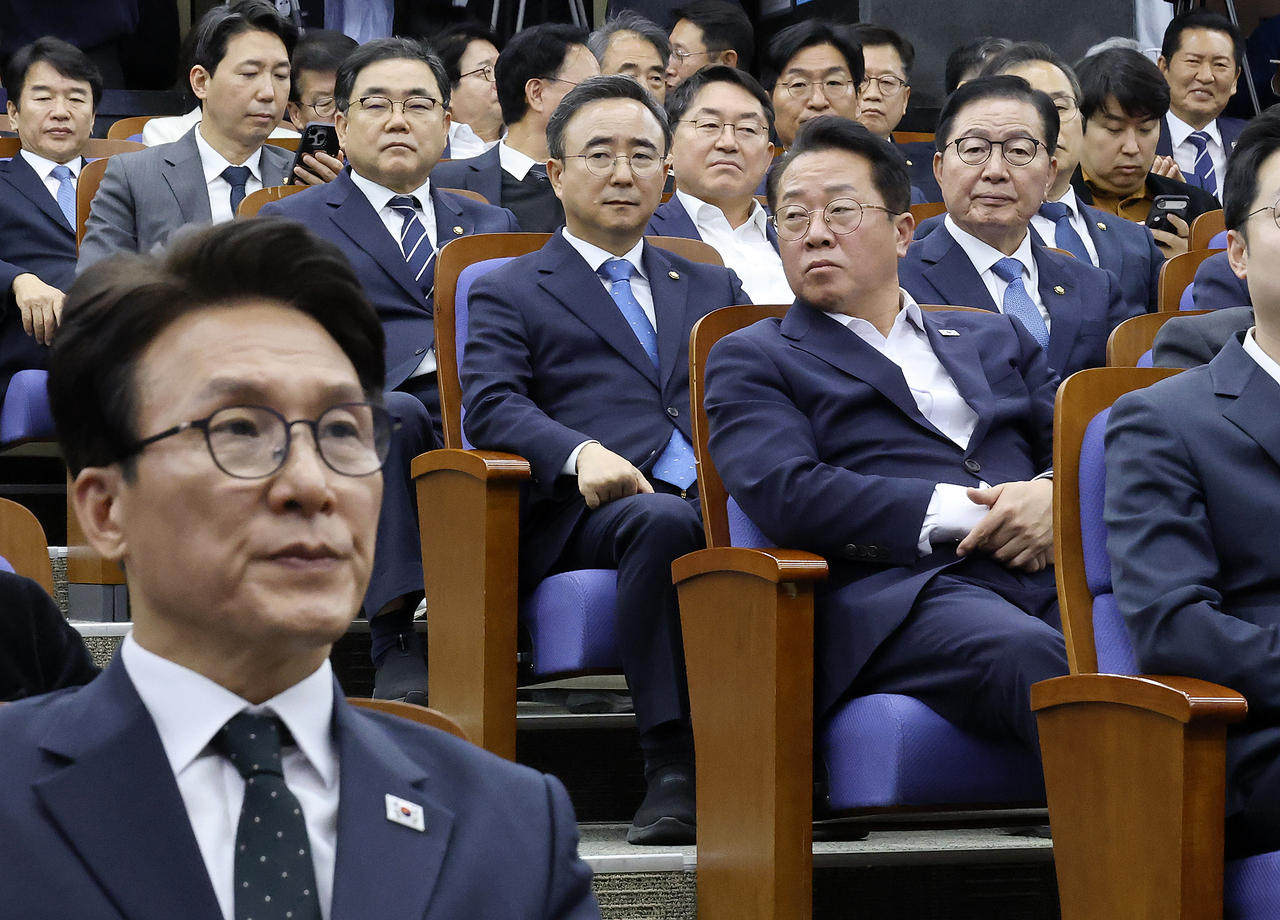
Democratic Party of Korea leader Kim Min-seok apologized Tuesday over allegations that Shincheonji church members had joined the party en masse, in a bid to defuse tensions — but factional divisions within the party showed no signs of easing.
Jung Chung-rae, a former party leader who was himself targeted by the Shincheonji allegations during the Aug. 17 party leadership primary, sharpened his criticism of Kim, signaling that the internal conflict could reignite.
At a closed-door general assembly of lawmakers held at the National Assembly on Tuesday, Kim said "the investigation found no evidence of a three-way secret alliance" and that he wanted to offer "a sincere apology to those who were unintentionally harmed," floor spokesperson Kim Sung-hoe told reporters after the meeting.
Kim was also seen becoming emotional during his remarks. A lawmaker close to Kim said Kim wiped away tears after finishing his address, and that fellow lawmakers went up to comfort him afterward.
A scheduled report by the party's membership review TF on the findings of its internal investigation was also canceled at Tuesday's assembly.
Floor spokesperson Kim said the party leader had decided against releasing the results, hoping the matter could be resolved quietly within the party. Kim added that TF head Park Seon-won confirmed one finding: that claims by some YouTubers alleging that large numbers of Shincheonji members had joined the party in certain regions were groundless.
Kim's apology — for his claims during the party leadership race that a secret alliance of anti-Lee Jae-myung forces, splinter factions and Shincheonji members needed to be broken up — was seen as driven by a sense of urgency that the internal conflict could no longer be allowed to grow.
Supporters of Jung had strongly criticized Kim since the party convention, calling the secret alliance claim a smear campaign targeting Jung.
When Kim set up the membership review TF and ordered an internal investigation into the Shincheonji allegations shortly after winning the leadership race, they fired back that Kim would have to take responsibility if no clear evidence of a secret alliance emerged.
Jung, who heard Kim's apology at Tuesday's assembly, did not back down.
Speaking to reporters after the meeting, Jung said Kim should not be "hiding behind a closed-door assembly to say sorry" but should "apologize publicly to party members." Jung added that actions that had "insulted and confused party members and put the party in grave danger" amounted to conduct warranting disciplinary action.
Jung also posted on Facebook, writing that Kim's raising of the Shincheonji allegations "ended as a political operation that was effectively baseless but successful." "He committed an act that warrants an apology and got elected party leader," Jung wrote. "He must now take responsibility and clean up what he started."
20ki@heraldcorp.com