Rooms and living areas can be separated or merged as needed
Railless precision drive and AI management technology applied
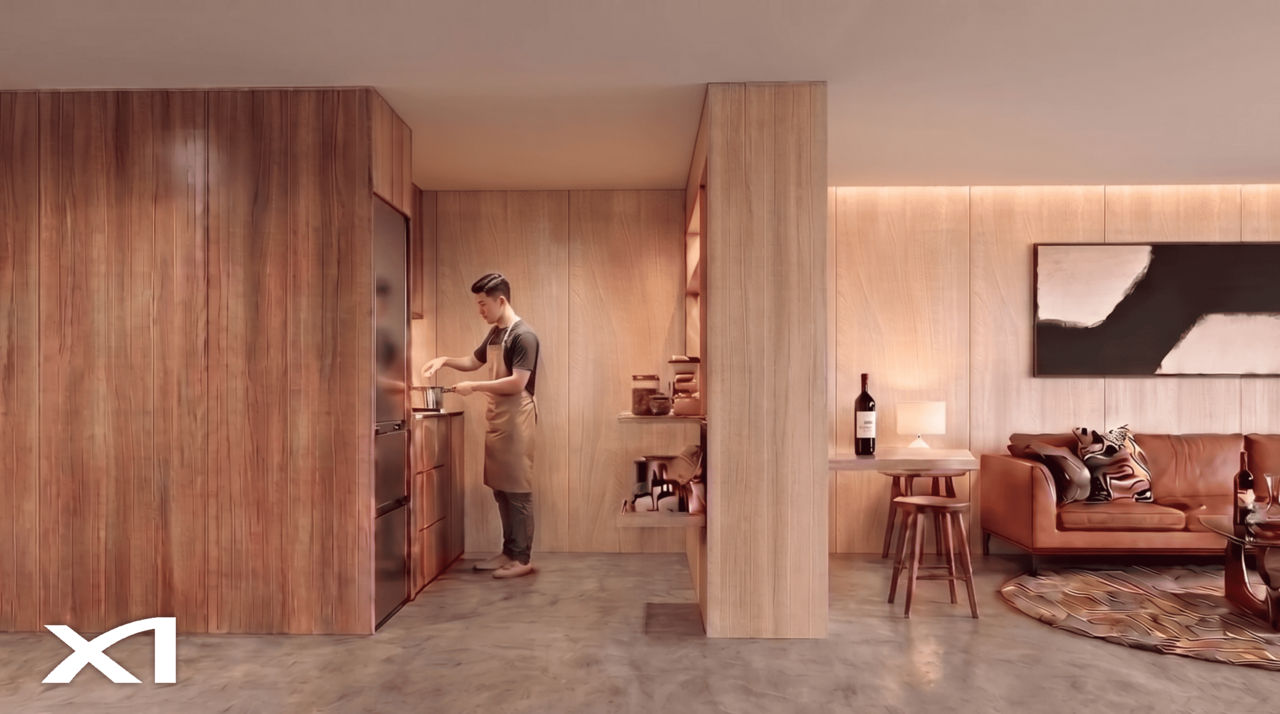
GS Engineering & Construction has unveiled a new residential product called the Moving Wall, which uses robotics technology to let apartment residents reconfigure their interior spaces as needed.
The company announced the flexible space solution Tuesday, describing it as a system that allows residents to freely divide or combine rooms based on their lifestyle and intended use.
The Moving Wall's defining feature is that it breaks from the fixed layout model that has long defined apartment living. Until now, buyers had to choose from a set of predetermined floor plan options at the pre-sale stage — adding a room, expanding the living area or enlarging the kitchen — and had virtually no way to change that layout after moving in.
The Moving Wall lets residents shift wall panels to transform a single space for multiple purposes. Rather than choosing between a bedroom and a spacious living room, residents can have both depending on the situation — using the space as a private study or children's learning room during remote work or study sessions, then opening it up into a wide living or dining area when the family gathers.
The product comes in four types tailored to different living patterns: a wide dining and alpha room type that alternates between a dining area and a separate work or study space; a hidden kitchen type that conceals the kitchen when not in use; a wide living and alpha room type that switches between a large living room and a private room; and a room-in-room type that creates a separate enclosed space within a bedroom.
GS Engineering & Construction developed the underlying furniture technology in partnership with Rovothome, a robotics furniture venture backed by its subsidiary Xplor Investment.
The Moving Wall uses precision drive control technology that moves the furniture unit horizontally without floor-mounted rails. The system detects and corrects lateral drift and minor misalignment in real time, allowing stable movement even in tight spaces. Low-noise, low-vibration design and obstacle and collision detection ensure safety, while an AI-based management system analyzes operational data to predict maintenance needs.
Residents can control the Moving Wall's position, lighting brightness and color temperature, security and locking functions, and automated presets through a dedicated app. GS Engineering & Construction also plans to link the system with the AI Home platform it is co-developing with LG Electronics, expanding voice control capabilities and ultimately working toward a stage where the system learns residents' daily patterns and adjusts spaces automatically.
The company said it intends to develop the Moving Wall — and the broader range of robotics- and AI-integrated smart flexible space solutions it represents — into a signature differentiated product for its Xi residential brand.
"How efficiently and flexibly residents can use limited urban living space will become the fundamental competitive edge of apartment products going forward," a GS Engineering & Construction official said. "Through the Moving Wall, we aim to deliver a new residential value unique to Xi that residents can feel in their everyday lives."
Meanwhile, GS Engineering & Construction posted consolidated sales of 2.74 trillion won ($2.05 billion) and operating profit of 95.5 billion won in the third quarter of this year.
hwshin@heraldcorp.com